



Modern websites no longer operate as isolated systems. A typical business website today connects to payment providers, messaging platforms, analytics dashboards, cloud storage services, authentication systems, marketing automation tools, and AI engines. All of this connectivity is made possible through APIs. If you are building a product, scaling a SaaS platform, or launching a digital marketplace, understanding API integration is not optional. It is foundational.
This section explains what an API actually is in practical terms, what it means to integrate one into a website, and why API integration has become essential for modern digital infrastructure.
What Is an API?
An API, or Application Programming Interface, is a structured way for one software system to communicate with another. In simple terms, it acts as a messenger that allows your website to request data or functionality from another service and receive a response in return.
For example, when a customer pays through Stripe, your website does not process credit card data directly. Instead, it sends payment details securely to Stripe through its API. Stripe processes the transaction and returns a response confirming success or failure. Similarly, when you embed a map from Google Maps, your website uses the Google Maps API to fetch location data and render it visually. Social login through platforms like Google or Facebook also relies on APIs to verify user identities without exposing sensitive credentials.
It is important to distinguish between an API, an SDK, and a webhook. An API is the interface itself, defining how requests and responses are structured. An SDK, or Software Development Kit, is a packaged toolkit that simplifies working with an API by providing prebuilt functions and utilities. A webhook is a mechanism that allows one system to automatically send data to another system when a specific event occurs. Instead of your website repeatedly asking, “Has a payment been completed?” a webhook pushes that information automatically once the event happens.
In practical website development, APIs are the backbone of external functionality.
What Does It Mean to Integrate an API into a Website?
Integrating an API into a website means connecting your web application to an external or internal service so that it can send requests, receive data, and perform actions programmatically. This integration can occur either on the client side, the server side, or through a combination of both.
Client-side integration happens directly in the browser. The website’s frontend makes API calls using JavaScript to fetch or send data. This approach is common for public APIs that do not require sensitive credentials. However, it carries security limitations because API keys can be exposed if not handled carefully.
Server-side integration, on the other hand, involves your backend communicating with the API. The frontend sends a request to your server, the server securely calls the external API, processes the response, and then returns safe data to the browser. This method protects credentials, allows advanced logic, and enables logging and monitoring.
Frontend-only integration may be sufficient for simple data retrieval, such as displaying weather information. Full backend orchestration is required for more complex operations such as payment processing, subscription management, order fulfillment, or CRM synchronization. For instance, in an eCommerce platform, adding a payment gateway involves backend validation, fraud checks, database updates, webhook handling, and user notifications. That is orchestration, not just a simple API call.
API integration is not just about sending a request. It is about designing secure, scalable communication between systems.
Why API Integration Is Critical for Modern Websites
Modern websites are deeply interconnected with the SaaS ecosystem. Very few businesses build everything from scratch. Instead of developing proprietary payment engines, email servers, SMS gateways, analytics platforms, fraud detection systems, or mapping tools, companies integrate specialized providers through APIs. This reduces development time, lowers infrastructure complexity, and improves reliability.
APIs also enable automation and structured data exchange. When a user submits a form on your website, that data can automatically sync to a CRM, trigger an email sequence, update a database, and notify internal teams. Without APIs, such automation would require manual effort and disconnected systems.
Scalability is another critical factor. API-driven architecture allows you to extend features without rewriting your entire application. Want to add real-time chat? Integrate a messaging API. Need global shipping rate calculation? Connect to a logistics API. Planning to incorporate AI recommendations? Use a machine learning API. This modular approach makes your website adaptable to new business requirements.
As digital products become more complex and user expectations increase, API integration becomes the foundation of competitive web development. A website that does not integrate external systems effectively is limited in functionality, inefficient in operations, and difficult to scale.
Types of APIs You Can Integrate
Not all APIs function the same way. The architecture, communication style, and use cases vary significantly depending on whether you are integrating a modern SaaS tool, an enterprise legacy system, or an internal microservice. Understanding API types helps you choose the right integration strategy and avoid architectural mistakes that affect performance, security, or scalability.
Below are the primary API categories commonly integrated into websites.
-
REST APIs
REST, or Representational State Transfer, is the most widely used API architecture for modern web applications. Most third-party services today expose RESTful APIs because they are simple, scalable, and built around standard HTTP protocols.
REST APIs use standard HTTP methods:
- GET to retrieve data
- POST to create new data
- PUT or PATCH to update data
- DELETE to remove data
For example, if you are integrating a payment provider, your website may send a POST request to create a transaction, and a GET request to retrieve its status.
Data exchanged through REST APIs is typically formatted in JSON (JavaScript Object Notation). JSON is lightweight, human-readable, and easy for both frontend and backend systems to parse. A response might include structured fields such as transaction_id, status, amount, and timestamp.
REST APIs are also stateless, meaning each request contains all the information required to process it. The server does not store client session data between requests. This design improves scalability because servers can handle large volumes of independent requests without maintaining session memory.
Due to their flexibility and simplicity, REST APIs power most integrations, including eCommerce systems, SaaS dashboards, CRM platforms, and AI services.
-
GraphQL APIs
GraphQL is a query-based API architecture developed to address inefficiencies in REST APIs, particularly when clients need specific subsets of data.
Unlike REST, where different endpoints return fixed data structures, GraphQL allows the client to request exactly the fields it needs. For example, instead of retrieving an entire user object with dozens of properties, the client can request only name, email, and subscription_status.
This approach improves efficiency by reducing over-fetching and under-fetching of data. It is especially useful in applications with complex data relationships, such as SaaS dashboards, social platforms, or content-heavy systems.
GraphQL operates through a single endpoint, and clients send structured queries describing the desired data. While it adds flexibility and performance benefits, it requires more careful backend schema design and security validation.
-
SOAP APIs
SOAP, or Simple Object Access Protocol, is an older protocol-based API standard commonly found in enterprise systems, financial institutions, and government platforms.
Unlike REST, SOAP relies heavily on XML for data formatting and follows strict communication standards. It supports advanced security features and transactional reliability, which made it popular in regulated industries.
Although SOAP APIs are less common in modern startup environments, many legacy enterprise systems still use them. If your website integrates with banking systems, insurance providers, or internal ERP software, you may encounter SOAP-based APIs that require specialized handling.
-
Third-Party APIs
Third-party APIs are external services provided by other companies that extend your website’s functionality without building features from scratch.
Payment APIs allow secure transaction processing, subscription management, and refund handling. Instead of building your own payment infrastructure, you connect to a provider that manages compliance and security.
SMS APIs enable automated messaging for OTP verification, order updates, appointment reminders, and marketing campaigns.
Maps APIs provide geolocation services, route calculation, and address validation, commonly used in delivery platforms and travel applications.
Analytics APIs connect your website to data tracking and reporting systems, helping businesses measure traffic, conversion rates, and user behavior.
Third-party APIs significantly reduce development complexity while accelerating feature deployment.
-
Internal / Private APIs
Internal or private APIs are designed for communication within your own system rather than public use. These APIs are critical in modern microservices architecture, where applications are divided into smaller, independent services.
For example, an eCommerce platform may have separate services for user management, order processing, inventory control, and payment handling. Each service communicates through internal APIs. This modular structure improves maintainability and scalability.
Private APIs are also commonly used for internal dashboards and administrative systems. An internal reporting dashboard may fetch aggregated sales data from backend services through private API endpoints that are not exposed publicly.
Unlike third-party APIs, internal APIs provide complete control over data, security policies, and performance optimization. However, they require disciplined documentation, versioning, and monitoring to maintain long-term reliability.
Choosing the correct API type depends on your business goals, system architecture, security requirements, and scalability plans. Understanding these distinctions ensures that your website integration is technically sound and future-ready.
Common API Integration Use Cases
API integration becomes meaningful when viewed through real-world business applications. Most modern websites depend on multiple APIs working together to deliver seamless user experiences. Whether you are building an eCommerce store, SaaS platform, marketplace, or service portal, the following use cases represent the most common and commercially critical API integrations.
-
Payment Gateway Integration
Payment gateway integration allows websites to process online transactions securely without handling sensitive card data directly. Instead of storing financial information on your own servers, your system communicates with providers such as Stripe, PayPal, or Razorpay via their APIs.
When a user completes checkout, your website sends payment details to the provider’s API. The provider validates the transaction, performs fraud checks, and returns a success or failure response. Webhooks are often used to confirm asynchronous events such as successful subscription renewals or refunds.
Payment APIs also support recurring billing, multi-currency pricing, invoicing, and tax calculations. Without API integration, implementing secure and compliant online payments would be operationally and legally complex.
-
Social Login Integration
Social login integration enables users to sign in using existing accounts from platforms like Google, Facebook, or Apple. This is powered by OAuth-based authentication APIs.
Instead of creating a new username and password, users authorize your website to access verified identity data such as name and email. The API returns an authentication token confirming the user’s identity without exposing their password.
This approach reduces friction during onboarding, improves conversion rates, and enhances security by leveraging established identity providers. Social login APIs also help prevent password fatigue and reduce abandoned registrations, especially in mobile-first applications.
-
Maps and Location Services
Maps and location APIs are essential for delivery platforms, travel applications, ride-hailing services, and event-based businesses. Providers such as Google Maps and Mapbox offer APIs that provide geolocation, route optimization, distance calculation, and address validation.
For example, when a user enters a delivery address, your website can validate the location instantly and calculate shipping costs based on distance. Real-time tracking systems use map APIs to display moving vehicles and estimated arrival times.
These integrations reduce manual errors in address entry, improve logistics efficiency, and provide transparent user experiences through interactive mapping interfaces.
-
Chat and Messaging APIs
Chat and messaging APIs enable real-time communication within websites and applications. Platforms like Twilio and Sendbird provide APIs for SMS notifications, in-app messaging, and voice communication.
For example, an eCommerce platform may send order confirmations via SMS. A marketplace may integrate real-time buyer-seller chat. Customer support portals often integrate messaging APIs to provide instant assistance.
These APIs handle message routing, delivery confirmations, and international telecom compliance. They also support event-triggered notifications such as appointment reminders, OTP verification, and promotional campaigns. Messaging APIs improve engagement and reduce response delays across digital platforms.
-
CRM and Marketing Automation
CRM and marketing automation APIs connect your website to customer data platforms such as HubSpot or Salesforce. When users submit forms, create accounts, or complete purchases, the data is automatically pushed into CRM systems via API calls.
This integration enables lead tracking, automated email campaigns, segmentation, and performance analytics. Instead of manually exporting spreadsheets, businesses synchronize data in real time.
Marketing automation APIs can trigger follow-up emails, assign leads to sales teams, and update customer lifecycle stages automatically. This creates operational efficiency while maintaining accurate customer records across systems.
-
Shipping and Logistics APIs
Shipping APIs integrate real-time carrier data into your website. Logistics providers such as FedEx, UPS, and DHL provide APIs for shipment tracking, label generation, rate calculation, and delivery status updates.
During checkout, your system can fetch shipping costs dynamically based on weight, destination, and delivery speed. After dispatch, tracking numbers can be synced and displayed automatically.
These integrations reduce operational errors and provide transparency for customers. In marketplaces or multi-vendor platforms, shipping APIs also enable automated fulfillment coordination across different sellers.
-
AI APIs (Chatbots, Recommendations, Automation)
AI APIs power intelligent features such as chatbots, content generation, predictive recommendations, and workflow automation. Platforms like OpenAI provide APIs that allow websites to embed conversational AI or automated content tools.
For example, an online store may integrate recommendation APIs to suggest products based on browsing behavior. A SaaS dashboard may use AI APIs to summarize reports or detect anomalies. Customer support portals may deploy AI chatbots to answer frequently asked questions before escalating to human agents.
AI APIs accelerate feature development by providing advanced machine learning capabilities without requiring in-house data science teams. As AI adoption grows, these integrations are becoming central to digital product differentiation.
API integrations across these use cases enable websites to move beyond static content and operate as dynamic, automated, and scalable digital systems.
API Integration Architecture Explained
Integrating an API into a website is not just about sending HTTP requests. It requires architectural decisions that affect security, scalability, performance, and long-term maintainability. A poorly designed integration can expose credentials, create bottlenecks, and increase operational risk. A well-designed architecture, on the other hand, protects sensitive data, supports high traffic volumes, and allows future expansion without rewriting core systems.
This section explains the major architectural patterns involved in API integration and how they fit into modern web development.
Client-Side API Calls
Client-side API calls are executed directly from the user’s browser. In this setup, JavaScript running in the frontend application sends HTTP requests to an external API endpoint and processes the response for display.
This approach is common in single-page applications built with frameworks such as React or Vue. For example, a weather website may call a public weather API directly from the browser to fetch forecast data. The request is made using tools such as fetch or Axios, and the response is rendered dynamically without a page refresh.
However, client-side API calls come with significant architectural considerations.
- Browser-Based Requests
When an API request is initiated from the browser, it is fully visible in developer tools. Headers, payload, and endpoints can be inspected. If the API requires authentication through an API key, that key may become exposed unless properly restricted. This is why public APIs often limit browser-based usage to read-only operations or require domain-based key restrictions.
- CORS Considerations
CORS, or Cross-Origin Resource Sharing, is a browser security mechanism that restricts how web applications can request resources from a different domain. If your website at example.com tries to call an API hosted at api.provider.com, the browser checks whether the provider allows cross-origin requests.
If CORS is not properly configured, the browser blocks the request even if the API itself is functioning correctly. Developers often encounter CORS errors during frontend integrations and mistakenly assume the API is broken. In reality, it is a security safeguard.
- Security Risks
Client-side integration is vulnerable to:
- Exposure of API keys
- Manipulation of request payloads
- Unauthorized use of endpoints
For example, if a payment processing API were called directly from the browser without backend validation, malicious users could alter transaction amounts before submission. That is why sensitive operations should never be handled exclusively on the client side.
Client-side API calls are best suited for non-sensitive, read-only data retrieval.
Server-Side API Calls
Server-side API calls are executed from your backend infrastructure rather than the browser. In this architecture, the frontend communicates only with your server. The server then securely communicates with the external API.
This is often referred to as using a backend proxy.
- Why Backend Proxy Is Safer
A backend proxy acts as an intermediary layer. Instead of exposing external API endpoints directly to the client, your server receives requests from the frontend, validates them, and then forwards a secure request to the third-party API.
This allows you to:
- Validate user input
- Enforce authentication rules
- Sanitize data
- Log transactions
- Control rate limits
For example, in payment gateway integration, the frontend collects card details through a secure provider interface, but the backend confirms transaction status and updates internal records. Sensitive credentials remain protected on the server.
- API Key Protection
API keys and secrets should always be stored as environment variables on the server. They should never be hard-coded into frontend code or exposed in public repositories.
With server-side integration:
- API credentials remain hidden
- Access tokens can be rotated securely
- Secret keys can be restricted to backend IP addresses
For most production systems, server-side integration is the recommended standard.
Middleware Layer
Middleware acts as an additional processing layer between incoming requests and outgoing API calls. It allows centralized control over how data flows through the system.
- Rate Limiting
Middleware can enforce rate limits to prevent abuse. If a user attempts to trigger excessive API requests, middleware can block or throttle requests before they reach the external service. This prevents hitting third-party usage limits and reduces infrastructure strain.
- Logging
Every API request and response can be logged through middleware. Logging supports:
- Debugging integration errors
- Monitoring system health
- Auditing sensitive operations
- Tracking API usage patterns
Without structured logging, diagnosing production issues becomes difficult.
- Data Transformation
Sometimes the external API response format does not match your frontend requirements. Middleware can transform data structures before returning them to the client. For example, it can rename fields, filter unnecessary properties, or aggregate multiple API responses into a single optimized payload.
Middleware improves maintainability by centralizing logic rather than scattering transformation code across frontend components.
API Gateway Concept
An API Gateway is a centralized management layer that sits between clients and backend services. It is commonly used in large-scale systems or microservices environments.
- Traffic Management
The gateway handles:
- Request routing
- Load balancing
- Rate limiting
- Caching
Instead of clients directly calling multiple backend services, they communicate with a single gateway endpoint. The gateway then routes requests to appropriate services.
This simplifies architecture and improves scalability. For high-traffic platforms, gateways distribute load across multiple service instances.
- Authentication Enforcement
API gateways can enforce authentication policies consistently. Rather than implementing authentication separately in every service, the gateway validates tokens and authorizes access before forwarding requests.
This centralization improves security and reduces redundancy. It is particularly useful in SaaS platforms with role-based access control and complex permission structures.
Microservices and API Integration
Modern web applications increasingly use microservices architecture. Instead of building one monolithic application, systems are divided into smaller, independent services.
For example, an online marketplace might have separate services for:
- User management
- Product catalog
- Payments
- Order processing
- Notifications
Each service communicates through APIs, often internally over secure networks.
- Service-to-Service Communication
Microservices rely on internal API calls for coordination. When a customer places an order:
- The order service validates cart data
- The payment service processes payment
- The inventory service updates stock
- The notification service sends confirmation
All of this happens through structured API communication between services.
This architecture improves:
- Scalability, since each service can scale independently
- Fault isolation, because failure in one service does not crash the entire system
- Maintainability, allowing teams to update services without rewriting everything
However, it increases architectural complexity and requires disciplined versioning and monitoring.
API integration architecture determines whether your website remains secure and scalable under growth. Client-side calls offer simplicity but limited security. Server-side proxies protect credentials and enforce validation. Middleware enhances control. API gateways centralize management. Microservices enable modular scaling.
When integrating APIs into production systems, architecture must be treated as a long-term infrastructure decision rather than a short-term implementation task.
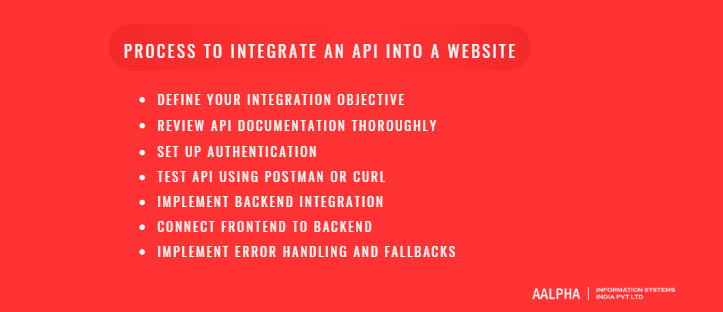
Step-by-Step Process to Integrate an API into a Website
Integrating an API into a website is not a single technical action. It is a structured engineering workflow that moves from planning and documentation review to authentication, testing, backend implementation, frontend connection, and resilience planning. This process is commonly handled within teams or by an API development company, depending on project scope and technical ownership. Skipping steps often leads to fragile integrations that break under load or expose security vulnerabilities.
This section provides a production-ready implementation framework that can be applied to payment systems, logistics providers, CRM integrations, AI APIs, or any other third-party or internal service.
Step 1: Define Your Integration Objective
Before writing a single line of code, you must clearly define what the integration is meant to accomplish. Many API projects fail because teams begin implementation without clarity about scope.
Start by identifying the specific functionality you need. Ask:
- What data do we need from the API?
- What actions must our system perform?
- Is the integration read-only, write-only, or bidirectional?
For example, integrating a shipping provider might require:
- Fetching shipping rates (read operation)
- Creating shipment labels (write operation)
- Tracking delivery status (read operation via webhook or polling)
The distinction between read and write operations is important. Read operations retrieve information from external systems, such as product data, analytics reports, or user profiles. Write operations modify or create data, such as processing payments, creating subscriptions, or submitting orders.
Write operations require stricter validation and stronger security controls because they affect financial transactions or system states. Read operations, while simpler, still require authentication and rate management.
Defining your integration objective also includes understanding performance expectations. Will the API be called once per user session, or thousands of times per minute? Will it impact checkout flows or background analytics?
Clear objectives reduce architectural errors and prevent over-engineering.
Step 2: Review API Documentation Thoroughly
API documentation is your technical contract with the provider. Reviewing it carefully before implementation saves significant debugging time.
The first area to examine is authentication. Determine:
- Does the API use API keys?
- Does it require OAuth authorization?
- Are tokens short-lived?
- Is there IP whitelisting?
Next, review available endpoints. Each endpoint defines a specific operation. For example:
- /create-payment
- /get-user
- /update-order-status
Understand what HTTP method each endpoint requires and whether requests must include headers, query parameters, or request bodies.
Pay close attention to request formats. Most modern APIs use JSON, but some legacy systems may use XML. Identify required fields, optional fields, data types, and formatting requirements such as date formats or currency codes.
Equally important are error codes. Good API documentation defines:
- HTTP status codes such as 200, 400, 401, 404, 500
- Custom error messages
- Rate limit thresholds
If the API supports webhooks, study event payload formats and signature verification methods.
Documentation often includes sandbox environments. Always use sandbox or test environments before production integration. This prevents accidental charges, data corruption, or compliance violations.
Thorough documentation review reduces uncertainty and allows you to design clean backend logic before implementation begins.
Step 3: Set Up Authentication
Authentication ensures that only authorized systems can access the API. The authentication method depends on the provider.
API Keys
API keys are the simplest form of authentication. The provider issues a unique key that must be included in request headers. This key identifies your application.
Best practices:
- Store API keys in secure environment variables
- Never expose them in frontend code
- Rotate keys periodically
- Restrict usage by IP or domain when possible
OAuth
OAuth is used when users must grant permission to access their data. Social login integrations commonly use OAuth flows.
The process involves:
- Redirecting users to the provider’s authorization page
- Receiving an authorization code
- Exchanging the code for an access token
OAuth improves security by avoiding password sharing.
JWT Tokens
JSON Web Tokens (JWTs) are compact tokens used for secure data transmission. APIs may issue JWTs after authentication. These tokens contain encoded claims and expiration timestamps.
Token Refresh Handling
Some APIs issue short-lived tokens that expire within minutes or hours. In such cases, you must implement token refresh logic. This typically involves:
- Detecting expiration
- Using a refresh token to request a new access token
- Updating stored credentials securely
Improper token handling can cause authentication failures in production systems. Robust authentication setup is foundational to secure API integration.
Step 4: Test API Using Postman or Curl
Before integrating the API into your application code, test it independently using tools like Postman or Curl. This isolates issues and ensures that authentication and endpoint usage are correct.
Testing helps you:
- Confirm that authentication credentials work
- Verify required headers and payload formats
- Observe real API responses
- Understand error behaviors
For example, send a test request to create a resource. Inspect:
- HTTP status code
- Response structure
- Response time
- Error messages if invalid input is provided
Testing also helps identify rate limits. If repeated calls trigger a limit error, you must design throttling logic.
Testing in isolation prevents unnecessary debugging in your frontend or backend code later. If a request works in Postman but fails in your application, the issue is likely in your implementation rather than the API itself.
This validation step improves development efficiency and reduces integration errors.
Step 5: Implement Backend Integration
Production-grade API integration should occur on the backend for security and control.
Secure Request Handling
Create a dedicated service layer in your backend that handles API communication. Do not scatter external API calls throughout unrelated modules. Centralizing API logic improves maintainability and debugging.
Validate all incoming requests from the frontend before forwarding them to the external API. This prevents injection attacks and malformed requests.
Environment Variables
Store sensitive credentials such as API keys, client secrets, and webhook verification tokens in environment variables. Never commit these values to version control systems.
Use separate credentials for development, staging, and production environments. This prevents accidental production data modification during testing.
Error Handling
Wrap API calls in structured error-handling logic. Handle:
- Network failures
- Timeouts
- Invalid responses
- Rate limit errors
Return sanitized error messages to the frontend. Avoid exposing internal stack traces or sensitive provider messages.
For example:
- If the external API returns a 500 error, log detailed information internally.
- Return a generic, user-friendly message such as “Service temporarily unavailable.”
Backend implementation should also include logging and monitoring to track request frequency and performance.
A disciplined backend layer ensures long-term reliability and protects against security breaches.
Step 6: Connect Frontend to Backend
Once backend integration is stable, connect the frontend to your internal API endpoints rather than directly to the third-party provider.
Frontend requests can be made using Fetch or Axios. The frontend should:
- Send validated input to your backend endpoint
- Await response asynchronously
- Update the UI based on results
Handling Asynchronous Data
API calls are asynchronous operations. Use proper async handling to:
- Prevent UI freezing
- Manage loading indicators
- Avoid race conditions
For example, during checkout:
- Display a loading state while payment is processing
- Disable the payment button to prevent duplicate submissions
- Show confirmation or failure message after response
Loading States
User experience depends heavily on feedback during API calls. Implement:
- Loading spinners
- Progress indicators
- Disabled buttons during submission
Never leave users uncertain whether an action succeeded. Clear UI feedback reduces frustration and abandoned transactions.
The frontend’s role is presentation and interaction, while backend systems handle validation and security.
Step 7: Implement Error Handling and Fallbacks
No external API guarantees 100 percent uptime. Your integration must anticipate failures.
Timeouts
Define timeout thresholds for API requests. If a provider does not respond within a reasonable time, abort the request and inform the user.
Retries
For transient errors such as temporary network failures, implement retry logic with exponential backoff. Avoid aggressive retries that could trigger rate limits.
User Feedback
Never expose raw technical errors to users. Provide actionable messages such as:
- “Payment processing is delayed. Please try again.”
- “Shipping rates temporarily unavailable.”
For critical systems such as payments, consider fallback mechanisms. For example:
- If the primary provider fails, route to a backup payment processor.
- Cache previous shipping rate responses temporarily if live API calls fail.
Robust error handling ensures business continuity and protects brand reputation.
API integration is not simply about connecting endpoints. It is a structured process involving planning, documentation review, authentication setup, controlled backend development, frontend orchestration, and resilience engineering.
When executed properly, this process results in secure, scalable, and production-ready integrations capable of supporting long-term growth.
Security Best Practices for API Integration
API integration increases functionality, but it also expands exposure to security threats. Every external API connection introduces new entry points into your system. If these connections are not secured properly, attackers can exploit exposed credentials, intercept data in transit, overload endpoints, or manipulate request payloads. A secure API integration strategy must be systematic, layered, and enforced at both application and infrastructure levels.
Below are the essential API security best practices that should be implemented in production-grade API integrations.
-
Protecting API Keys
API keys act as authentication credentials that grant access to external services. If these keys are exposed, unauthorized users can consume API quotas, perform fraudulent operations, or access sensitive data. Protecting API keys is therefore one of the most critical security responsibilities in any integration.
API keys must never be stored in frontend code, embedded in client-side scripts, or committed to public repositories. They should always be stored securely as environment variables on the backend server. Access to these variables should be restricted through role-based permissions and encrypted storage mechanisms when possible.
It is also important to create separate API keys for development, staging, and production environments. This prevents accidental misuse of live systems during testing. Many API providers allow key restrictions based on IP addresses or specific domains, which adds another layer of protection. Regularly rotating keys and revoking unused credentials further reduces the risk of long-term exposure.
-
HTTPS Enforcement
All API communication must occur over HTTPS to ensure encryption in transit. When data is transmitted over HTTP without encryption, it can be intercepted by attackers through man-in-the-middle attacks. HTTPS uses TLS encryption to protect request headers, authentication tokens, and payload data from being read or modified during transmission.
Your website should enforce HTTPS at multiple levels, including web server configuration and application-level redirects. All backend-to-external API communication must also use HTTPS endpoints. Even internal service-to-service communication should be encrypted when operating in distributed environments.
For additional protection, implementing HTTP Strict Transport Security ensures that browsers automatically use encrypted connections. Encryption in transit is not optional in modern systems, especially when handling authentication tokens, financial transactions, or personal data.
-
Rate Limiting
Rate limiting is a preventive control that restricts the number of API requests a user or system can make within a defined time period. Without rate limiting, attackers can overwhelm endpoints with automated traffic, potentially causing denial-of-service conditions or unexpected billing charges from third-party providers.
Rate limiting can be enforced at the backend or through API gateways. Limits can be applied per user, per IP address, or globally across the application. For example, login endpoints should restrict repeated attempts to prevent brute-force attacks. Similarly, payment or order submission endpoints should block rapid repeated submissions.
In addition to preventing malicious abuse, rate limiting also protects your system from accidental misuse caused by programming errors or infinite loops. A well-configured rate control strategy preserves system stability and protects operational costs.
-
Input Validation
Every API integration must validate incoming data before forwarding it to an external service. Client-side validation alone is insufficient because users can bypass browser restrictions and send manipulated requests directly to backend endpoints.
Backend validation should verify required fields, enforce correct data types, apply length restrictions, and ensure that values follow expected formats such as valid email addresses or structured date strings. Numeric fields such as currency amounts must be validated to prevent tampering.
Proper validation protects against injection attacks, malformed payloads, and logic manipulation. It also ensures that external APIs receive properly structured data, reducing the risk of unexpected errors. Strong validation improves both security and system reliability.
-
Handling Sensitive Data
Many API integrations involve sensitive information, including personal data, authentication tokens, payment details, and confidential business records. Mishandling such data can lead to compliance violations, financial loss, and reputational damage.
Sensitive information should be minimized wherever possible. If data is not required for processing, it should not be stored. When storage is necessary, data should be encrypted at rest and in transit. Logging systems must avoid recording full authentication tokens, credit card numbers, or personal identifiers. Instead, use masked or truncated formats for auditing purposes.
Tokenization techniques should be used for financial transactions so that raw payment details are never stored on your servers. In regulated industries, additional safeguards such as access logging and audit trails may be required to meet compliance standards.
-
Webhooks Security
Webhooks allow external systems to send real-time event notifications to your application. While powerful, they introduce a reverse communication channel that must be secured carefully.
Every webhook request should be verified before processing. Most providers include a signature header that allows your system to confirm the authenticity of the request. This signature is generated using a shared secret known only to your server and the provider. Your backend must validate this signature to ensure that the request was not forged.
Webhooks should be exposed through secure HTTPS endpoints and protected against replay attacks by validating timestamps or unique event identifiers. Additionally, webhook endpoints should implement idempotency, meaning repeated delivery of the same event does not cause duplicate processing.
Proper webhook security ensures that only legitimate external events trigger internal system changes.
-
Monitoring and Logging
Continuous monitoring and logging are essential for detecting abnormal behavior in API integrations. Even well-designed systems can encounter unexpected traffic patterns, provider outages, or malicious activity.
Comprehensive logging should capture request metadata such as timestamps, response status codes, and execution times. However, logs must exclude sensitive payload data to prevent security leaks. Structured logging enables faster debugging and root cause analysis during incidents.
Monitoring tools can track API performance metrics, error rates, and latency. Alerts should be configured to notify engineering teams when thresholds are exceeded, such as repeated authentication failures or sudden traffic spikes.
Proactive monitoring reduces downtime, prevents cost overruns, and enables rapid incident response. Security is not a one-time configuration; it requires ongoing observation and adaptation.
A secure API integration strategy combines credential protection, encrypted communication, rate control, validation, sensitive data handling, webhook verification, and continuous monitoring. When these practices are implemented together, they create a resilient foundation for scalable and secure digital systems.
Common API Integration Challenges and How to Solve Them
API integrations rarely fail because an API is unusable. Most failures stem from architectural oversights, misconfigured security, incomplete testing, or unplanned edge cases. Production-grade systems must anticipate failure scenarios and include structured mitigation strategies. Below are the most common API integration challenges and how to address them effectively.
-
CORS Errors
CORS, or Cross-Origin Resource Sharing, errors occur when a browser blocks a request made from one domain to another. This is a browser-enforced security mechanism designed to prevent unauthorized cross-site data access. Developers typically encounter CORS issues when attempting to call a third-party API directly from frontend JavaScript.
Even if the endpoint is valid and authentication credentials are correct, the browser will reject the request if the external API does not explicitly allow your domain through proper CORS headers. This leads to confusion because the API may work perfectly in testing tools but fail in the browser.
The most reliable solution is to shift the integration to the backend. Instead of making direct client-side calls, your frontend should communicate with your own server, and the server should call the external API. This removes browser restrictions and improves credential security. For simple public APIs, domain whitelisting may resolve CORS issues, but backend proxy integration remains the recommended long-term solution.
-
Authentication Failures
Authentication failures usually appear as HTTP 401 Unauthorized or 403 Forbidden errors. These indicate that credentials are missing, incorrect, expired, or lacking required permissions. Authentication problems are among the most common integration challenges.
Typical causes include incorrect API keys, using sandbox credentials in production, missing headers, expired access tokens, or misconfigured OAuth redirect URLs. In token-based systems, failing to implement proper token refresh logic can cause intermittent authentication breakdowns in live environments.
Resolving authentication failures requires systematic verification. Confirm that credentials are stored securely in environment variables and loaded correctly. Validate that headers are formatted exactly as required in the documentation. For OAuth-based integrations, ensure that client IDs, secrets, and redirect URIs match provider settings.
Detailed but sanitized logging helps identify root causes without exposing sensitive data. Authentication should always be tested independently before full system integration.
-
Rate Limit Exceeded
Most API providers enforce rate limits to protect their infrastructure. When your system exceeds allowed request thresholds, the API typically returns a 429 Too Many Requests error. This can disrupt user-facing functionality if not handled properly.
Rate limit issues often arise from inefficient polling, background jobs making excessive requests, unoptimized loops, or unexpected traffic spikes. Without control mechanisms, integrations can quickly exhaust daily or monthly quotas, leading to downtime or unexpected costs.
To solve this, first understand the provider’s usage limits. Implement throttling mechanisms that restrict outbound requests per user or per time window. Introduce exponential backoff strategies for retrying failed requests. Caching frequently requested data reduces unnecessary API calls, especially for information that does not change frequently.
Proactive request management ensures stability, prevents abuse, and maintains predictable operational costs.
-
Inconsistent API Responses
Not all APIs return perfectly consistent data structures. Optional fields may be missing, null values may appear unexpectedly, or undocumented updates may alter response formats. If your system assumes a fixed response structure without validation, it can crash when encountering unexpected data.
For example, if your application expects a string field but receives null, rendering logic may fail. Similarly, changes in numeric formatting or nested object structures can break data processing pipelines.
The solution is defensive programming. Always validate API responses before using them. Implement schema validation to confirm that required fields exist and have correct data types. Provide fallback values for optional fields. Avoid tightly coupling frontend logic to raw third-party responses; instead, normalize responses through backend transformation layers.
Version pinning, when supported by the provider, prevents sudden breaking changes. Defensive validation significantly improves resilience.
-
Third-Party Downtime
No external API guarantees uninterrupted availability. Even major providers experience occasional outages or latency spikes. If your application depends entirely on a third-party API without fallback mechanisms, downtime can disrupt core functionality.
For example, if a payment provider experiences temporary service degradation, checkout processes may fail. If a shipping API becomes unavailable, rate calculations may not load during purchase.
Mitigation strategies include implementing timeouts to prevent indefinite waiting, caching recent successful responses when appropriate, and displaying user-friendly fallback messages. For mission-critical systems, consider integrating backup providers to maintain continuity.
Monitoring API health metrics and setting automated alerts allows teams to respond quickly to outages. Building systems that assume occasional failure, rather than assuming constant availability, ensures operational resilience.
Addressing these challenges requires proactive architectural planning rather than reactive debugging. By anticipating CORS restrictions, authentication complexity, rate limits, inconsistent responses, and provider downtime, developers can build API integrations that remain stable under real-world conditions.
API Integration Cost Breakdown
The cost of API integration depends on more than just writing code to connect two systems. It includes third-party API pricing, development effort, infrastructure requirements, security controls, and long-term maintenance. Businesses often underestimate API-related expenses because they focus only on initial implementation, ignoring scaling and operational factors.
Understanding cost structure early allows better budgeting and avoids surprises during growth phases.
-
Free vs Paid APIs
Many APIs advertise free access, but most operate under structured usage tiers. Free plans typically include limited request volumes, reduced feature sets, or development-only environments. For small projects, proof-of-concept systems, or early-stage startups, free tiers may be sufficient.
However, as traffic increases, businesses often move to paid plans. Paid APIs typically charge based on request volume, data consumption, transaction value, or active users. For example, payment APIs may charge per transaction, messaging APIs may charge per message sent, and mapping APIs may charge per thousand requests.
Enterprise pricing models are more complex. They may include:
- Custom rate limits
- Dedicated support
- Service-level agreements
- Advanced analytics access
- Compliance features
Enterprise agreements often require negotiation and long-term contracts. When selecting APIs, businesses must evaluate not just current costs but projected usage growth. A low-cost API can become expensive if pricing scales aggressively with volume.
-
Development Cost Factors
The cost of integrating an API varies significantly depending on technical complexity. Simple read-only integrations may require minimal backend logic, while transactional or multi-system integrations demand more engineering effort.
Key development cost factors include integration complexity. A basic weather API integration may take only a few development hours. In contrast, integrating a payment gateway with recurring billing, webhook handling, subscription lifecycle management, and fraud detection requires significantly more effort.
Custom middleware also affects cost. If your system requires data transformation, caching, retry logic, or centralized logging, additional development layers are necessary. These components improve reliability but increase initial engineering time.
Security requirements further impact cost. Systems handling financial transactions, healthcare data, or personal information require strict validation, encryption, audit logging, and compliance considerations. Implementing these safeguards increases development time and testing cycles.
The more critical the API function is to core business operations, the more robust and therefore more expensive the integration becomes.
-
Ongoing Maintenance Costs
API integration is not a one-time expense. Ongoing maintenance is essential for stability, performance, and compliance.
Monitoring tools must be implemented to track API response times, error rates, and usage volumes. Alert systems should notify teams when performance thresholds are exceeded or authentication failures increase. Monitoring infrastructure adds recurring operational costs.
Version upgrades are another ongoing factor. API providers periodically release new versions and deprecate older endpoints. When this happens, your integration may require code updates, regression testing, and redeployment. Failing to upgrade can lead to service disruptions.
Scaling costs also increase over time. As user traffic grows, API usage increases proportionally. Paid tiers may shift from basic plans to enterprise pricing. Infrastructure costs for backend servers, caching systems, and logging tools also rise with higher request volumes.
Businesses must evaluate API integration costs not only from an implementation perspective but from a lifecycle perspective. Long-term planning ensures that growth does not create unexpected financial strain.
How to Choose the Right Development Partner for API Integration
API integration directly influences system performance, operational stability, and data security. Selecting the wrong partner can result in fragile architecture, exposed credentials, performance bottlenecks, and expensive technical debt. Choosing the right development company requires evaluating technical depth, security maturity, scalability experience, and long-term partnership capabilities.
-
Backend Architecture Expertise
API integration is fundamentally a backend engineering responsibility. While frontend components initiate requests, the complexity lies in server-side validation, authentication handling, data transformation, retry logic, logging, and structured error management. A competent development partner must design integration layers that are modular, testable, and maintainable.
Strong backend expertise ensures integrations are centralized within dedicated service layers instead of being scattered across unrelated modules. This improves long-term maintainability and simplifies debugging when issues arise. Experienced teams also design with extensibility in mind, anticipating additional API providers, version upgrades, or traffic growth.
Without architectural discipline, integrations become tightly coupled and difficult to scale. Aalpha Information Systems has extensive experience designing backend-driven systems where API orchestration forms the core of platform functionality, ensuring clean separation of concerns and production-grade reliability.
-
Security-First Development
API integrations often handle authentication tokens, financial transactions, personal data, or business-critical information. Security must therefore be embedded from the beginning rather than added later.
A qualified partner should implement secure storage of API credentials using environment variables, enforce encrypted communication over HTTPS, validate and sanitize all incoming inputs, and verify webhook signatures before processing external events. They should also understand OAuth flows, JWT token management, secret rotation, and rate limiting to prevent abuse.
Security-first development includes structured logging, audit trails, and proper error handling that avoids exposing sensitive information. Aalpha follows a rigorous security-focused engineering process, ensuring integrations are hardened against common vulnerabilities while meeting compliance expectations across industries.
-
Experience with Scalable Systems
API integrations that perform well during testing may fail under real-world traffic if scalability is not engineered properly. High-volume systems require load management, caching strategies, background job processing, and careful rate limit handling.
An experienced development partner understands how to design integrations that tolerate traffic spikes without overwhelming third-party providers. This includes implementing retry strategies with exponential backoff, caching stable data to reduce redundant calls, and building fallback mechanisms to maintain service continuity during provider downtime.
Scalability planning also considers cost growth. Usage-based APIs can become expensive at scale, so efficient request management is essential. Aalpha has delivered enterprise-grade systems capable of handling sustained growth while maintaining performance and cost predictability.
-
Long-Term Support
API providers frequently update endpoints, deprecate older versions, adjust authentication mechanisms, or modify rate limits. Without ongoing support, integrations can break unexpectedly after provider changes.
A strong development partner offers long-term maintenance that includes monitoring API performance, upgrading integrations when versions change, adjusting security policies, and optimizing performance as traffic grows. This prevents operational disruptions and protects business continuity.
API integration is not a one-time task; it is an evolving technical layer within your product ecosystem. Partnering with an experienced company such as Aalpha ensures that your integrations remain secure, scalable, and aligned with future business expansion rather than becoming a source of technical risk.
Future Trends in API Integration
API integration is evolving from a supporting technical function into a central architectural strategy. As digital systems become more interconnected, APIs are no longer treated as secondary connectors but as primary building blocks of software design. Several emerging trends are reshaping how businesses approach API integration and system architecture.
-
API-First Development
API-first development is a methodology where APIs are designed before the application itself is built. Instead of developing a backend and later exposing endpoints, teams define API contracts at the beginning of the product lifecycle. This approach ensures consistency, documentation clarity, and alignment across frontend, backend, and third-party integrations.
In API-first models, schemas and endpoint structures are defined early, allowing frontend and backend teams to work in parallel. This reduces bottlenecks and accelerates product development. It also improves scalability because APIs are intentionally structured for reuse across web apps, mobile apps, and partner systems.
Organizations adopting API-first strategies build more modular systems that are easier to maintain, extend, and integrate with external platforms over time.
-
Headless Architecture
Headless architecture separates the frontend presentation layer from backend logic and content management systems. In this model, APIs act as the bridge between the frontend and backend services. The backend provides data through APIs, while the frontend consumes and renders it independently.
This approach enables multi-channel delivery. A single backend can serve web applications, mobile apps, smart devices, and even IoT systems through consistent API endpoints. Businesses benefit from flexibility because frontend interfaces can evolve without requiring backend rewrites.
Headless systems rely heavily on stable, well-designed APIs. As digital experiences expand across platforms, API integration becomes the foundation of consistent data delivery and user experience management.
-
AI-Powered API Orchestration
AI is increasingly being used to manage and optimize API workflows. Instead of manually orchestrating multiple API calls, intelligent systems can dynamically determine which services to call, in what sequence, and under what conditions.
For example, AI-driven orchestration can analyze traffic patterns and adjust caching strategies automatically. It can prioritize critical API calls during peak load and reroute requests if certain services show latency. AI can also detect anomalies in API responses and flag potential integration failures before they escalate.
As AI becomes embedded in infrastructure tooling, API integration will shift from static logic to adaptive, self-optimizing systems.
-
Event-Driven Systems
Event-driven architecture is gaining momentum as an alternative to traditional request-response models. In event-driven systems, services communicate through events rather than synchronous API calls. When a specific action occurs, such as a payment confirmation or user registration, an event is emitted and consumed by other services.
This model improves scalability and responsiveness because systems do not need to wait for immediate responses. Instead, they react asynchronously to events. Event-driven integration is particularly valuable in microservices environments where multiple services must coordinate without tight coupling.
As digital systems grow more distributed, event-driven API integration will play a central role in building resilient, high-performance platforms.
The future of API integration lies in structured design, modular architecture, intelligent orchestration, and event-based communication. Businesses that adopt these approaches early position themselves for long-term scalability and technological adaptability.
Final Thoughts
API integration is no longer a technical enhancement. It is the foundation of modern digital infrastructure. From payments and authentication to AI automation and logistics orchestration, APIs enable websites to operate as intelligent, interconnected systems. A secure, scalable integration strategy determines whether your platform remains resilient under growth or becomes constrained by technical limitations.
Successful API integration requires architectural clarity, strong backend engineering, strict security controls, and long-term maintenance planning. When implemented correctly, APIs accelerate feature expansion, improve automation, and create measurable business value.
If you are planning to integrate third-party services, modernize legacy systems, or build an API-first platform from scratch, partnering with an experienced engineering team is critical. Aalpha Information Systems specializes in secure, scalable API integrations for SaaS platforms, marketplaces, enterprise systems, and high-growth digital products.
Connect with Aalpha to design and implement API integrations that are robust, future-ready, and aligned with your long-term business goals.