


Artificial Intelligence (AI) is transforming supply chain management from a reactive, manual process into a predictive, data-driven system capable of making real-time decisions at scale. Traditional supply chains relied heavily on historical data, human judgment, and static planning models. This approach often resulted in inefficiencies such as overstocking, stockouts, delayed shipments, and poor demand forecasting accuracy. Today, businesses are shifting toward AI-enabled supply chains that continuously learn, adapt, and optimize operations based on live data inputs.
The question many decision-makers ask is straightforward: how exactly does AI improve supply chain performance in practical terms? The answer lies in its ability to process massive volumes of structured and unstructured data across multiple touchpoints, including procurement, inventory, warehousing, logistics, and customer delivery. AI systems identify patterns, predict disruptions, automate workflows, and recommend optimal actions faster and more accurately than traditional systems. This leads to measurable improvements in efficiency, cost control, and customer satisfaction.
Organizations across industries, from retail and manufacturing to logistics and healthcare, are adopting AI to build resilient and responsive supply chains. Whether it is predicting demand fluctuations, optimizing delivery routes, or identifying supplier risks, AI provides a competitive advantage by enabling proactive decision-making rather than reactive problem-solving.
What Does AI in Supply Chain Mean?
AI in supply chain refers to the use of advanced algorithms and data-driven models to automate, optimize, and enhance supply chain operations. It combines technologies such as machine learning, predictive analytics, natural language processing, and computer vision to analyze large datasets and generate actionable insights.
At its core, AI enables predictive analytics, which allows businesses to forecast demand, anticipate delays, and optimize inventory levels with higher accuracy. For example, instead of relying solely on past sales data, AI models incorporate variables such as seasonality, market trends, weather patterns, and real-time demand signals to produce dynamic forecasts. This reduces uncertainty and improves planning precision.
Automation is another critical component. AI-powered systems can automate repetitive tasks such as order processing, inventory updates, and shipment tracking. In warehouses, computer vision systems can monitor stock levels, detect defects, and guide robotic picking systems, reducing human error and increasing operational speed.
Decision intelligence represents a more advanced application of AI. It involves using AI to recommend or even autonomously execute decisions based on complex data inputs. For instance, an AI system can determine the most cost-effective shipping route in real time by analyzing traffic conditions, fuel costs, delivery deadlines, and weather disruptions. This level of intelligence transforms supply chains into self-optimizing ecosystems.
Why Businesses Are Investing in AI for Supply Chains
The growing adoption of AI in supply chains is driven by increasing complexity, global disruptions, and rising customer expectations. Modern supply chains are no longer linear systems; they are interconnected networks involving multiple suppliers, distribution centers, and transportation channels across different geographies. Managing this complexity manually or with traditional systems is no longer viable.
One of the primary drivers is demand volatility. Consumer behavior has become less predictable due to factors such as e-commerce growth, seasonal fluctuations, and rapid market shifts. Businesses need systems that can adapt quickly to changing demand patterns, and AI provides the capability to do so through real-time forecasting and scenario analysis.
Global disruptions have further accelerated AI adoption. Events such as pandemics, geopolitical tensions, and supply shortages have exposed vulnerabilities in traditional supply chains. Companies are now prioritizing resilience and risk management, using AI to detect early warning signals and adjust operations proactively.
Cost pressure is another major factor. Rising transportation costs, labor shortages, and increasing operational expenses are forcing businesses to optimize every aspect of their supply chain. AI helps reduce costs by improving efficiency, minimizing waste, and optimizing resource allocation.
Additionally, customer expectations have evolved significantly. Faster delivery times, real-time tracking, and high service reliability are now standard requirements. AI enables companies to meet these expectations by improving delivery accuracy, reducing delays, and enhancing overall service quality.
Key Benefits of AI Integration
Integrating AI into supply chain operations delivers measurable and strategic benefits that directly impact business performance. One of the most significant advantages is cost reduction. AI optimizes inventory levels, reduces excess stock, minimizes transportation inefficiencies, and lowers operational overhead. For example, predictive maintenance powered by AI can reduce equipment downtime and avoid costly disruptions in production or logistics.
Efficiency improvements are another key benefit. AI automates repetitive tasks and streamlines workflows, allowing organizations to operate faster and with fewer errors. In warehouses, AI-driven robotics can significantly increase picking and packing speed, while in logistics, route optimization algorithms ensure faster and more efficient deliveries.
Enhanced visibility across the supply chain is critical for effective decision-making. AI provides real-time insights into inventory levels, shipment status, supplier performance, and potential disruptions. This level of transparency enables businesses to monitor operations continuously and respond quickly to issues.
Risk mitigation is also a major advantage. AI systems can analyze historical and real-time data to identify potential risks, such as supplier delays, demand spikes, or transportation disruptions. By predicting these risks in advance, companies can take proactive measures to minimize their impact.
Finally, improved demand forecasting accuracy is one of the most valuable outcomes of AI integration. Accurate forecasts lead to better inventory planning, reduced stockouts, and improved customer satisfaction. Instead of relying on static models, AI continuously learns and refines its predictions, ensuring that forecasts remain relevant in dynamic market conditions.
In practical terms, this means businesses can align supply more closely with demand, reduce waste, and deliver a consistent customer experience, which ultimately strengthens competitiveness in the market.
Core Use Cases of AI in Supply Chain
Artificial Intelligence delivers the most value in supply chains when applied to specific operational problems rather than treated as a generic technology layer. Across planning, sourcing, manufacturing, warehousing, logistics, and customer delivery, AI enables faster decisions, higher accuracy, and reduced operational friction. What makes these use cases powerful is not just automation, but the ability to continuously learn from new data and improve outcomes over time. The following sections break down the most impactful applications of AI across the supply chain lifecycle, showing how organizations are moving from reactive operations to predictive and autonomous systems.
-
Demand Forecasting and Planning
Demand forecasting is one of the earliest and most widely adopted AI use cases in supply chain management because it directly influences inventory, production, and distribution decisions. Traditional forecasting models rely heavily on historical sales data and static assumptions, which often fail in volatile markets. AI-driven predictive models, by contrast, incorporate a wide range of variables including historical demand, seasonal trends, promotions, pricing changes, macroeconomic indicators, and even external signals such as weather patterns or social sentiment.
Machine learning algorithms continuously refine forecasts by learning from new data inputs, making them significantly more accurate over time. For example, a retail company can use AI to adjust forecasts daily based on real-time sales trends rather than relying on monthly planning cycles. This level of responsiveness helps businesses avoid both understocking and overproduction.
AI also supports scenario planning, allowing companies to simulate different demand scenarios and assess their impact on supply chain operations. This enables proactive planning rather than reactive adjustments. As a result, organizations can align production schedules, procurement strategies, and distribution plans more effectively, reducing waste and improving service levels.
-
Inventory Optimization
Inventory management has always been a balancing act between maintaining sufficient stock to meet demand and minimizing carrying costs. AI transforms this process by introducing dynamic, data-driven inventory optimization. Instead of fixed reorder points and safety stock levels, machine learning models continuously adjust inventory policies based on real-time demand signals, lead times, and supply variability.
AI systems analyze patterns across multiple variables such as sales velocity, supplier reliability, transportation delays, and seasonal fluctuations. This allows businesses to determine optimal stock levels for each product at each location. For instance, fast-moving products in high-demand regions can be stocked more aggressively, while slow-moving items are minimized to reduce holding costs.
Another critical advantage is the reduction of stockouts and overstocks. AI predicts when inventory levels are likely to fall below critical thresholds and triggers replenishment actions automatically. At the same time, it identifies excess inventory and suggests redistribution or markdown strategies.
Multi-echelon inventory optimization is another area where AI excels. It considers the entire supply network, including warehouses, distribution centers, and retail outlets, ensuring that inventory is positioned efficiently across all nodes. This leads to improved working capital efficiency and better product availability.
-
Warehouse Automation
Warehouses are becoming increasingly complex due to the growth of e-commerce and the need for faster order fulfillment. AI-powered warehouse automation addresses this complexity by combining robotics, computer vision, and intelligent orchestration systems to streamline operations.
Robotic systems guided by AI can perform tasks such as picking, packing, sorting, and palletizing with high precision and speed. These systems use machine learning algorithms to optimize picking routes within the warehouse, reducing travel time and increasing throughput. For example, instead of following fixed paths, AI-driven robots dynamically adjust their routes based on real-time order priorities and warehouse conditions.
Computer vision plays a crucial role in warehouse automation by enabling systems to identify products, detect defects, and monitor inventory levels. Cameras and sensors can track item movement, verify order accuracy, and ensure quality control without human intervention. This reduces errors and improves overall operational reliability.
AI also enhances warehouse layout optimization. By analyzing order patterns and product demand, AI systems can recommend optimal storage locations for different items, ensuring that frequently picked products are easily accessible. This significantly reduces picking time and improves efficiency.
-
Logistics and Route Optimization
Logistics is one of the most cost-intensive components of the supply chain, and even small inefficiencies can lead to significant financial losses. AI addresses this challenge by optimizing transportation planning and route selection in real time.
Traditional routing systems rely on static maps and predefined routes, which do not account for real-world variables such as traffic congestion, weather conditions, fuel costs, or delivery time windows. AI-driven routing systems, on the other hand, continuously analyze these variables to determine the most efficient routes for each delivery.
For example, an AI system can dynamically reroute vehicles based on live traffic updates or unexpected delays, ensuring that deliveries are completed on time. It can also consolidate shipments, optimize load distribution, and reduce empty miles, leading to better resource utilization.
Fuel efficiency is another critical benefit. By optimizing routes and driving patterns, AI reduces fuel consumption and lowers transportation costs. Additionally, predictive analytics can forecast potential delays and suggest alternative strategies before disruptions occur.
The result is improved delivery accuracy, reduced operational costs, and enhanced customer satisfaction. Companies using AI in logistics often achieve significant improvements in on-time delivery rates and overall transportation efficiency.
-
Supplier Risk Management
Supply chains are increasingly exposed to risks such as supplier failures, geopolitical tensions, natural disasters, and regulatory changes. AI enables proactive risk management by identifying potential disruptions before they impact operations.
AI systems analyze data from multiple sources, including supplier performance metrics, financial reports, news feeds, and global events, to assess risk levels. For instance, if a supplier shows signs of financial instability or operates in a region facing political unrest, AI can flag this risk and recommend alternative sourcing strategies.
Machine learning models also evaluate supplier reliability based on historical performance, including delivery times, quality issues, and compliance records. This helps businesses select and prioritize suppliers more effectively.
Another important capability is real-time monitoring. AI can track global events such as port congestion, weather disruptions, or trade restrictions and assess their potential impact on the supply chain. This allows companies to take preventive actions, such as rerouting shipments or sourcing from alternative suppliers.
By improving visibility and enabling early detection of risks, AI enhances supply chain resilience and reduces the likelihood of costly disruptions.
-
Procurement and Spend Analysis
Procurement is evolving from a transactional function to a strategic driver of value, and AI plays a key role in this transformation. AI-powered procurement systems analyze large volumes of purchasing data to identify cost-saving opportunities, optimize supplier selection, and improve contract management.
Spend analysis is one of the most impactful applications. AI can categorize and analyze procurement data across different departments, suppliers, and categories, providing insights into spending patterns and inefficiencies. For example, it can identify duplicate suppliers, maverick spending, or opportunities for bulk purchasing discounts.
AI also supports smart sourcing decisions by evaluating suppliers based on multiple criteria such as price, quality, delivery performance, and risk factors. This enables businesses to select the most suitable suppliers while balancing cost and reliability.
Automation further enhances procurement efficiency. AI systems can automate tasks such as purchase order generation, invoice processing, and contract analysis. Natural language processing can extract key terms from contracts and identify potential risks or inconsistencies.
Overall, AI-driven procurement leads to better cost control, improved supplier relationships, and more strategic decision-making.
-
Customer Experience and Order Fulfillment
Customer expectations in supply chain operations are higher than ever, with demands for faster delivery, real-time tracking, and accurate order fulfillment. AI enhances customer experience by improving the speed, accuracy, and transparency of order processing and delivery.
AI systems optimize order fulfillment by selecting the most efficient fulfillment center, determining the fastest shipping method, and ensuring accurate order picking. This reduces delivery times and minimizes errors.
Real-time tracking powered by AI provides customers with accurate updates on their orders, improving transparency and trust. Predictive analytics can also estimate delivery times more accurately, allowing businesses to set realistic expectations.
Additionally, AI enables proactive communication. If a delay is anticipated, the system can notify customers in advance and suggest alternative options, such as expedited shipping or order modifications.
By aligning operational efficiency with customer expectations, AI helps businesses deliver a consistent and reliable experience, which is critical for customer retention and competitive differentiation.
Key Technologies Powering AI in Supply Chain
AI in supply chain is not a single technology but a combination of multiple advanced systems working together to process data, generate insights, and automate decisions. For decision-makers, understanding these underlying technologies is critical because it directly influences architecture choices, investment priorities, and implementation strategy. Each technology addresses a specific layer of the supply chain, from forecasting and communication to physical operations and strategic planning. When integrated effectively, these technologies create a unified, intelligent supply chain capable of real-time optimization and continuous improvement.
-
Machine Learning
Machine learning (ML) is the foundation of most AI applications in supply chain management. It enables systems to identify patterns in large datasets and make predictions or decisions without being explicitly programmed for every scenario. In supply chains, ML models are widely used for demand forecasting, inventory optimization, pricing strategies, and risk assessment.
Unlike traditional statistical models, machine learning algorithms continuously learn from new data. For example, a demand forecasting model can adapt to changes in consumer behavior, seasonal trends, or external disruptions such as economic shifts. This dynamic learning capability significantly improves forecast accuracy and reduces planning errors.
ML also supports anomaly detection. It can identify unusual patterns in supply chain data, such as unexpected demand spikes or supplier delays, and trigger alerts for proactive intervention. Additionally, reinforcement learning techniques can optimize complex decisions, such as routing or warehouse operations, by continuously improving outcomes based on feedback loops.
In practical terms, machine learning transforms supply chains from static systems into adaptive environments where decisions become more accurate over time.
-
Natural Language Processing
Natural Language Processing (NLP) enables AI systems to understand, interpret, and generate human language. In supply chain operations, this capability is particularly valuable for managing communication and unstructured data, which are often overlooked in traditional systems.
One of the most common applications of NLP is supplier communication. AI-powered systems can analyze emails, messages, and documents to extract key information such as delivery timelines, pricing updates, or contract changes. This reduces manual effort and ensures that critical information is captured and processed accurately.
NLP is also widely used in contract analysis. Supply chain contracts often contain complex terms and conditions that are difficult to review manually at scale. AI systems can scan contracts, identify key clauses, detect risks, and highlight inconsistencies. For example, an NLP model can flag unfavorable payment terms or compliance issues across hundreds of supplier agreements within minutes.
By converting unstructured text into actionable insights, NLP improves decision-making speed and reduces the risk of human error in communication-heavy processes.
-
Computer Vision
Computer vision enables machines to interpret and analyze visual data from images and videos. In supply chain environments, particularly warehouses and manufacturing facilities, this technology plays a critical role in automation and quality control.
In warehouse operations, computer vision systems can monitor inventory levels, track item movement, and verify order accuracy. Cameras and sensors capture visual data, which is then analyzed by AI models to identify products, count items, and detect discrepancies. This reduces reliance on manual scanning and minimizes errors in inventory management.
Quality inspection is another key application. Computer vision systems can detect defects in products during manufacturing or packaging processes. For example, an AI model can identify damaged goods, incorrect labeling, or packaging inconsistencies in real time, ensuring that only quality-compliant products move forward in the supply chain.
Additionally, computer vision supports worker safety by monitoring activities and identifying potential hazards. This contributes to safer and more efficient operations across warehouses and production facilities.
-
IoT and Real-Time Data Integration
The Internet of Things (IoT) provides the real-time data infrastructure required for AI to function effectively in supply chains. IoT devices such as sensors, GPS trackers, and RFID tags collect continuous data from physical assets, including vehicles, inventory, and equipment.
For example, sensors installed in warehouses can monitor temperature, humidity, and storage conditions, which is critical for industries such as pharmaceuticals and food logistics. GPS-enabled fleet tracking systems provide real-time visibility into vehicle locations, delivery progress, and route conditions. RFID tags enable precise tracking of inventory across multiple locations.
This real-time data is integrated into AI systems, allowing them to make informed decisions instantly. For instance, if a shipment is delayed due to traffic congestion, the system can automatically adjust delivery schedules or reroute vehicles.
Data integration is equally important. AI systems rely on data from multiple sources, including ERP, WMS, and TMS platforms. Integrating these systems ensures that data flows seamlessly across the supply chain, enabling end-to-end visibility and coordination.
Without IoT and real-time data integration, AI models would lack the timely and accurate information needed to deliver meaningful insights.
-
Digital Twins
A digital twin is a virtual replica of a physical supply chain system that allows businesses to simulate, analyze, and optimize operations in a risk-free environment. This technology is increasingly being used to model complex supply chain networks and test different scenarios before implementing changes in the real world.
For example, a company can use a digital twin to simulate the impact of a supplier disruption, a sudden demand spike, or a change in transportation routes. The system can evaluate multiple scenarios and recommend the most effective course of action.
Digital twins are particularly valuable for strategic planning and decision-making. They provide a comprehensive view of how different components of the supply chain interact, enabling businesses to identify bottlenecks, inefficiencies, and potential risks.
By combining real-time data with simulation capabilities, digital twins help organizations make more informed decisions and improve overall supply chain performance without exposing operations to unnecessary risks.
-
Generative AI in Supply Chain
Generative AI is an emerging technology that is beginning to reshape how supply chain decisions are made and executed. Unlike traditional AI models that focus on prediction, generative AI can create new scenarios, recommendations, and workflows based on existing data.
One of its primary applications is scenario planning. Generative AI can simulate multiple supply chain scenarios, such as changes in demand, supplier disruptions, or cost fluctuations, and generate optimal strategies for each situation. This allows decision-makers to evaluate different options quickly and choose the most effective approach.
Generative AI also enhances decision support by providing contextual recommendations. For example, it can suggest procurement strategies, optimize inventory policies, or generate logistics plans based on real-time data and historical patterns.
Automation of workflows is another key benefit. Generative AI can create and execute workflows for tasks such as order processing, supplier onboarding, and exception handling, reducing manual intervention.
As this technology continues to evolve, it is expected to play a central role in building autonomous supply chains that can plan, adapt, and execute operations with minimal human involvement.
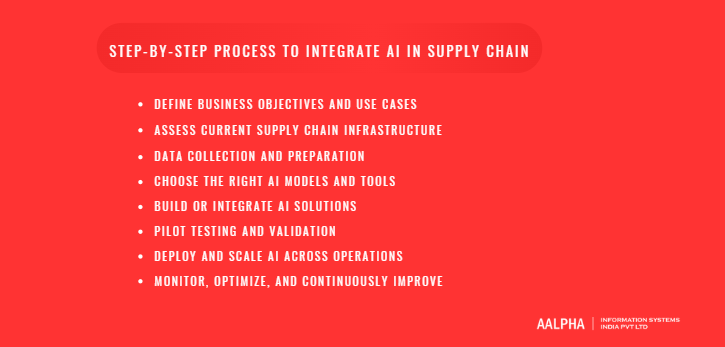
Step-by-Step Process to Integrate AI in Supply Chain
Integrating AI into a supply chain is not a one-time technology upgrade but a structured transformation that requires alignment between business goals, data infrastructure, and operational workflows. Organizations that succeed with AI adoption follow a phased approach, starting with clearly defined objectives and progressing toward scalable, continuously improving systems. This section outlines a practical, step-by-step framework that decision-makers can use to implement AI in supply chain operations with measurable outcomes.
-
Define Business Objectives and Use Cases
The first and most critical step in AI integration is defining clear business objectives. Many AI initiatives fail because they are driven by technology rather than solving real operational problems. Instead of asking, “Where can we use AI?”, organizations should start with, “What supply chain challenges are we trying to solve?”
Common pain points include inaccurate demand forecasting, frequent stockouts, excess inventory, delayed shipments, inefficient routing, and lack of visibility across operations. Each of these challenges represents a potential AI use case. For example, if delays in delivery are a recurring issue, route optimization using AI becomes a high-priority use case. If inventory carrying costs are too high, AI-driven inventory optimization should be explored.
Objectives should be specific, measurable, and aligned with business outcomes. For instance, reducing inventory holding costs by 15 percent, improving forecast accuracy by 20 percent, or increasing on-time delivery rates to 95 percent. These targets provide a clear benchmark for evaluating AI performance.
It is also important to prioritize use cases based on impact and feasibility. High-impact, low-complexity use cases should be implemented first to demonstrate quick wins and build organizational confidence. This approach ensures that AI adoption is driven by tangible business value rather than experimentation without direction.
-
Assess Current Supply Chain Infrastructure
Before implementing AI, organizations must evaluate their existing supply chain systems and technology stack. AI does not operate in isolation; it depends on the underlying infrastructure, including enterprise resource planning (ERP), warehouse management systems (WMS), transportation management systems (TMS), and other operational platforms.
The first step in this assessment is understanding system capabilities and limitations. Many legacy systems were not designed to handle real-time data processing or advanced analytics. This can create integration challenges when introducing AI. Decision-makers need to determine whether existing systems can support AI integration or if upgrades are required.
Data readiness is another critical factor. AI systems rely on high-quality, structured, and accessible data. Organizations should assess whether their data is centralized or fragmented across multiple systems. Data silos can significantly limit the effectiveness of AI by restricting access to complete and accurate information.
Integration capabilities must also be evaluated. Modern supply chain systems should support APIs or middleware that allow seamless data exchange between platforms. Without proper integration, AI models may not receive real-time data, reducing their effectiveness.
Finally, organizations should assess process maturity. If core processes are inconsistent or poorly defined, AI implementation will amplify inefficiencies rather than resolve them. Establishing standardized workflows is essential before introducing automation and intelligence layers.
-
Data Collection and Preparation
Data is the foundation of any AI system, and its quality directly determines the accuracy and reliability of outcomes. In supply chain environments, data is generated from multiple sources, including ERP systems, IoT devices, supplier databases, customer orders, and logistics platforms. Collecting and preparing this data is one of the most time-intensive yet critical steps in AI integration.
The first task is identifying relevant data sources. For demand forecasting, this may include historical sales data, seasonal trends, pricing information, and external factors such as market conditions. For logistics optimization, data sources may include GPS tracking, traffic patterns, fuel consumption, and delivery schedules.
Once data sources are identified, the next step is data cleaning. Raw data often contains inconsistencies, duplicates, missing values, and errors. These issues must be addressed through data validation, normalization, and standardization processes. For example, inconsistent product naming conventions or incorrect timestamps can lead to inaccurate predictions.
Data integration is equally important. Supply chain data is often stored in multiple systems, and integrating these datasets into a unified platform ensures that AI models have access to complete information. This may involve using data warehouses, data lakes, or integration tools to consolidate data.
Data governance should also be established at this stage. This includes defining data ownership, access controls, and quality standards. Without proper governance, data inconsistencies can re-emerge over time, reducing the effectiveness of AI systems.
-
Choose the Right AI Models and Tools
Selecting the appropriate AI models and tools is a strategic decision that depends on the complexity of the use case, available data, and organizational capabilities. Broadly, organizations can choose between custom-built AI solutions and pre-built AI platforms.
Custom AI solutions offer greater flexibility and can be tailored to specific business requirements. For example, a company with unique supply chain dynamics may develop a custom demand forecasting model that incorporates proprietary data. However, custom development requires significant expertise, time, and investment.
Pre-built AI platforms, on the other hand, provide ready-to-use solutions for common supply chain use cases such as forecasting, inventory optimization, and route planning. These platforms are faster to implement and require less technical expertise but may offer limited customization.
The choice of AI models also depends on the problem being addressed. Time-series models are commonly used for demand forecasting, while optimization algorithms are used for routing and scheduling. Classification and regression models are used for risk assessment and anomaly detection.
Decision-makers should also consider scalability and integration capabilities when selecting tools. The chosen solution should be able to handle increasing data volumes and integrate seamlessly with existing systems.
Ultimately, the goal is to select tools that align with business objectives, provide measurable value, and can be scaled across the supply chain.
-
Build or Integrate AI Solutions
Once the models and tools are selected, the next step is to build or integrate AI solutions into the existing supply chain ecosystem. This phase involves translating business requirements into functional systems that can operate in real-time environments.
For organizations opting for custom development, this includes designing model architectures, developing algorithms, and building data pipelines. The development process should follow best practices such as modular design, version control, and thorough testing to ensure reliability and scalability.
For those using SaaS-based AI solutions, the focus shifts to integration. This involves connecting the AI platform with existing systems such as ERP, WMS, and TMS through APIs or middleware. Data flows must be configured to ensure that the AI system receives real-time inputs and can deliver actionable outputs.
User interface design is also an important consideration. AI insights should be presented in a clear and actionable format, enabling decision-makers to interpret and act on recommendations easily Dashboards, alerts, and automated workflows should be designed to align with operational needs.
Security and compliance must be addressed during this phase. Supply chain data often includes sensitive information, and appropriate measures should be implemented to protect data integrity and confidentiality.
-
Pilot Testing and Validation
Before full-scale deployment, AI solutions should be tested in a controlled environment through pilot programs. This step is essential to validate model performance, identify potential issues, and ensure that the solution delivers the expected business outcomes.
Pilot testing typically involves selecting a specific segment of the supply chain, such as a single warehouse, product category, or geographic region. This allows organizations to evaluate the effectiveness of AI solutions without disrupting the entire operation.
Key performance indicators (KPIs) should be defined to measure success. These may include forecast accuracy, inventory turnover, delivery times, cost savings, and error reduction. Comparing these metrics before and after implementation provides a clear assessment of AI impact.
It is also important to gather feedback from end users during the pilot phase. Operational teams can provide insights into usability, practicality, and potential improvements. This feedback helps refine the solution before scaling.
Validation ensures that AI models are reliable, accurate, and aligned with business objectives. It also reduces the risk of failure during full-scale deployment.
-
Deploy and Scale AI Across Operations
After successful pilot testing, the next step is to deploy AI solutions across the broader supply chain. Scaling requires careful planning to ensure consistency, reliability, and minimal disruption to ongoing operations.
A phased rollout approach is often recommended. Instead of deploying AI across all operations simultaneously, organizations can expand gradually, starting with high-impact areas and extending to other regions, products, or processes. This reduces risk and allows for continuous learning.
Training and change management are critical during this phase. Employees must understand how to use AI systems, interpret outputs, and integrate them into daily workflows. Resistance to change can hinder adoption, so clear communication and training programs are essential.
System performance should be closely monitored during deployment. Any issues related to data flow, model accuracy, or system integration should be addressed promptly to ensure smooth operations.
Scaling also involves ensuring that infrastructure can handle increased data volumes and processing requirements. Cloud-based platforms are often used to support scalability and flexibility.
-
Monitor, Optimize, and Continuously Improve
AI integration does not end with deployment. Continuous monitoring and optimization are essential to maintain performance and adapt to changing conditions. Supply chains are dynamic environments, and AI models must evolve accordingly.
Performance tracking should be based on predefined KPIs, such as forecast accuracy, cost savings, and service levels. Regular evaluation helps identify areas for improvement and ensures that AI systems continue to deliver value.
Feedback loops are a key component of continuous improvement. Data generated from ongoing operations should be fed back into AI models to refine predictions and recommendations. This process, known as model retraining, ensures that AI systems remain accurate and relevant.
Organizations should also monitor external factors such as market trends, regulatory changes, and technological advancements. These factors can influence supply chain dynamics and require adjustments to AI strategies.
Over time, additional use cases can be introduced, expanding the scope of AI across the supply chain. What begins as a single use case, such as demand forecasting, can evolve into a fully integrated, intelligent supply chain ecosystem.
By treating AI as an ongoing capability rather than a one-time project, organizations can achieve sustained improvements in efficiency, resilience, and competitiveness.
Benefits of Integrating AI in Supply Chain
Integrating AI into supply chain operations delivers measurable business value across cost, efficiency, accuracy, and risk management. Unlike traditional systems that rely on static rules and manual intervention, AI-driven supply chains continuously learn from data and adapt to changing conditions in real time. This shift enables organizations to move from reactive problem-solving to proactive optimization. The following benefits highlight how AI directly impacts operational performance and strategic decision-making.
-
Improved Forecast Accuracy
One of the most significant advantages of AI in supply chains is its ability to dramatically improve demand forecasting accuracy. Traditional forecasting models rely heavily on historical data and fixed assumptions, which often fail in dynamic market conditions. AI models, however, incorporate both historical and real-time data, including external variables such as market trends, weather patterns, and consumer behavior.
Machine learning algorithms continuously refine their predictions as new data becomes available. This means forecasts are not static but evolve with changing conditions. For example, if demand for a product suddenly increases due to a seasonal trend or promotion, AI systems can detect the shift early and adjust forecasts accordingly.
Improved forecast accuracy leads to better planning across procurement, production, and distribution. It reduces uncertainty, minimizes errors, and ensures that supply aligns more closely with actual demand, ultimately improving service levels and customer satisfaction.
-
Reduced Operational Costs
AI helps organizations significantly reduce operational costs by optimizing processes across the entire supply chain. One of the primary ways it achieves this is through better inventory management. By accurately predicting demand and adjusting stock levels, AI minimizes excess inventory and reduces carrying costs.
Transportation and logistics costs are also reduced through AI-driven route optimization. By analyzing factors such as traffic, fuel consumption, and delivery schedules, AI systems identify the most efficient routes, reducing fuel usage and delivery times.
Automation further contributes to cost savings. Repetitive tasks such as order processing, inventory updates, and warehouse operations can be handled by AI-powered systems, reducing the need for manual labor and minimizing errors. Predictive maintenance is another cost-saving application, where AI identifies potential equipment failures before they occur, preventing costly downtime.
Overall, AI enables businesses to operate more efficiently while maintaining or improving service quality, leading to a stronger cost structure.
-
Enhanced Supply Chain Visibility
Visibility is a critical factor in effective supply chain management, and AI significantly enhances it by providing real-time insights across all operations. Traditional systems often operate in silos, making it difficult to gain a comprehensive view of the supply chain. AI integrates data from multiple sources, including ERP systems, IoT devices, and logistics platforms, to create a unified, end-to-end view.
This visibility allows businesses to track inventory levels, monitor shipments, evaluate supplier performance, and identify potential disruptions in real time. For example, if a shipment is delayed or a supplier fails to meet delivery timelines, AI systems can immediately flag the issue and suggest corrective actions.
Enhanced visibility also improves collaboration across departments and stakeholders. Decision-makers have access to accurate and up-to-date information, enabling them to make informed decisions بسرعة and with greater confidence.
By providing a clear and continuous view of operations, AI reduces uncertainty and improves overall supply chain coordination.
-
Faster Decision-Making
In traditional supply chains, decision-making is often delayed due to manual processes, fragmented data, and limited analytical capabilities. AI eliminates these bottlenecks by enabling real-time analysis and automated decision support.
AI systems can process vast amounts of data within seconds and generate actionable insights. For example, if demand patterns shift अचानक, the system can instantly recommend adjustments to inventory levels, production schedules, or distribution plans. This speed is critical in industries where delays can lead to lost revenue or customer dissatisfaction.
Decision intelligence takes this a step further by automating certain decisions. For instance, AI can automatically reroute shipments, trigger replenishment orders, or adjust pricing strategies based on predefined rules and real-time data.
Faster decision-making not only improves operational efficiency but also enhances responsiveness to market changes. Businesses can act quickly on opportunities and mitigate risks before they escalate, giving them a competitive advantage.
-
Increased Resilience and Risk Management
Supply chains are increasingly exposed to disruptions, including supplier failures, geopolitical issues, natural disasters, and demand fluctuations. AI strengthens resilience by enabling proactive risk management and rapid response to disruptions.
AI systems continuously monitor data from internal and external sources to identify potential risks. For example, they can detect early warning signs such as delays in supplier shipments, changes in market conditions, or disruptions in transportation networks. Once a risk is identified, AI can recommend alternative strategies, such as sourcing from different suppliers or rerouting shipments.
Scenario analysis is another key capability. AI can simulate different disruption scenarios and evaluate their impact on the supply chain, allowing businesses to prepare contingency plans in advance.
By improving risk visibility and enabling proactive decision-making, AI reduces the impact of disruptions and ensures business continuity. This level of resilience is essential in today’s unpredictable global environment, where supply chain stability directly affects overall business performance.
Challenges in AI Integration
While AI offers substantial benefits in supply chain optimization, its implementation is not without challenges. Organizations often underestimate the complexity involved in integrating AI into existing systems and workflows. These challenges are not purely technical; they also involve data readiness, organizational alignment, cost considerations, and human factors. Addressing these risks early is essential for successful adoption and long-term sustainability. The following sections outline the most common challenges businesses face when integrating AI into supply chain operations and why they matter for decision-makers.
-
Data Quality and Availability Issues
AI systems are only as effective as the data they are trained on. In many organizations, supply chain data is fragmented across multiple systems, inconsistent in format, and often incomplete or outdated. Poor data quality leads to inaccurate predictions, unreliable insights, and flawed decision-making.
For example, inconsistent product identifiers, missing transaction records, or incorrect timestamps can significantly impact demand forecasting models. Similarly, lack of real-time data limits the ability of AI systems to respond dynamically to changing conditions.
Data availability is another major concern. Some organizations simply do not have sufficient historical data to train robust AI models, especially for new products or markets. In such cases, models may produce unreliable outputs until enough data is accumulated.
To overcome these challenges, businesses must invest in data governance frameworks, standardization processes, and centralized data infrastructure. Ensuring clean, consistent, and accessible data is a foundational requirement for any AI initiative.
-
Integration with Legacy Systems
Many supply chain operations still rely on legacy systems that were not designed to support modern AI capabilities. These systems often lack real-time data processing, API support, or integration flexibility, making it difficult to connect them with AI platforms.
Integrating AI into such environments can require significant effort, including system upgrades, middleware implementation, or even partial system replacement. Without proper integration, AI models may not receive timely data inputs or may operate in isolation, limiting their effectiveness.
Another challenge is data silos. Legacy systems often store data in separate, disconnected environments, preventing a unified view of the supply chain. AI requires integrated datasets to generate accurate insights, and breaking down these silos can be complex.
Organizations must carefully evaluate their existing infrastructure and plan for integration strategies that ensure seamless data flow. In some cases, adopting cloud-based systems or modernizing legacy platforms becomes necessary to fully leverage AI capabilities.
-
High Initial Investment
Implementing AI in supply chains involves significant upfront costs, which can be a barrier for many organizations. These costs include data infrastructure setup, software development or licensing, system integration, and ongoing maintenance.
Custom AI solutions, in particular, require substantial investment in development, testing, and deployment. Even pre-built AI platforms may involve licensing fees, integration costs, and training expenses.
In addition to technology costs, organizations must also consider indirect expenses such as process redesign, employee training, and change management initiatives. These factors can increase the total cost of ownership.
While AI delivers long-term cost savings and efficiency gains, the initial investment can be difficult to justify without a clear return on investment (ROI) strategy. Businesses must carefully evaluate potential benefits, prioritize high-impact use cases, and adopt a phased implementation approach to manage costs effectively.
-
Skill Gap and Talent Shortage
AI integration requires specialized skills that are often scarce in the job market. Expertise in machine learning, data engineering, data science, and AI system architecture is essential for building and maintaining AI solutions.
Many organizations lack in-house talent with the necessary technical knowledge, which can delay implementation or lead to suboptimal outcomes. Hiring skilled professionals can be expensive and time-consuming, especially given the high demand for AI expertise globally.
Beyond technical roles, there is also a need for domain experts who understand both supply chain operations and AI applications. Bridging this gap is critical to ensure that AI solutions align with real-world business requirements.
To address this challenge, companies often rely on external partners, invest in employee training programs, or adopt user-friendly AI platforms that require less technical expertise. Building a balanced team with both technical and operational knowledge is key to successful AI adoption.
-
Change Management and Adoption
One of the most underestimated challenges in AI integration is organizational resistance to change. Introducing AI often requires significant changes to existing workflows, roles, and decision-making processes. Employees may be hesitant to adopt new systems due to fear of job displacement, lack of understanding, or discomfort with technology.
Without proper change management, even the most advanced AI solutions can fail due to low adoption rates. Employees need to trust AI systems and understand how to use them effectively. This requires clear communication, training, and involvement of stakeholders throughout the implementation process.
Another challenge is aligning AI outputs with human decision-making. In some cases, decision-makers may be reluctant to rely on AI recommendations, especially if they lack transparency or explainability. Ensuring that AI systems provide interpretable insights can help build confidence and encourage adoption.
Successful AI integration depends not only on technology but also on people and processes. Organizations must foster a culture of innovation, provide adequate training, and ensure that AI is seen as a tool for augmentation rather than replacement.
Cost of Implementing AI in Supply Chain
The cost of implementing AI in supply chain operations varies widely depending on the scope, complexity, and level of customization required. For decision-makers, understanding these cost drivers is essential to plan budgets, prioritize use cases, and evaluate return on investment. AI is not a single purchase but a combination of data infrastructure, software, integration, and ongoing optimization. While the initial investment can be significant, the long-term financial benefits often outweigh the costs when implemented strategically.
-
Factors Affecting Cost
Several factors influence the overall cost of AI implementation in supply chains, and these must be evaluated carefully before starting any initiative. The most important factor is the complexity of the use case. Simple applications such as demand forecasting using pre-built tools are relatively low-cost, while advanced solutions like end-to-end supply chain optimization or digital twins require higher investment.
Data readiness plays a critical role in cost estimation. Organizations with clean, structured, and centralized data can implement AI faster and at lower cost. In contrast, companies with fragmented or poor-quality data may need to invest heavily in data cleaning, integration, and infrastructure before AI can be deployed.
The scale of deployment also impacts cost. Implementing AI for a single warehouse or region is significantly less expensive than rolling it out across a global supply chain network. Integration requirements further add to costs, especially when dealing with legacy systems that require customization or middleware.
Finally, the choice between custom development and pre-built platforms influences cost significantly. Custom solutions offer flexibility but require higher upfront investment, while SaaS-based tools reduce initial costs but may involve recurring subscription fees.
-
Cost Breakdown by Solution Type
AI implementation costs can be broadly categorized based on the type of solution being deployed. For basic use cases such as demand forecasting or inventory optimization using existing AI platforms, costs typically include software licensing, data integration, and minimal customization. These solutions are relatively quick to deploy and can deliver value within a short timeframe.
Mid-level implementations, such as AI-driven logistics optimization or warehouse automation systems, involve higher costs due to the need for deeper integration, process redesign, and potentially hardware investments such as sensors or robotics. These projects require more planning and coordination across multiple systems.
Advanced implementations, such as fully integrated AI-driven supply chain ecosystems or digital twin models, represent the highest level of investment. These solutions require custom model development, extensive data infrastructure, and continuous optimization. They often involve multiple stakeholders and long implementation timelines.
In addition to direct costs, organizations must also consider indirect expenses such as employee training, change management, and ongoing system maintenance. These factors contribute to the total cost of ownership and should be included in budgeting decisions.
-
Custom AI vs SaaS AI Tools
Choosing between custom AI solutions and SaaS-based AI tools is one of the most important cost-related decisions. Each approach has distinct financial and operational implications.
Custom AI solutions are designed specifically for an organization’s supply chain requirements. They offer greater flexibility, deeper integration, and the ability to incorporate proprietary data and unique business logic. However, they come with higher upfront costs, longer development timelines, and ongoing maintenance requirements. Custom solutions are typically suitable for large enterprises with complex supply chain operations and specific needs that cannot be addressed by standard tools.
SaaS-based AI tools, on the other hand, provide ready-to-use solutions for common use cases such as forecasting, routing, and procurement optimization. These platforms are faster to deploy and require lower initial investment. Costs are usually subscription-based, making them more predictable and scalable.
However, SaaS tools may have limitations in terms of customization and may not fully align with unique business processes. Organizations must evaluate whether the trade-off between cost and flexibility aligns with their strategic goals.
-
ROI Expectations and Payback Period
One of the most important considerations in AI implementation is the expected return on investment (ROI). While the upfront costs can be substantial, AI typically delivers measurable financial benefits through cost savings, efficiency improvements, and revenue growth.
Common ROI drivers include reduced inventory carrying costs, improved demand forecasting accuracy, lower transportation expenses, and increased operational efficiency. For example, even a small improvement in forecast accuracy can lead to significant reductions in excess inventory and stockouts, directly impacting profitability.
The payback period for AI investments varies depending on the use case and scale of implementation. For smaller, targeted solutions such as demand forecasting, organizations may see returns within 6 to 12 months. More complex implementations, such as end-to-end supply chain optimization, may take 12 to 24 months to achieve full ROI.
It is important to define clear performance metrics and track them consistently to measure the impact of AI. Organizations that adopt a phased approach, starting with high-impact use cases, are more likely to achieve faster returns and build momentum for broader AI adoption.
In practical terms, AI should not be viewed as a cost but as a strategic investment that drives long-term efficiency, resilience, and competitive advantage.
How to Choose the Right AI Development Partner
Selecting the right AI development partner is one of the most critical decisions in your supply chain transformation journey. The success or failure of your AI initiative depends not only on the technology but also on the expertise, execution capability, and long-term support provided by your partner. A strong partner does more than build models; they understand your business, align AI with operational goals, and ensure seamless integration into existing workflows.
For decision-makers, the evaluation process should go beyond pricing or portfolio. It should focus on domain expertise, technical depth, adaptability, and the ability to deliver measurable outcomes. The following criteria provide a structured framework to assess potential AI partners and make an informed decision.
-
Industry Experience
Industry experience is a key differentiator when selecting an AI development partner for supply chain projects. Supply chains vary significantly across industries such as retail, manufacturing, logistics, and healthcare, each with its own complexities, regulatory requirements, and operational challenges. A partner with proven experience in your domain is more likely to understand these nuances and deliver solutions that align with real-world requirements.
For example, demand forecasting in retail involves handling seasonal trends and promotional spikes, while in manufacturing, it may involve production planning and raw material sourcing. An experienced partner can tailor AI models to these specific scenarios rather than applying generic solutions.
Additionally, industry expertise reduces the learning curve and accelerates implementation timelines. The partner can anticipate potential challenges, recommend best practices, and avoid common pitfalls. This leads to faster time-to-value and more reliable outcomes.
-
Technical Expertise in AI and Supply Chain
Technical expertise is fundamental to building effective and scalable AI solutions. A capable partner should have strong proficiency in machine learning, data engineering, and AI model deployment, along with a deep understanding of supply chain systems such as ERP, WMS, and TMS.
It is important to evaluate whether the partner has experience with relevant AI use cases such as demand forecasting, inventory optimization, route planning, and risk analysis. They should be able to explain how different models work, why a particular approach is chosen, and how it will deliver measurable results.
Scalability and performance are also critical considerations. The partner should design solutions that can handle large volumes of data and adapt to growing business needs. This includes expertise in cloud platforms, data pipelines, and real-time processing.
A strong technical foundation ensures that the AI solution is not only functional but also reliable, efficient, and future-ready.
-
Customization Capabilities
Every supply chain is unique, and off-the-shelf solutions may not fully address specific business requirements. A reliable AI partner should offer customization capabilities to tailor solutions according to your operational workflows, data structure, and strategic goals.
Customization includes adapting AI models to incorporate proprietary data, configuring workflows to match business processes, and developing features that address specific pain points. For example, a logistics company may require custom routing algorithms that consider unique constraints such as delivery time windows or regional regulations.
The ability to customize ensures that the AI solution delivers maximum value and integrates seamlessly into existing operations. It also provides flexibility to evolve the system as business needs change over time.
-
Integration Expertise
AI solutions must work in harmony with existing supply chain systems to deliver meaningful results. Integration expertise is therefore a critical factor when choosing a development partner. The partner should have experience integrating AI with platforms such as ERP, WMS, TMS, and other enterprise systems.
Seamless integration ensures that data flows continuously between systems, enabling real-time insights and decision-making. Without proper integration, AI models may operate in isolation, limiting their effectiveness.
The partner should also be familiar with APIs, middleware, and data integration tools that facilitate connectivity between different systems. They should be able to design architectures that support scalability and maintain data consistency across the supply chain.
Strong integration capabilities reduce implementation complexity and ensure that AI becomes an integral part of your operational ecosystem rather than a standalone tool.
-
Pricing and Engagement Model
Pricing and engagement models play a significant role in selecting the right AI partner, especially for long-term projects. Organizations should look for transparent pricing structures that clearly outline development costs, licensing fees, integration expenses, and ongoing maintenance charges.
Different partners may offer different engagement models, such as fixed-price projects, time-and-material contracts, or dedicated development teams. The choice depends on the scope, complexity, and flexibility required for the project.
It is important to balance cost with value. The lowest-cost option may not always deliver the best results, especially for complex AI implementations. Decision-makers should evaluate the expected ROI and ensure that the pricing aligns with the quality and scope of services provided.
A well-defined engagement model also helps manage expectations, timelines, and deliverables, reducing the risk of project overruns.
-
Post-Deployment Support
AI implementation does not end with deployment. Continuous monitoring, optimization, and maintenance are essential to ensure long-term success. A reliable AI partner should provide comprehensive post-deployment support, including model monitoring, performance tuning, and system updates.
AI models require periodic retraining to remain accurate as data patterns change. The partner should have processes in place to update models, address performance issues, and incorporate new data sources. They should also provide technical support to resolve any operational challenges that arise.
Training and knowledge transfer are equally important. The partner should equip your internal teams with the skills needed to use and manage AI systems effectively. This ensures that the organization can sustain and scale AI initiatives independently over time.
Experienced providers such as Aalpha bring a combination of domain expertise, technical capability, and long-term support, enabling businesses to implement AI solutions that are not only effective at launch but continue to deliver value as the supply chain evolves.
A well-chosen AI development partner acts as a strategic collaborator rather than just a service provider. By focusing on expertise, integration capability, and long-term support, organizations can ensure that their AI investments translate into measurable business outcomes and sustained competitive advantage.
Final Thoughts
AI is no longer optional in supply chain management; it is becoming a core capability for businesses that want to remain competitive, efficient, and resilient. From improving forecast accuracy to optimizing logistics and reducing operational costs, AI enables supply chains to move from reactive execution to intelligent, data-driven decision-making.
The key to success lies in taking a structured approach. Start with clearly defined use cases, ensure your data is ready, and partner with experts who understand both AI and supply chain dynamics. Organizations that begin with focused, high-impact implementations often see faster results and build a strong foundation for scaling AI across operations.
If you are planning to integrate AI into your supply chain, working with an experienced technology partner can significantly accelerate your journey. At Aalpha, we help businesses design, develop, and deploy tailored AI solutions that align with real operational challenges and deliver measurable results.
Connect with us to explore how AI can transform your supply chain and unlock long-term efficiency, visibility, and growth.