



Global trade has shifted from traditional offline negotiations to highly digitized, platform-driven ecosystems. Businesses no longer rely solely on trade fairs, brokers, or physical networks to source products or find international buyers. Instead, import export websites have become the backbone of modern cross-border commerce, enabling companies to connect, negotiate, and transact globally with speed and transparency. Whether a manufacturer is looking to export goods to new markets or a buyer wants to source products from verified suppliers, these platforms serve as centralized digital marketplaces that streamline the entire trade lifecycle.
An import export website is not just a listing portal. It combines supplier discovery, product showcasing, inquiry management, and often payment and logistics coordination into a single system. Platforms such as Alibaba Group and IndiaMART have demonstrated how digital infrastructure can simplify international trade by removing intermediaries, increasing price transparency, and enabling direct communication between buyers and sellers. As global trade volumes continue to grow, businesses are increasingly asking how to build their own import export website to capture market opportunities, improve margins, and scale internationally.
This guide provides a complete, step-by-step breakdown of how to build an import export website from both a business and technical perspective. It covers everything from selecting the right platform model and defining core features to designing scalable architecture and launching the platform effectively. Whether you are a startup, trading company, or manufacturer, this article is structured to help you understand not only what to build, but also how to build it strategically.
What is an Import Export Website?
An import export website is a digital platform designed to facilitate international trade between buyers and suppliers. It typically operates as a B2B marketplace, sourcing portal, or cross-border trade platform where businesses can list products, discover suppliers, and initiate transactions across different countries. Unlike traditional eCommerce websites that focus on direct consumer sales, these platforms are structured for bulk transactions, negotiation-based pricing, and long-term business relationships.
At its core, an import export website allows suppliers to create detailed business profiles and showcase their product catalogs, including specifications, certifications, pricing tiers, and minimum order quantities. Buyers can search for products based on industry, location, or compliance standards, and submit inquiries or RFQs (Request for Quotations) to multiple suppliers simultaneously. This creates a competitive and transparent sourcing environment.
Platforms like Global Sources demonstrate how these systems go beyond simple listings by integrating verification mechanisms, supplier ratings, and communication tools. The result is a structured ecosystem where global trade becomes more efficient, data-driven, and accessible even for small and mid-sized businesses.
Why Businesses Need Import Export Platforms Today
The demand for import export websites has increased significantly due to globalization and the rapid digitalization of supply chains. Businesses are no longer limited to local suppliers or regional markets. Instead, they actively seek global sourcing opportunities to reduce costs, access specialized products, and improve supply chain resilience. This shift has made digital trade platforms essential rather than optional.
One of the primary drivers is the need for efficient supplier discovery. Traditionally, finding reliable international suppliers required travel, trade exhibitions, or intermediaries. Today, businesses can evaluate hundreds of suppliers online, compare pricing, review certifications, and initiate communication instantly. This reduces procurement time and improves decision-making accuracy.
Another critical factor is the acceleration of digital trade. Companies increasingly ask how they can scale import export operations without expanding physical infrastructure. Import export platforms solve this by providing automated workflows for inquiries, negotiations, and order management. They also enable multi-country operations without requiring a physical presence in each market.
Additionally, trust and transparency have improved through digital verification systems. Features such as supplier ratings, trade assurance programs, and documented transaction histories help mitigate risks that were previously common in international trade. As a result, even small businesses can confidently engage in cross-border transactions, something that was historically limited to large enterprises.
What This Guide Will Help You Achieve
This guide is designed to provide a comprehensive, practical roadmap for building an import export website from the ground up. It answers the key question many businesses have: what does it take to create a scalable and successful global trade platform?
You will learn how to define your business model, identify your target users, and determine the essential features required for your platform. The guide also walks through the technical aspects, including choosing the right architecture, integrating payment and logistics systems, and ensuring platform scalability. Beyond development, it covers go-to-market strategies, monetization models, and long-term growth considerations.
By the end of this guide, you will have a clear understanding of both the strategic and technical steps involved in building an import export website. More importantly, you will be equipped to make informed decisions that align with your business goals, whether you are launching a niche trade platform or building a large-scale B2B marketplace.
Types of Import Export Websites
Choosing the right type of import export website is a foundational decision that directly impacts your platform’s architecture, monetization model, and long-term scalability. Not all trade platforms operate in the same way. Some focus on connecting thousands of buyers and suppliers globally, while others are built to represent a single manufacturer or a specialized niche industry. Before starting development, businesses often ask which model is most suitable for their goals. The answer depends on factors such as target audience, product category, operational capacity, and revenue strategy.
Broadly, import export websites can be categorized into four main types: B2B marketplace platforms, manufacturer-owned export websites, trading company websites, and niche trade platforms. Each model serves a distinct purpose and requires a different approach to design, features, and growth strategy.
-
B2B Marketplace Platforms
B2B marketplace platforms are the most widely recognized type of import export website. These platforms act as intermediaries that connect buyers and suppliers from different parts of the world within a single digital ecosystem. Their primary goal is to facilitate product discovery, supplier comparison, and business transactions at scale.
Platforms such as Alibaba Group and IndiaMART are prime examples of this model. They allow thousands of suppliers to create profiles, list products, and respond to buyer inquiries, while buyers can browse catalogs, compare vendors, and submit RFQs to multiple suppliers simultaneously. This creates a highly competitive environment where pricing, quality, and trust signals play a critical role.
From a development perspective, B2B marketplaces are complex systems. They require robust user management, advanced search and filtering, inquiry systems, messaging tools, and often integrated payment or trade assurance features. These platforms also rely heavily on verification mechanisms such as supplier badges, certifications, and ratings to build trust among users.
This model is ideal for entrepreneurs and businesses aiming to build large-scale platforms with network effects. As more suppliers join, the platform becomes more valuable to buyers, and vice versa. However, it also requires significant investment in technology, onboarding, and platform moderation to maintain quality and prevent fraud.
-
Manufacturer-Owned Export Websites
Manufacturer-owned export websites are built by individual factories or wholesalers to showcase their products directly to international buyers. Unlike marketplaces, these platforms do not aggregate multiple suppliers. Instead, they serve as a dedicated digital storefront for a single business, focusing on brand positioning and direct client acquisition.
These websites typically include detailed product catalogs, technical specifications, certifications, and company information that highlights manufacturing capabilities. Buyers visiting the site can explore products, request quotations, and initiate direct communication with the manufacturer. This eliminates intermediaries and allows businesses to retain full control over pricing, negotiations, and customer relationships.
For example, a textile manufacturer exporting garments or a machinery producer supplying industrial equipment may use this model to attract global clients. The focus is often on credibility, showcasing production facilities, and demonstrating compliance with international standards.
From a technical standpoint, manufacturer-owned websites are less complex than marketplaces but still require strong features such as inquiry management, multilingual support, and SEO optimization to attract international traffic. This model is particularly suitable for businesses that already have production capabilities and want to expand their export reach without relying on third-party platforms.
-
Trading Company Websites
Trading company websites represent businesses that act as intermediaries between manufacturers and buyers. Unlike manufacturer-owned platforms, these websites typically offer a wide range of products sourced from multiple suppliers. The trading company manages supplier relationships, negotiates pricing, and handles transactions on behalf of buyers.
This model is common in industries where buyers prefer dealing with a single point of contact rather than managing multiple supplier relationships. For instance, a trading company may source products from different factories, consolidate orders, and offer value-added services such as quality inspection, packaging, and logistics coordination.
These websites usually feature extensive product catalogs across multiple categories, along with inquiry forms and communication tools. However, unlike open marketplaces, supplier information is often not fully disclosed. The trading company acts as the central authority managing the entire transaction process.
From a development perspective, trading company websites require strong catalog management systems and inquiry handling workflows. They may also include backend tools for supplier management and order coordination. This model is ideal for businesses that specialize in sourcing and want to position themselves as trusted intermediaries in global trade.
-
Niche Trade Platforms
Niche trade platforms focus on specific industries or product categories, such as agriculture, textiles, chemicals, or industrial machinery. Instead of targeting a broad audience, these platforms are designed to serve a highly specialized market with tailored features and domain-specific requirements.
For example, a platform dedicated to agricultural exports may include features like crop certifications, seasonal availability tracking, and compliance with food safety standards. Similarly, a machinery-focused platform may emphasize technical specifications, customization options, and after-sales support.
The advantage of niche platforms lies in their ability to provide deeper value to a targeted audience. By focusing on a specific industry, these platforms can build stronger trust, offer more relevant features, and attract high-quality users who are actively engaged in that sector.
From a business perspective, niche platforms often face less competition compared to large marketplaces. However, they require strong industry knowledge and targeted marketing strategies to succeed. This model is particularly effective for entrepreneurs looking to solve specific trade challenges within a defined domain rather than building a general-purpose marketplace.
Key Features of an Import Export Website
An import export website is fundamentally different from a standard eCommerce platform. It is not designed for simple transactions but for enabling complex, negotiation-driven, cross-border trade relationships. This means the platform must support supplier discovery, product evaluation, communication, compliance, and transaction management in a structured and reliable way. Businesses often ask what features are essential to make such a platform functional and competitive. The answer lies in building a system that reduces friction in global trade while increasing trust, transparency, and efficiency.
Below are the core features every import export website must include to operate effectively at scale.
-
User Registration and Business Profiles
The foundation of any import export platform is a robust user registration and onboarding system. Unlike consumer platforms, users here are businesses, which means onboarding must capture detailed company-level information rather than just basic personal data.
Suppliers and buyers should be able to create accounts with clear role selection. During registration, suppliers typically provide business details such as company name, location, product categories, certifications, production capacity, and export experience. Buyers may include sourcing preferences, target markets, and procurement requirements. This structured onboarding process ensures that the platform can match relevant users effectively.
Business profiles act as digital identities and trust signals. A well-designed profile includes company descriptions, product catalogs, certifications, trade history, and verification badges. Verified profiles significantly increase credibility and improve conversion rates, as buyers are more likely to engage with trusted suppliers.
Additionally, onboarding flows should include document verification, email authentication, and optional KYC processes. This reduces the risk of fraudulent accounts and builds a more reliable ecosystem. A strong user registration system is not just about access control; it is a critical component of trust and matchmaking in global trade platforms.
-
Product Listings and Catalog Management
Product listing and catalog management form the core of how suppliers showcase their offerings. Unlike traditional eCommerce listings, import export platforms require highly detailed and structured product data to support international buyers who rely on specifications for decision-making.
Suppliers should be able to upload products individually or in bulk using spreadsheets or API integrations. Each listing must include detailed attributes such as product name, category, specifications, materials, dimensions, certifications, and compliance standards. High-quality images and videos are essential, as buyers often cannot physically inspect products before placing orders.
Pricing structures in B2B platforms are more complex than fixed retail pricing. Suppliers may define multiple pricing tiers based on minimum order quantity (MOQ), bulk discounts, and custom quotations. This flexibility allows negotiation and caters to different buyer requirements.
Catalog management systems should also support inventory updates, product variations, and multilingual descriptions to cater to global audiences. A well-structured catalog improves discoverability, enhances user experience, and directly impacts inquiry rates. Poorly organized product data, on the other hand, leads to confusion and lost opportunities.
-
Advanced Search and Filtering
Search functionality is one of the most critical features in an import export website, as it directly influences how efficiently buyers can find relevant suppliers and products. Given the vast number of listings typically present on such platforms, a basic search system is insufficient.
Advanced search capabilities should allow users to filter results based on multiple parameters, including product category, supplier location, minimum order quantity, price range, certifications, and production capacity. For example, a buyer sourcing industrial components may want to filter suppliers based on ISO certifications or specific compliance standards required in their country.
Geographical filtering is particularly important in global trade. Buyers often prefer suppliers from specific regions due to cost advantages, trade agreements, or logistics considerations. Similarly, filters for verified suppliers or premium listings help users prioritize trusted partners.
The search system should also include intelligent ranking algorithms that prioritize relevance, supplier credibility, and user behavior. Autocomplete, keyword suggestions, and personalized recommendations further enhance usability. An efficient search and filtering system reduces friction in the discovery process and significantly improves user engagement and conversion rates.
-
Inquiry and RFQ System
The inquiry and RFQ (Request for Quotation) system is the backbone of any import export platform. Unlike standard eCommerce transactions where users add items to a cart and check out, B2B trade relies heavily on negotiation and customized pricing.
An RFQ system allows buyers to send detailed inquiries to one or multiple suppliers simultaneously. These inquiries typically include product specifications, required quantities, target price, delivery timelines, and any customization needs. Suppliers can then respond with quotations, clarifications, or counteroffers.
This feature must be designed to handle structured communication. Inquiry forms should capture all necessary details to avoid back-and-forth communication and reduce response time. Additionally, the system should allow buyers to track the status of their inquiries, compare multiple quotations, and manage ongoing negotiations.
Bulk RFQ capabilities are particularly important for large buyers who need to source from multiple vendors at once. By enabling efficient communication and comparison, the RFQ system accelerates decision-making and improves procurement efficiency.
In many ways, this feature replaces the traditional role of trade agents and brokers, making it one of the most critical components of the platform.
-
Messaging and Communication Tools
Effective communication is essential for building trust and closing deals in international trade. Import export websites must include integrated messaging systems that allow buyers and suppliers to interact directly within the platform.
These tools typically include real-time chat, threaded messaging, and email notifications. Conversations should be organized by inquiries or orders, making it easy for users to track discussions and refer back to previous communications. Features such as file sharing enable users to exchange documents, product specifications, and contracts.
Negotiation tools can further enhance communication by allowing structured discussions around pricing, delivery terms, and payment conditions. Automated notifications ensure that users are alerted to new messages, quotation updates, or inquiry responses, reducing delays in communication.
Security and transparency are also important. Keeping communication within the platform ensures that interactions are recorded and can be monitored if disputes arise. This not only protects users but also strengthens the platform’s credibility.
-
Payment Integration and Escrow Systems
Handling payments in international trade introduces complexities such as currency conversion, fraud risk, and compliance requirements. An import export website must integrate secure payment systems that support cross-border transactions while minimizing risk for both buyers and suppliers.
Payment gateways should support multiple currencies and international payment methods, including bank transfers, credit cards, and digital payment solutions. However, direct payments alone may not be sufficient to build trust, especially for new users.
Escrow systems play a critical role in addressing this challenge. In an escrow model, the buyer’s payment is held by a third party until the supplier fulfills the agreed terms, such as shipping the goods or meeting quality standards. Once the conditions are met, the payment is released to the supplier. This significantly reduces the risk of fraud and increases confidence in the platform.
Additionally, platforms may include trade assurance programs, dispute resolution mechanisms, and transaction tracking features. These elements create a secure financial environment that encourages more users to engage in cross-border trade.
-
Logistics and Shipment Tracking
Logistics is a central component of import export operations, and integrating shipment tracking capabilities enhances the overall user experience. While the platform may not directly handle shipping, it should connect with logistics providers to provide visibility into the delivery process.
Users should be able to view shipment status, estimated delivery timelines, and tracking updates directly within the platform. Integration with freight forwarders, courier services, or shipping APIs enables real-time updates and reduces uncertainty.
For buyers, this transparency improves confidence and allows better planning. For suppliers, it provides a streamlined way to manage order fulfillment and communicate delivery progress. Even basic tracking features can significantly enhance the perceived reliability of the platform.
-
Admin Dashboard and Moderation
The admin dashboard is the control center of the import export website. It allows platform operators to manage users, monitor transactions, and ensure the integrity of the ecosystem.
Key functionalities include user management, product moderation, inquiry monitoring, and dispute resolution. Administrators should be able to verify supplier profiles, approve or reject listings, and flag suspicious activity. Analytics tools provide insights into platform performance, user behavior, and revenue generation.
Fraud prevention is a critical responsibility of the admin system. By monitoring transactions, communication patterns, and user activity, the platform can identify and mitigate risks before they escalate. Moderation tools also ensure that content remains accurate, compliant, and aligned with platform standards.
A well-designed admin dashboard not only supports operational efficiency but also plays a vital role in maintaining trust, which is essential for the long-term success of any import export platform.
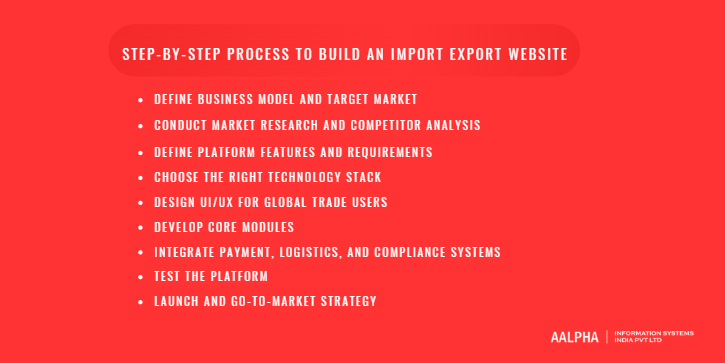
Step-by-Step Process to Build an Import Export Website
Building an import export website requires a structured approach that balances business strategy, technical execution, and market positioning. Many businesses underestimate the complexity of global trade platforms, assuming they function like standard eCommerce websites. In reality, these systems must support negotiation-driven transactions, multi-country operations, compliance requirements, and trust-building mechanisms.
Given these technical and operational demands, such platforms are often developed with the involvement of an eCommerce development company to handle architecture, integrations, and scalability requirements. This section provides a step-by-step framework to help you move from idea to launch with clarity and precision.
-
Define Business Model and Target Market
The first step in building an import export website is to clearly define your business model and identify your target market. This decision determines everything that follows, from platform features to monetization and marketing strategy.
Start by identifying who your primary users are. Are you targeting manufacturers looking to export goods, buyers seeking suppliers, or both? If you are building a marketplace, your platform must cater to two-sided users, meaning you need to solve problems for both suppliers and buyers simultaneously. If you are building a manufacturer-owned platform, your focus shifts toward showcasing products and generating direct inquiries.
Next, define the core problem your platform will solve. For example, are you helping buyers find verified suppliers faster? Are you enabling small manufacturers to access international markets? Are you simplifying procurement for specific industries such as textiles or machinery? The clearer your problem statement, the more focused your platform will be.
Geographic focus is equally important. Some platforms target global markets, while others focus on specific regions such as Southeast Asia, Europe, or the Middle East. Trade regulations, logistics costs, and language preferences vary across regions, so defining your market early helps avoid unnecessary complexity.
A well-defined business model also includes your revenue strategy. Whether you plan to charge subscription fees, commissions, or offer premium listings, this decision influences your feature set and platform design. Without clarity at this stage, development efforts can become fragmented and misaligned with business goals.
-
Conduct Market Research and Competitor Analysis
Once your business model is defined, the next step is to analyze the market and understand existing platforms. This helps you identify gaps, differentiate your offering, and avoid repeating mistakes made by competitors.
Start by studying established platforms such as Alibaba Group, Global Sources, and IndiaMART. These platforms provide valuable insights into how global trade ecosystems operate. Analyze their user interface, onboarding flows, product listing structures, and communication systems.
Pay close attention to how these platforms build trust. Features such as supplier verification, ratings, certifications, and trade assurance programs are critical in international trade. Understanding how competitors implement these mechanisms can guide your own platform design.
In addition to feature analysis, evaluate their business models. For example, some platforms rely heavily on supplier subscriptions, while others generate revenue through advertising or transaction fees. Understanding these models helps you choose a strategy that aligns with your target market.
Market research should also include identifying unmet needs. Are there industries that lack specialized platforms? Are there inefficiencies in existing systems, such as slow inquiry responses or poor search functionality? These gaps represent opportunities to create a differentiated product.
Finally, analyze user behavior and expectations. Modern buyers expect fast responses, transparent pricing, and reliable communication. Suppliers expect visibility, lead generation, and easy product management. Your platform must address these expectations effectively to compete in the market.
-
Define Platform Features and Requirements
After understanding the market, the next step is to translate your business goals into a clear set of platform features and technical requirements. This stage acts as a bridge between strategy and development.
Begin by listing all essential features required to support your business model. For a B2B marketplace, this typically includes user registration, business profiles, product catalogs, search and filtering, RFQ systems, messaging tools, and payment integration. Each feature should be defined in terms of functionality, user flow, and expected outcomes.
It is important to prioritize features based on impact and feasibility. Many businesses attempt to build everything at once, which increases development time and cost. Instead, focus on a minimum viable product that includes core functionalities necessary for launch. Additional features can be added in later phases based on user feedback.
Define user journeys in detail. For example, map how a buyer searches for a product, submits an inquiry, receives quotations, and completes a transaction. Similarly, outline how a supplier registers, lists products, and responds to inquiries. These workflows help developers understand how different components interact.
Technical requirements should also include scalability considerations. As your platform grows, it must handle increasing numbers of users, products, and transactions without performance issues. Security requirements are equally critical, especially when handling sensitive business data and financial transactions.
A well-documented feature and requirement specification ensures that development teams have a clear roadmap, reducing ambiguity and minimizing costly revisions later in the process.
-
Choose the Right Technology Stack
Selecting the right eCommerce technology stack is a critical decision that affects performance, scalability, and long-term maintainability. An import export website must handle complex workflows, large datasets, and real-time communication, making it essential to choose technologies that can support these requirements.
On the frontend, frameworks such as React or Next.js are commonly used to build responsive and dynamic user interfaces. These technologies enable fast loading times and smooth user interactions, which are essential for global users accessing the platform from different devices and regions.
For the backend, technologies like Node.js or Django are widely used due to their scalability and flexibility. The backend is responsible for handling business logic, managing user data, processing inquiries, and integrating third-party services. It must be designed to support concurrent users and complex workflows efficiently.
Database selection is equally important. Relational databases such as PostgreSQL are often used for structured data, while NoSQL databases may be used for handling large volumes of unstructured data. The choice depends on your platform’s requirements and expected scale.
Cloud infrastructure plays a key role in ensuring availability and scalability. Platforms are typically hosted on cloud providers such as AWS, Azure, or Google Cloud, which offer services for storage, computing, and content delivery. Cloud-based deployment allows your platform to scale dynamically as user demand increases.
Additionally, you must consider integrations with third-party services such as payment gateways, logistics providers, and communication tools. Choosing a flexible and modular technology stack ensures that these integrations can be implemented efficiently.
-
Design UI/UX for Global Trade Users
Designing user experience for an import export website requires a deep understanding of global users and their expectations. Unlike local platforms, your audience may include users from different countries, languages, and cultural backgrounds.
The interface should be clean, intuitive, and easy to navigate. Buyers should be able to find products quickly, while suppliers should be able to manage listings without complexity. Multi-language support is essential for reaching international users, and content should be localized to improve accessibility.
Trust signals play a crucial role in UI design. Features such as verified badges, ratings, certifications, and secure payment indicators should be prominently displayed. These elements help users feel confident when interacting with unfamiliar businesses across borders.
The platform should also be optimized for performance. Slow loading times or complex navigation can lead to user drop-off, especially for international users accessing the platform on varying network conditions. Mobile responsiveness is equally important, as many users rely on mobile devices for business activities.
Ultimately, good UI/UX design reduces friction, improves engagement, and increases conversion rates. It ensures that users can complete their tasks efficiently, whether they are searching for suppliers or managing inquiries.
-
Develop Core Modules
Once the design and technology stack are finalized, the development phase begins with building core modules. These modules form the backbone of the platform and must be developed with precision and scalability in mind.
The user system handles registration, authentication, and profile management. It ensures that buyers and suppliers can create accounts, manage their information, and access platform features securely. Role-based access control is important to differentiate between different types of users.
The product system manages listings, catalogs, and product data. It allows suppliers to upload products, define specifications, and update inventory. This module must support large volumes of data and provide efficient retrieval for search functionality.
The RFQ system is responsible for handling inquiries and quotations. It enables buyers to submit detailed requests and suppliers to respond with offers. This module must support structured communication and allow users to track inquiry status.
The messaging system facilitates direct communication between users. It includes real-time chat, notifications, and document sharing. This module is essential for negotiation and relationship building.
Each of these modules must be developed with scalability in mind. As the platform grows, it should be able to handle increasing user activity without performance degradation. Modular architecture ensures that new features can be added without disrupting existing functionality.
-
Integrate Payment, Logistics, and Compliance Systems
Integration with external systems is a critical step in building a functional import export platform. Payments, logistics, and compliance are core components of international trade, and your platform must support them effectively.
Payment integration involves connecting with global payment gateways that support multiple currencies and secure transactions. Escrow systems can be implemented to reduce risk and build trust between buyers and suppliers.
Logistics integration allows users to track shipments and manage delivery processes. By connecting with shipping providers and freight forwarders, the platform can provide real-time updates and improve transparency.
Compliance is another important consideration. International trade involves regulations related to customs, taxes, and product standards. Your platform should support documentation, certifications, and compliance checks to ensure that transactions meet legal requirements.
These integrations not only enhance functionality but also make the platform more reliable and user-friendly. Without them, users may face challenges in completing transactions and managing logistics.
-
Test the Platform
Before launching, thorough testing is essential to ensure that the platform functions correctly and provides a seamless user experience. Testing should cover multiple aspects, including functionality, performance, and security.
Functional testing ensures that all features work as intended. This includes user registration, product listings, search functionality, inquiries, messaging, and payments. Any bugs or inconsistencies must be identified and resolved.
Performance testing evaluates how the platform handles high traffic and large datasets. This is particularly important for marketplaces that expect rapid growth. Load testing and stress testing help identify potential bottlenecks.
Security testing is critical for protecting user data and preventing unauthorized access. Measures such as encryption, secure authentication, and vulnerability assessments must be implemented to safeguard the platform.
Usability testing involves real users interacting with the platform to identify any issues in navigation or user experience. Feedback from this stage can be used to refine the interface and improve overall usability.
-
Launch and Go-to-Market Strategy
Launching an import export website requires more than just making the platform live. A well-planned go-to-market strategy is essential to attract users and build momentum.
Supplier onboarding should be prioritized, as a strong supply base is necessary to attract buyers. This may involve direct outreach, partnerships, and incentives such as free listings or promotional offers. Without sufficient suppliers, the platform will struggle to generate value.
Buyer acquisition strategies include digital marketing, SEO, and targeted advertising. Content marketing can also be effective in attracting businesses searching for sourcing solutions.
Building trust is crucial during the early stages. Highlighting verified suppliers, showcasing success stories, and offering customer support can help establish credibility. Partnerships with logistics providers or trade organizations can further enhance trust and visibility.
The initial launch phase should focus on creating a balanced ecosystem where both buyers and suppliers find value. Once this balance is achieved, the platform can scale more effectively through network effects and organic growth.
Technology Stack for Import Export Websites
The technology stack of an import export website directly influences its performance, scalability, security, and long-term maintainability. Unlike simple websites, global trade platforms must handle large product catalogs, real-time communication, multi-country users, and complex workflows such as RFQs, negotiations, and cross-border transactions. Choosing the right combination of frontend, backend, database, and integrations ensures that the platform can scale efficiently while delivering a seamless user experience.
Businesses often ask which technologies are best suited for building a B2B trade platform. The answer depends on factors such as expected user volume, feature complexity, and integration requirements. However, there are widely adopted, proven technologies that provide the flexibility and reliability needed for such systems.
-
Frontend Technologies
The frontend is responsible for how users interact with the platform. It must be fast, responsive, and capable of handling dynamic content such as product listings, search results, and messaging interfaces. Modern import export websites typically use JavaScript frameworks like React and Next.js.
React enables the development of highly interactive user interfaces with reusable components. This is particularly useful for building complex features such as dashboards, product catalogs, and real-time messaging systems. Its component-based architecture allows developers to maintain consistency across the platform while improving development efficiency.
Next.js builds on React by adding features such as server-side rendering and static site generation. These capabilities improve page load speed and search engine visibility, which is critical for attracting organic traffic to the platform. Faster loading times also enhance user experience, especially for international users accessing the platform from different regions.
Additionally, frontend development must prioritize mobile responsiveness. Many users, especially in emerging markets, rely on mobile devices for business operations. A well-optimized frontend ensures that the platform is accessible across all devices without compromising usability.
-
Backend Technologies
The backend forms the core of the platform, handling business logic, data processing, and integration with external services. It must be designed to support high concurrency, complex workflows, and secure data management. Popular backend technologies include Node.js and Django.
Node.js is widely used for building scalable, real-time applications. Its event-driven architecture makes it well-suited for handling multiple simultaneous requests, such as user interactions, inquiries, and messaging. This is particularly important for marketplaces where many users are active at the same time.
Django, on the other hand, is known for its robustness and built-in features. It provides strong security mechanisms, rapid development capabilities, and a structured framework for building complex applications. Django is often preferred for platforms that require strict data integrity and administrative control.
The backend should also be designed using modular architecture principles. This allows different components, such as user management, product systems, and RFQ modules, to operate independently while remaining connected. Such an approach improves scalability and simplifies future enhancements.
-
Database and Cloud Infrastructure
An import export website must manage large volumes of structured and unstructured data, including user profiles, product catalogs, inquiries, and transaction records. Choosing the right database and cloud infrastructure is essential for ensuring reliability and performance.
Relational databases such as PostgreSQL are commonly used due to their ability to handle complex queries and maintain data consistency. PostgreSQL is particularly suitable for managing structured data such as product specifications, user information, and transaction histories.
In some cases, NoSQL databases may be used alongside relational databases to handle unstructured data or high-volume operations. This hybrid approach allows platforms to optimize performance for different types of data.
Cloud infrastructure plays a critical role in scalability and availability. Platforms are typically hosted on providers such as Amazon Web Services, which offer services for computing, storage, networking, and content delivery. Cloud-based deployment enables the platform to scale resources dynamically based on user demand, ensuring consistent performance even during peak usage.
Additionally, cloud services provide built-in security features, backup mechanisms, and global distribution networks, which are essential for supporting international users.
-
Third-Party Integrations
Third-party integrations extend the functionality of an import export website and are essential for enabling real-world trade operations. These integrations allow the platform to connect with external systems for payments, logistics, communication, and customer management.
Payment integrations are critical for handling cross-border transactions. Platforms must support multiple currencies and payment methods, including bank transfers, credit cards, and digital payment systems. Integration with global payment gateways ensures secure and efficient transactions, while escrow services can be added to build trust between buyers and suppliers.
Logistics integrations connect the platform with shipping providers, freight forwarders, and courier services. These integrations enable features such as shipment tracking, delivery estimation, and automated logistics updates. By providing real-time visibility into shipping processes, the platform improves transparency and user confidence.
Customer relationship management (CRM) systems can be integrated to manage leads, track user interactions, and support sales processes. This is particularly useful for platforms that focus on lead generation and supplier-buyer matchmaking.
Other integrations may include email services for notifications, analytics tools for performance tracking, and compliance systems for handling trade regulations. A well-integrated platform ensures that users can complete the entire trade lifecycle within a single ecosystem, reducing reliance on external tools and improving overall efficiency.
Cost of Building an Import Export Website
Understanding the cost of building an import export website is essential for planning and decision-making. Businesses often ask how much investment is required to launch a global trade platform, and the answer depends on multiple variables including platform type, feature complexity, technology stack, and long-term scalability requirements. Unlike simple websites, import export platforms involve advanced functionalities such as RFQ systems, real-time communication, multi-currency payments, and integrations with logistics providers, all of which contribute to the overall cost.
The total website development cost can range from a modest investment for a basic platform to a significantly higher budget for a full-scale B2B marketplace. To make informed decisions, it is important to break down the cost into key components.
-
Cost Based on Platform Type
The type of import export website you choose to build has the most significant impact on development cost. A basic manufacturer-owned export website is relatively straightforward and focuses primarily on product showcasing and inquiry generation. These platforms typically include features such as company profiles, product catalogs, and contact forms. As a result, development costs are lower, making them suitable for small to mid-sized businesses entering international trade.
In contrast, trading company websites require more advanced functionality, including multi-category product management, supplier coordination, and inquiry handling systems. These platforms involve more complex workflows and backend systems, which increases development time and cost.
The highest cost is associated with building a full-scale B2B marketplace. These platforms must support multiple user types, advanced search and filtering, RFQ systems, messaging tools, payment integrations, and admin moderation features. They also require scalable architecture to handle large volumes of users and transactions. Developing such a platform involves significant investment in both frontend and backend systems, as well as ongoing infrastructure.
For example, a basic export website may cost in the range of a few thousand dollars, while a mid-level trading platform may require a moderate investment. A large-scale marketplace similar in concept to platforms like IndiaMART can require a substantial budget, often extending into tens or hundreds of thousands of dollars depending on complexity and scale.
Ultimately, the choice of platform type should align with your business goals, available resources, and long-term vision.
-
Feature-Based Cost Breakdown
Beyond platform type, the specific features you choose to implement play a critical role in determining the overall cost. Each feature adds development complexity, requires testing, and may involve third-party integrations.
The RFQ system is one of the most important and complex features. It involves structured inquiry forms, multi-supplier communication, quotation management, and status tracking. Building a robust RFQ system requires careful planning and backend development, making it a significant cost component.
Messaging and communication tools also contribute to development cost. Real-time chat, notification systems, and document sharing capabilities require additional infrastructure and may involve technologies such as WebSockets or third-party communication APIs. Ensuring that these systems are reliable and scalable adds to the overall expense.
Payment integration is another major cost factor. Supporting international payments involves integrating with global payment gateways, handling currency conversions, and implementing security measures such as encryption and fraud detection. If an escrow system is included, the complexity increases further, as it requires additional workflows for holding and releasing funds based on transaction conditions.
Other features such as advanced search and filtering, product catalog management, and admin dashboards also add to the cost. Each of these components must be designed, developed, and tested to ensure seamless functionality.
It is important to prioritize features based on business needs and launch with a minimum viable product. This approach helps control initial costs while allowing room for future expansion.
-
Ongoing Maintenance and Scaling Costs
Building the platform is only the initial investment. Ongoing maintenance and scaling costs are equally important and must be factored into your budget. Many businesses underestimate these recurring expenses, which can impact long-term sustainability.
Hosting and infrastructure costs depend on the scale of your platform and the number of users. Cloud services such as Amazon Web Services or similar providers charge based on usage, including storage, bandwidth, and computing power. As your platform grows, these costs increase accordingly.
Regular updates and maintenance are necessary to keep the platform secure and functional. This includes fixing bugs, updating dependencies, improving performance, and adding new features. Without continuous maintenance, the platform may become outdated or vulnerable to security risks.
Customer support is another ongoing cost. Users may require assistance with onboarding, inquiries, or transactions, and providing reliable support is essential for maintaining trust and user satisfaction.
Scaling costs also include performance optimization and infrastructure upgrades. As user activity increases, the platform must handle higher loads without compromising speed or reliability. This may involve implementing load balancing, caching systems, and database optimization.
In addition, marketing and user acquisition costs should be considered as part of the overall investment. Building a platform is only effective if users actively engage with it, which requires ongoing promotional efforts.
A realistic budget should account for both initial development and long-term operational costs, ensuring that the platform remains sustainable and competitive over time.
Challenges in Building an Import Export Website
Building an import export website involves far more complexity than developing a standard digital platform. While the opportunity in global trade is significant, the operational, technical, and regulatory challenges can impact both user adoption and long-term scalability. Businesses often assume that connecting buyers and suppliers is the primary challenge, but in reality, the success of such platforms depends on trust, compliance, financial reliability, and logistics efficiency.
Understanding these challenges early allows businesses to design systems that mitigate risks and create a more reliable and scalable platform. Below are the key challenges that must be addressed when building an import export website.
-
Trust and Verification Issues
Trust is the most critical factor in international trade, especially when transactions occur between parties who have never met physically. One of the biggest challenges in building an import export website is ensuring that both buyers and suppliers can trust each other.
Fraudulent suppliers, misrepresented products, and non-delivery of goods are common risks in cross-border trade. Without proper verification mechanisms, platforms can quickly lose credibility. This is why leading platforms such as Alibaba Group have invested heavily in supplier verification systems, trade assurance programs, and buyer protection mechanisms.
To address this challenge, platforms must implement multi-layered verification processes. This includes document verification, business registration checks, certifications, and optional third-party audits. Verified badges and trust scores help buyers assess supplier reliability at a glance.
User-generated feedback systems such as ratings and reviews also play a crucial role. However, these systems must be carefully moderated to prevent manipulation or fake reviews. Additionally, platforms should monitor communication patterns and transaction behavior to detect suspicious activity.
Building trust is not a one-time effort. It requires continuous monitoring, moderation, and improvement. Without strong trust mechanisms, even the most feature-rich platform will struggle to retain users.
-
Regulatory and Compliance Challenges
International trade is governed by a complex network of regulations, which vary significantly across countries. Compliance is one of the most challenging aspects of building an import export website, as failure to adhere to regulations can result in legal issues, financial penalties, or blocked transactions.
Different countries have specific requirements related to product standards, certifications, import duties, and export restrictions. For example, certain products may require compliance with safety standards, environmental regulations, or industry-specific certifications before they can be traded internationally.
Customs documentation is another critical aspect. Transactions often require invoices, packing lists, certificates of origin, and other documents to clear customs. A platform that does not support or guide users through these requirements can create friction and delays.
Additionally, data protection and financial regulations must be considered. Platforms handling user data and transactions must comply with privacy laws and financial regulations in multiple jurisdictions. This adds another layer of complexity to system design.
To address these challenges, platforms should incorporate compliance support features such as documentation templates, certification tracking, and regulatory guidance. Partnering with legal and trade experts can also help ensure that the platform operates within the required legal frameworks.
-
Payment and Currency Complexities
Handling payments in international trade introduces significant complexity due to currency differences, varying payment methods, and financial risks. Unlike domestic transactions, cross-border payments must account for exchange rate fluctuations, transaction fees, and regulatory restrictions.
Multi-currency support is essential for any import export platform. Buyers and suppliers often operate in different currencies, and the platform must facilitate smooth conversion while maintaining transparency. Fluctuating exchange rates can impact pricing and profitability, making it important to provide real-time currency conversion and clear pricing structures.
Payment security is another major concern. Fraud, chargebacks, and non-payment risks can discourage users from engaging in transactions. To mitigate this, platforms often implement escrow systems, where funds are held until both parties fulfill agreed conditions.
Different regions also have varying preferred payment methods. While some markets rely on bank transfers, others may prefer digital payment solutions. Supporting multiple payment options increases accessibility but also adds technical complexity.
To manage these challenges effectively, platforms must integrate reliable payment gateways, implement strong security protocols, and provide clear transaction workflows. Without a robust payment system, user trust and platform adoption can be significantly affected.
-
Logistics and Delivery Challenges
Logistics is one of the most complex aspects of import export operations, and it presents significant challenges for platform builders. Unlike local delivery systems, cross-border shipping involves multiple stakeholders, including freight forwarders, customs authorities, and local carriers.
Shipping costs can vary widely depending on distance, product type, and shipping method. Delays due to customs clearance, documentation errors, or regulatory checks are common and can impact user satisfaction. Platforms must account for these variables and provide accurate information to users.
Tracking shipments across multiple carriers and regions is another challenge. Without proper integration, users may lack visibility into the status of their orders, leading to uncertainty and reduced trust. Real-time tracking systems require integration with logistics providers and standardized data formats.
Additionally, handling returns or disputes in international shipping is far more complex than in domestic transactions. Issues such as damaged goods, incorrect shipments, or delays require structured resolution mechanisms.
To address logistics challenges, platforms should integrate with global shipping providers, provide estimated delivery timelines, and offer tracking features. Clear communication and transparency throughout the delivery process are essential to maintaining user confidence.
Addressing these challenges is essential for building a successful import export website. While they introduce complexity, they also create opportunities for differentiation. Platforms that effectively solve trust, compliance, payment, and logistics challenges can establish themselves as reliable ecosystems for global trade and achieve long-term growth.
How to Choose the Right Development Partner
Selecting the professional web development company or partner is one of the most critical decisions when building an import export website. The complexity of global trade platforms requires more than just coding expertise. It demands a deep understanding of B2B workflows, scalable system design, and long-term product evolution. Many projects fail not because of a lack of ideas, but because of poor execution by teams that do not fully understand the business and technical requirements of such platforms.
Decision-makers often ask what separates an average development vendor from a reliable partner. The answer lies in evaluating experience, technical capability, process transparency, and long-term support. A strong development partner does not just build your platform; they help you make strategic decisions that influence performance, scalability, and user adoption.
-
Experience in B2B Marketplace Development
Experience in building B2B marketplaces is a fundamental requirement when selecting a development partner. Import export platforms are not typical applications; they involve multi-user ecosystems, complex workflows such as RFQs, and trust-based interactions between businesses.
A development team with prior experience in marketplace systems understands the nuances of supplier onboarding, buyer journeys, product catalog structuring, and inquiry management. They are familiar with challenges such as handling large datasets, optimizing search functionality, and designing communication systems that support negotiation rather than instant transactions.
Industry-specific knowledge is equally important. A partner who understands trade workflows, supply chain dynamics, and cross-border operations can anticipate requirements that may not be immediately obvious. For example, they may suggest features such as certification management, supplier verification systems, or compliance tracking, which are essential for global trade platforms.
When evaluating potential partners, review their portfolio and case studies. Look for evidence of similar projects, particularly in B2B or marketplace domains. Companies with a strong track record in building scalable platforms, such as experienced firms like Aalpha Information Systems, are often better equipped to handle the complexity of import export systems.
-
Technical Expertise and Scalability
Technical expertise is another critical factor, particularly when building a platform that must scale over time. Import export websites need to handle growing numbers of users, products, and transactions without compromising performance.
A capable development partner should demonstrate strong knowledge of system architecture. This includes designing modular and scalable systems that can support future growth. For example, they should be able to implement microservices or modular architectures that allow different components, such as user management, product systems, and messaging, to scale independently.
Performance optimization is also essential. The platform must deliver fast response times, even when handling large volumes of data. This requires expertise in database design, caching mechanisms, and cloud infrastructure.
Security is another critical consideration. Since the platform will handle sensitive business data and financial transactions, it must be protected against threats such as data breaches and unauthorized access. A skilled development partner will implement secure authentication systems, encryption, and regular security audits.
Ultimately, the goal is to build a platform that not only meets current requirements but is also capable of evolving as your business grows.
-
Transparent Development Process
A transparent and well-structured development process is essential for ensuring that the project progresses smoothly and meets expectations. Many businesses face challenges due to poor communication, unclear timelines, and lack of visibility into development progress.
An effective development partner should follow an agile methodology, breaking the project into manageable phases and delivering incremental updates. This approach allows for continuous feedback and reduces the risk of major issues arising late in the project.
Regular communication is critical. The development team should provide updates on progress, highlight challenges, and discuss upcoming milestones. Tools such as project management dashboards, sprint reports, and regular meetings help maintain alignment between stakeholders and developers.
Documentation is another important aspect of transparency. Clear documentation of features, workflows, and technical decisions ensures that all parties have a shared understanding of the project. It also makes it easier to onboard new team members or transition the project if needed.
A transparent process not only improves efficiency but also builds trust between the business and the development team, which is essential for long-term collaboration.
-
Post-Launch Support and Maintenance
Launching the platform is only the beginning. Long-term success depends on continuous improvement, maintenance, and support. This is why post-launch services are a critical factor when choosing a development partner.
A reliable partner should offer ongoing support to address issues such as bug fixes, performance optimization, and security updates. As user feedback is collected, the platform will need enhancements and new features to remain competitive.
Scalability also requires continuous monitoring and infrastructure adjustments. As traffic increases, the system must be optimized to handle higher loads without affecting performance. This may involve upgrading servers, optimizing databases, or implementing new technologies.
Additionally, user support plays a key role in maintaining satisfaction and trust. A development partner who understands the platform can assist in resolving technical issues quickly and efficiently.
Choosing a partner that provides long-term support ensures that your import export website continues to evolve and adapt to changing market demands, ultimately contributing to sustained growth and success.
Future Trends in Import Export Platforms
Import export platforms are evolving rapidly as technology reshapes global trade. What began as simple listing portals has transformed into intelligent ecosystems that streamline sourcing, financing, logistics, and compliance. Businesses that plan to build or scale such platforms must look beyond current requirements and anticipate future trends that will define competitiveness. The next generation of import export websites will be driven by automation, data intelligence, and deeper integration across the trade lifecycle.
Below are the key trends shaping the future of import export platforms.
-
AI-Powered Supplier Matching
Artificial intelligence is transforming how buyers discover suppliers on import export platforms. Instead of relying solely on keyword-based search, modern systems are increasingly using machine learning algorithms to recommend suppliers based on user behavior, past transactions, and specific requirements.
AI-powered matching analyzes multiple factors such as product specifications, pricing patterns, supplier performance, response time, and buyer preferences. For example, a buyer searching for industrial components may receive personalized recommendations based on previous sourcing activity and preferred regions.
This approach significantly reduces the time required to identify reliable suppliers and improves the quality of matches. It also benefits suppliers by increasing visibility among relevant buyers rather than relying on generic search rankings.
As platforms evolve, AI will move beyond recommendations to predictive sourcing, where the system anticipates demand and proactively suggests suppliers before buyers even initiate a search. This shift will make import export platforms more intelligent, efficient, and user-centric.
-
Blockchain for Trade Transparency
Blockchain technology is emerging as a powerful solution for improving transparency and trust in international trade. One of the key challenges in import export transactions is the lack of visibility and verification across multiple stakeholders. Blockchain addresses this by creating a decentralized and immutable record of transactions.
Through blockchain-based systems, every step of the trade process, from order placement to shipment and delivery, can be recorded and verified. This reduces the risk of fraud, disputes, and data manipulation. Smart contracts further enhance this process by automating agreements between buyers and suppliers.
For example, a smart contract can automatically release payment once predefined conditions, such as shipment confirmation or delivery verification, are met. This eliminates the need for intermediaries and reduces delays.
As adoption increases, blockchain has the potential to standardize trade documentation, improve compliance, and create a more transparent global trade ecosystem.
-
Digital Trade Financing
Access to financing has traditionally been a barrier for many businesses involved in international trade, particularly small and mid-sized enterprises. Digital trade financing is addressing this challenge by integrating financial services directly into import export platforms.
Embedded fintech solutions allow buyers to access credit, financing, or payment flexibility within the platform itself. Suppliers can also benefit from faster payment cycles and reduced financial risk. For example, platforms may offer invoice financing, working capital loans, or deferred payment options based on transaction history and credit assessment.
This integration simplifies the financial aspect of trade, making it easier for businesses to manage cash flow and scale operations. It also increases platform engagement, as users prefer ecosystems where they can complete transactions without relying on external financial institutions.
As financial technology continues to evolve, import export platforms will increasingly function as integrated trade ecosystems, combining sourcing, transactions, and financing in a single environment.
-
Automation in Global Logistics
Logistics is one of the most complex components of international trade, and automation is playing a key role in improving efficiency and reliability. Modern import export platforms are moving toward deeper integration with logistics providers to enable real-time tracking, automated routing, and predictive delivery management.
Automation allows platforms to provide accurate shipping estimates, optimize routes based on cost and time, and update users with real-time shipment status. This reduces uncertainty and improves planning for both buyers and suppliers.
Advanced systems can also use data analytics to predict delays, identify bottlenecks, and suggest alternative logistics options. For example, if a shipment is delayed at customs, the platform can notify users and recommend corrective actions.
In the future, automation will extend to end-to-end logistics management, where platforms coordinate shipping, customs clearance, and delivery seamlessly. This level of integration will transform import export websites into comprehensive trade management systems, reducing operational complexity and enhancing user experience.
Final Words
Building an import export website is not just a technical project; it is a strategic move into global trade. From choosing the right platform model to implementing core features, integrations, and scalable architecture, every decision impacts how effectively your platform attracts users and facilitates transactions. Businesses that focus on trust, usability, and long-term scalability are the ones that succeed in this space.
If you are planning to build a reliable and scalable import export platform, now is the time to take action. Connect with an experienced development team to turn your idea into a fully functional global trade solution. Contact now to get started.