



Artificial intelligence is reshaping how financial institutions interact with customers, and AI chatbots have become one of the most practical and widely adopted applications. In an industry where speed, accuracy, and trust are critical, conversational AI enables banks, fintech companies, insurers, and wealth management firms to deliver instant, intelligent, and secure interactions at scale. Instead of relying solely on human agents or static interfaces, organizations are deploying AI-driven chatbots that can understand user intent, process financial queries, and execute actions in real time.
A financial chatbot is not just a support tool. It functions as a digital assistant capable of handling complex workflows such as account inquiries, transaction support, financial recommendations, and compliance-driven processes like KYC verification. As customer expectations shift toward always-on digital services, many users now expect to check balances, resolve issues, or get financial advice instantly without waiting in queues or visiting branches.
At the same time, financial institutions face pressure to reduce operational costs, improve customer retention, and maintain regulatory compliance. AI chatbots address all three challenges simultaneously. They automate repetitive interactions, reduce dependency on large support teams, and provide consistent, auditable responses aligned with regulatory requirements.
The adoption of AI chatbots in financial services is no longer experimental. Leading banks and fintech platforms already use them to manage millions of interactions daily. The question is no longer whether to use chatbots, but how to design, build, and deploy them effectively to deliver measurable business value while maintaining security and trust.
What Is an AI Chatbot in Finance?
An AI chatbot in financial services is a software system that uses artificial intelligence, natural language processing (NLP), and machine learning to simulate human-like conversations and perform financial tasks. These chatbots are designed to understand user queries in natural language, interpret intent, and respond with accurate, context-aware information or actions.
Unlike traditional rule-based bots that rely on predefined scripts, modern financial chatbots can handle complex queries such as “How much did I spend on groceries this month?” or “Can I afford a personal loan of ₹5 lakh?” They analyze user data, transaction history, and financial patterns to generate meaningful responses.
These systems are widely used across sectors including retail banking, digital wallets, insurance platforms, and investment advisory services. Depending on their capabilities, they can assist with everything from answering FAQs to executing transactions like fund transfers or bill payments. More advanced implementations integrate with backend financial systems, enabling end-to-end automation of customer interactions while maintaining strict security and compliance standards.
Why Financial Institutions Are Adopting AI Chatbots
Financial institutions are adopting AI chatbots primarily to balance rising customer expectations with the need for operational efficiency. One of the most immediate benefits is cost reduction. Customer support operations in banking and insurance are resource-intensive, often requiring large teams to handle repetitive queries. AI chatbots can automate a significant portion of these interactions, reducing support costs by up to 30–50% in many implementations, according to industry studies.
Another key driver is 24/7 availability. Financial services are no longer limited to business hours. Customers expect to access services, resolve issues, or make transactions at any time. AI chatbots provide continuous support without downtime, ensuring consistent service across time zones and geographies.
Personalization is also a major factor. Modern users expect tailored financial insights rather than generic responses. AI chatbots analyze user behavior, spending patterns, and financial goals to deliver personalized recommendations, such as budgeting advice or investment suggestions. This level of customization improves user engagement and builds long-term trust.
Operational efficiency is equally important. Chatbots streamline processes such as onboarding, document verification, and query resolution, reducing turnaround times and minimizing human error. They also integrate seamlessly with existing systems, allowing institutions to scale services without proportionally increasing operational overhead.
Key Use Cases Across Banking, Fintech, and Insurance
AI chatbots are used across the financial ecosystem to handle a wide range of customer and operational tasks. One of the most common applications is customer support, where chatbots answer queries related to account balances, transaction history, card issues, and service requests. This reduces wait times and improves overall customer satisfaction.
In fraud detection and alerts, chatbots play a proactive role by notifying users of suspicious transactions and guiding them through immediate actions such as blocking cards or verifying activity. This real-time communication is critical in preventing financial losses.
Customer onboarding is another major use case. Chatbots assist users in completing KYC processes, uploading documents, and verifying identity, significantly reducing onboarding time from days to minutes. In lending and fintech platforms, chatbots help users explore loan options, check eligibility, and even initiate applications through conversational interfaces.
Insurance companies use chatbots for policy recommendations, claims assistance, and status tracking, while wealth management platforms leverage them for portfolio insights and investment guidance. Across all these use cases, the common goal is to simplify complex financial interactions and make them more accessible, efficient, and user-friendly.
Key Benefits of AI Chatbots in Financial Services
AI chatbots are not just a convenience layer in financial services. They are a strategic infrastructure component that directly impacts cost efficiency, customer experience, risk management, and revenue growth. As financial institutions scale digitally, chatbots enable them to handle high volumes of interactions while maintaining consistency, compliance, and personalization.
Unlike traditional customer service models that rely heavily on human agents, AI chatbots can process thousands of simultaneous conversations, understand intent in real time, and integrate with backend financial systems to execute tasks. This combination of automation and intelligence allows organizations to optimize operations while delivering faster, more accurate services to customers.
Below are the core benefits that make AI chatbots a critical investment for modern financial institutions.
-
24/7 Customer Support and Reduced Operational Costs
One of the most immediate and measurable benefits of AI chatbots in financial services is the ability to provide continuous customer support without increasing operational costs. Traditional banking and insurance support systems depend on large call center teams, which are expensive to maintain and scale. These teams often handle repetitive queries such as balance checks, transaction status, password resets, or card-related issues.
AI chatbots automate these high-volume, low-complexity interactions, significantly reducing the workload on human agents. In many real-world deployments, chatbots handle 60–80% of routine queries without human intervention. This allows support teams to focus on complex or high-value customer interactions that require human judgment.
Cost reduction comes from multiple areas. First, fewer support agents are needed to manage the same volume of requests. Second, chatbots eliminate wait times and reduce call handling durations, improving operational efficiency. Third, they operate continuously without additional staffing costs, making them ideal for global financial institutions serving customers across time zones.
From a user perspective, the experience improves significantly. Customers no longer need to wait in queues or navigate complex IVR systems. Instead, they receive instant responses, whether they are checking account details at midnight or resolving an issue during peak hours. This combination of cost efficiency and improved service quality makes chatbot adoption a clear business advantage.
-
Faster Customer Onboarding and KYC Assistance
Customer onboarding in financial services has traditionally been a time-consuming process involving manual document verification, form submissions, and compliance checks. AI chatbots streamline this process by guiding users through onboarding steps in a conversational and automated manner.
When a new user initiates account creation, the chatbot can collect essential details, prompt document uploads, and validate identity information in real time. By integrating with identity verification systems, chatbots can perform tasks such as OCR-based document extraction, facial recognition, and database validation. This reduces onboarding time from several days to just a few minutes in many cases.
KYC processes benefit significantly from this automation. Instead of requiring users to visit branches or submit multiple forms, chatbots provide a guided experience that ensures all required information is captured accurately. They can also flag missing or incorrect data instantly, reducing back-and-forth communication.
For financial institutions, this leads to higher conversion rates and lower dropout during onboarding. For customers, the process becomes faster, simpler, and more transparent. In a competitive fintech landscape, where user acquisition depends heavily on frictionless onboarding, this advantage is critical.
-
Personalized Financial Recommendations
Modern financial services are shifting from transactional interactions to advisory-driven experiences, and AI chatbots play a central role in this transition. By analyzing user data such as transaction history, spending behavior, income patterns, and financial goals, chatbots can generate personalized recommendations that are both relevant and actionable.
For example, a chatbot can identify excessive spending in certain categories and suggest budgeting strategies. It can recommend savings plans based on income trends or highlight investment opportunities aligned with a user’s risk profile. In lending scenarios, it can suggest suitable loan products based on eligibility and repayment capacity.
This level of personalization is not achievable through traditional support systems. AI chatbots continuously learn from user interactions, improving the accuracy of recommendations over time. They also deliver these insights in a conversational format, making complex financial information easier to understand.
Personalized engagement increases customer trust and encourages users to interact more frequently with financial platforms. It also opens opportunities for cross-selling and upselling financial products in a non-intrusive manner. As a result, institutions can drive both customer satisfaction and revenue growth through intelligent, data-driven interactions.
-
Fraud Detection and Risk Alerts
Security is a critical concern in financial services, and AI chatbots enhance fraud detection by enabling real-time communication with users. When suspicious activity is detected, such as an unusual transaction or login attempt, the chatbot can instantly notify the user and guide them through verification or corrective actions.
This immediate response reduces the time between detection and intervention, which is crucial in preventing financial losses. Chatbots can assist users in blocking cards, confirming transactions, or escalating issues to human agents when necessary.
By integrating with fraud detection systems, chatbots act as a communication layer that ensures users are informed and empowered to respond quickly. This improves both security outcomes and user confidence in the platform.
-
Improved Customer Engagement and Retention
AI chatbots enable proactive engagement rather than reactive support. Instead of waiting for users to initiate contact, chatbots can send timely notifications, reminders, and financial insights based on user behavior. For example, they can remind users about upcoming bill payments, suggest savings opportunities, or provide updates on account activity.
This continuous interaction keeps users engaged with the platform and reinforces its value in their daily financial decisions. Over time, this leads to higher retention rates and stronger customer relationships.
Additionally, chatbots provide a consistent and personalized communication experience across multiple channels, including mobile apps, websites, and messaging platforms. This omnichannel presence ensures that users can interact with financial services in the way that is most convenient for them.
In an industry where trust and convenience are key differentiators, improved engagement directly translates into long-term customer loyalty and business growth.
Types of AI Chatbots in Financial Services
Financial institutions deploy different types of chatbots based on their use cases, risk tolerance, and level of automation required. Not all chatbots are built the same. Some are designed for simple query handling, while others can execute complex financial transactions or provide advisory-level insights.
Understanding these chatbot categories is essential when planning a financial AI system. The choice of chatbot type directly affects accuracy, scalability, compliance, and user experience. In practice, many institutions use a combination of these chatbot types to balance reliability with intelligence.
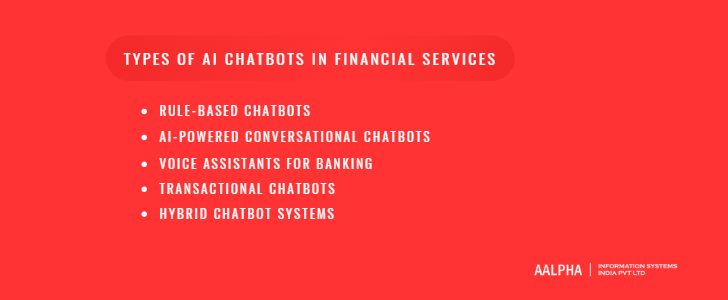
Below are the primary types of AI chatbots used in banking, fintech, insurance, and wealth management.
-
Rule-Based Chatbots
Rule-based chatbots operate on predefined logic and decision trees. They follow structured conversation paths where user inputs trigger specific responses based on keywords or menu selections. For example, a user selecting “Check balance” from a menu will be guided through a fixed flow to retrieve account information.
These chatbots are easy to implement and highly predictable, making them suitable for handling straightforward queries such as FAQs, branch information, or basic account services. They are also easier to audit and control, which can be beneficial in regulated financial environments.
However, rule-based systems have clear limitations. They cannot understand complex or ambiguous language and fail when users deviate from predefined paths. If a user asks a question in an unexpected way, the chatbot may not respond correctly or may escalate unnecessarily to a human agent.
As customer expectations evolve toward natural conversations, rule-based chatbots alone are no longer sufficient for delivering high-quality financial experiences. They are typically used as a foundational layer or for low-risk interactions.
-
AI-Powered Conversational Chatbots
AI-powered conversational chatbots represent the most advanced category in financial services. These systems use natural language processing (NLP), machine learning (ML), and increasingly large language models (LLMs) to understand user intent, context, and conversational nuances.
Unlike rule-based bots, AI chatbots can process unstructured queries such as “How much did I spend last month?” or “Should I invest in a fixed deposit or mutual fund?” They analyze intent, extract relevant entities, and generate context-aware responses. Over time, they improve through continuous learning from user interactions and data.
In financial environments, these chatbots are often integrated with backend systems to provide real-time data access. This allows them to deliver personalized responses, such as spending insights, investment suggestions, or loan eligibility checks.
LLM-based systems further enhance capabilities by enabling more natural, human-like conversations and handling multi-step queries without rigid flows. However, they must be carefully controlled to ensure accuracy, compliance, and explainability, especially when dealing with financial advice.
AI-powered chatbots are now central to digital banking strategies, as they combine scalability with intelligence, enabling institutions to deliver high-quality, personalized customer experiences.
-
Voice Assistants for Banking
Voice assistants extend chatbot functionality into spoken interactions, allowing users to perform banking tasks through voice commands. These systems are commonly integrated into mobile apps, smart devices, or IVR systems.
Traditional IVR systems relied on rigid menu navigation, but modern voice assistants use speech recognition and NLP to understand natural language. Users can ask questions like “What is my account balance?” or “Transfer ₹2,000 to my savings account,” and receive immediate responses.
Voice banking improves accessibility, especially for users who prefer hands-free interactions or have limited digital literacy. It also enhances convenience in scenarios where typing is not practical. As speech recognition technology improves, voice assistants are becoming a more integral part of financial service delivery.
-
Transactional Chatbots
Transactional chatbots are designed to execute financial actions directly within the conversation. Unlike informational bots that only provide answers, these systems can perform tasks such as fund transfers, bill payments, account updates, and service requests.
For example, a user can instruct the chatbot to “Pay my electricity bill” or “Transfer ₹5,000 to John,” and the chatbot will initiate and complete the transaction after appropriate authentication. These bots are tightly integrated with core banking systems, payment gateways, and security layers to ensure safe execution.
Security is a critical component of transactional chatbots. They typically use multi-factor authentication, OTP verification, and encryption to protect sensitive operations. Every action is logged for compliance and audit purposes.
By enabling users to complete tasks without navigating multiple interfaces, transactional chatbots significantly reduce friction and improve user experience. They also increase operational efficiency by automating processes that would otherwise require manual intervention.
-
Hybrid Chatbot Systems
Hybrid chatbot systems combine rule-based logic with AI-driven conversational capabilities. This approach allows financial institutions to maintain control over critical workflows while leveraging AI for flexibility and personalization.
In a hybrid model, structured processes such as KYC verification or transaction flows are handled using predefined rules to ensure accuracy and compliance. At the same time, AI components manage open-ended conversations, intent recognition, and personalized interactions.
This combination provides the best of both worlds. It ensures reliability in high-risk scenarios while allowing natural, human-like communication in less critical interactions. Hybrid systems are widely used in financial services because they balance innovation with regulatory requirements, making them a practical choice for enterprise-grade chatbot deployments.
Core Features of a Financial AI Chatbot
A financial AI chatbot must go beyond basic conversation capabilities to meet the demands of security, compliance, accuracy, and real-time execution. Unlike chatbots used in retail or entertainment, financial chatbots operate in a high-stakes environment where every interaction can involve sensitive data, regulatory obligations, and monetary transactions. As a result, their feature set must be carefully designed to ensure reliability, trust, and scalability.
The most effective financial chatbots combine strong authentication mechanisms, advanced natural language understanding, deep system integrations, and intelligent analytics. Each feature plays a specific role in delivering a seamless and secure user experience while enabling institutions to automate operations and reduce risk.
Below are the essential features that define a robust AI chatbot for financial services.
-
Secure Authentication and User Verification
Security is the foundation of any financial chatbot. Since users interact with sensitive financial data and perform transactions, the system must implement strong authentication and verification mechanisms at every stage.
Common methods include one-time passwords (OTP), biometric authentication such as fingerprint or facial recognition, and multi-factor authentication (MFA) that combines multiple verification layers. For example, a chatbot may allow users to check basic information after login but require OTP verification before executing a fund transfer.
Advanced systems also incorporate behavioral authentication, analyzing user patterns such as typing speed, device usage, and location to detect anomalies. This adds an additional layer of security without disrupting the user experience.
Secure authentication ensures that only authorized users can access accounts or perform actions, reducing the risk of fraud and unauthorized access. It also builds user confidence, which is critical in financial interactions where trust directly impacts adoption and engagement.
-
Natural Language Understanding (NLU)
Natural Language Understanding is the core intelligence layer of a financial chatbot. It enables the system to interpret user queries, identify intent, and extract relevant information from conversational input.
For instance, when a user asks, “How much did I spend on food last month?” the chatbot must recognize the intent as expense tracking, identify the category “food,” and determine the time frame “last month.” This requires accurate entity recognition and contextual interpretation.
Modern NLU systems use machine learning and deep learning models to handle variations in language, including slang, abbreviations, and multilingual input. They also maintain conversational context, allowing users to ask follow-up questions like “What about this month?” without repeating the full query.
In financial services, accuracy in understanding user intent is critical. Misinterpretation can lead to incorrect responses or actions, which can damage trust. Therefore, NLU systems must be rigorously trained and continuously improved using real-world data.
-
Account Management and Transaction Handling
A key capability of financial chatbots is the ability to manage accounts and execute transactions directly within the conversation. This transforms the chatbot from a support tool into a functional interface for banking operations.
Users can perform tasks such as checking account balances, viewing transaction history, transferring funds, paying bills, or updating account details. For example, a user might say, “Transfer ₹2,000 to my savings account,” and the chatbot will process the request after verifying authentication.
To ensure reliability, these actions must be tightly integrated with backend financial systems and include safeguards such as confirmation prompts and transaction validation. Each action should be logged for audit and compliance purposes.
By enabling conversational transactions, chatbots reduce the need for users to navigate complex interfaces, improving both efficiency and user satisfaction. This is particularly valuable in mobile-first markets where simplicity and speed are key factors in user adoption.
-
Integration with Core Banking Systems and APIs
A financial chatbot cannot function effectively in isolation. It must integrate seamlessly with core banking systems, payment gateways, customer relationship management (CRM) platforms, and third-party APIs.
These integrations allow the chatbot to access real-time data such as account balances, transaction records, loan details, and customer profiles. For example, when a user asks for their account balance, the chatbot retrieves this information directly from the bank’s core system rather than relying on static data.
Integration with APIs also enables additional capabilities such as payment processing, credit scoring, fraud detection, and external financial services. However, connecting to legacy banking systems can be complex due to outdated architectures and strict security requirements.
To address this, many institutions use middleware or API gateways to standardize communication between the chatbot and backend systems. This ensures scalability, reliability, and secure data exchange across all interactions.
-
AI-Driven Financial Insights and Recommendations
One of the most valuable features of an AI chatbot is its ability to provide intelligent financial insights based on user data. Instead of simply responding to queries, the chatbot can proactively guide users toward better financial decisions.
By analyzing transaction history, income patterns, and spending behavior, the chatbot can identify trends and generate personalized recommendations. For example, it may suggest reducing spending in certain categories, recommend savings plans, or highlight investment opportunities.
In wealth management, chatbots can provide portfolio summaries, risk assessments, and market insights tailored to individual users. In lending, they can evaluate eligibility and suggest suitable loan products.
These insights are delivered in a conversational format, making complex financial information easier to understand and act upon. This not only enhances user experience but also positions the chatbot as a trusted financial assistant rather than just a support tool.
-
Compliance and Regulatory Support
Financial services operate under strict regulatory frameworks, and chatbots must be designed to comply with these requirements. This includes maintaining detailed audit logs of all interactions, tracking user consent for data usage, and ensuring transparency in automated decisions.
For example, if a chatbot provides financial advice or executes a transaction, the system must record the interaction for compliance and dispute resolution. Consent mechanisms must also be in place when collecting or processing sensitive user data.
Additionally, chatbots must adhere to regulations such as KYC, AML, and data protection laws. This requires careful design of workflows, data handling practices, and security protocols.
Compliance features are not optional. They are essential for ensuring that the chatbot can operate legally and maintain trust with both users and regulatory authorities.
-
Omnichannel Support
Modern financial users interact across multiple platforms, and a chatbot must provide a consistent experience across all of them. Omnichannel support ensures that users can access the chatbot through web applications, mobile apps, messaging platforms like WhatsApp, and even SMS when needed.
For example, a user might start a conversation on a mobile app and continue it later on WhatsApp without losing context. This requires centralized conversation management and synchronization across channels.
Omnichannel capability increases accessibility and convenience, allowing users to interact with financial services in the way that suits them best. It also expands the reach of financial institutions, enabling them to serve diverse user segments, including those with limited access to traditional banking interfaces.
In a competitive digital landscape, providing seamless, cross-channel experiences is a key factor in user satisfaction and long-term engagement.
Step-by-Step Process to Build an AI Chatbot for Financial Services
Building an AI chatbot for financial services requires a structured, compliance-aware approach that balances automation, intelligence, and security. In many implementations, a chatbot development company may follow similar principles, but financial use cases demand stricter controls and deeper system integration. Unlike generic chatbot development, financial systems must handle sensitive data, execute transactions reliably, and meet strict regulatory standards. This means every stage, from planning to deployment, must be designed with precision.
A successful implementation is not just about choosing the right technology. It involves defining clear business goals, understanding user behavior, designing robust conversational flows, and integrating deeply with financial infrastructure. The following step-by-step process outlines how to build a production-ready financial AI chatbot that delivers measurable value.
-
Define Business Objectives and Use Cases
The first and most critical step is to clearly define what the chatbot is expected to achieve. Financial institutions often make the mistake of starting with technology rather than business outcomes, which leads to unclear scope and limited impact.
Begin by identifying the primary problem the chatbot will solve. Is the goal to reduce customer support costs, improve onboarding efficiency, provide financial advisory services, or automate transactions? Each objective requires a different design approach. For example, a support-focused chatbot will prioritize high query resolution rates, while an advisory chatbot must focus on accuracy and personalization.
Use cases should be clearly categorized into three main areas: customer support, transactional automation, and financial advisory. Customer support includes handling FAQs, account queries, and service requests. Transactional automation involves executing actions such as fund transfers or bill payments. Advisory use cases include budgeting assistance, investment guidance, and financial planning.
It is also important to define success metrics at this stage. These may include reduction in support costs, improvement in response time, increased customer satisfaction, or higher onboarding conversion rates. Clear KPIs ensure that the chatbot’s performance can be measured and optimized over time.
A well-defined objective acts as the foundation for all subsequent decisions, including technology selection, design, and integration.
-
Identify Target Users and Customer Journeys
Once objectives are defined, the next step is to understand who will use the chatbot and how they will interact with it. Financial services cater to diverse user segments, each with different needs, behaviors, and expectations.
Retail banking customers typically look for quick and simple interactions such as checking balances, paying bills, or resolving issues. Small and medium-sized businesses (SMEs) may require more complex functionalities such as transaction tracking, cash flow insights, and bulk payments. Investors and wealth management clients expect detailed insights, portfolio analysis, and personalized recommendations.
Mapping customer journeys is essential to designing an effective chatbot. This involves identifying key touchpoints where users interact with financial services, such as onboarding, daily transactions, issue resolution, and financial planning. For each journey, define the steps a user takes, the information they need, and the potential challenges they face.
For example, in a loan application journey, the chatbot should guide the user through eligibility checks, document submission, and application tracking. In a support journey, it should quickly identify the issue and provide resolution or escalation.
Understanding these journeys ensures that the chatbot is designed around real user needs rather than generic assumptions. It also helps prioritize features and optimize conversational flows for maximum efficiency and user satisfaction.
-
Choose the Right AI Technology Stack
Selecting the right technology stack is a crucial decision that determines the chatbot’s capabilities, scalability, and long-term viability. The stack typically consists of three main components: AI and NLP engines, backend infrastructure, and integration frameworks.
For natural language processing, organizations can choose between pre-built platforms such as Dialogflow, Azure AI, or custom frameworks like Rasa. Increasingly, large language models (LLMs) are being used to enhance conversational capabilities, enabling more natural and context-aware interactions. However, in financial services, LLMs must be carefully controlled using techniques such as prompt engineering, response validation, and guardrails to ensure accuracy and compliance.
The backend infrastructure should handle business logic, user authentication, and orchestration of workflows. This layer connects the chatbot to financial systems and ensures that actions such as transactions are executed securely and reliably.
Hosting and deployment options include cloud platforms such as AWS, Azure, or Google Cloud, which provide scalability, security, and compliance features. Many financial institutions prefer hybrid or private cloud environments to maintain control over sensitive data.
It is also important to consider monitoring tools, analytics platforms, and DevOps pipelines to support continuous improvement. The chosen technology stack should not only meet current requirements but also allow for future expansion as the chatbot evolves.
-
Design Conversational Flows and UX
Designing conversational flows is where the chatbot’s functionality is translated into user experience. A well-designed chatbot should feel intuitive, efficient, and reliable, guiding users through tasks without confusion.
Start by defining key intents, which represent the user’s goals, such as checking balance, making a payment, or applying for a loan. For each intent, design a conversation flow that includes prompts, responses, and actions. These flows should be structured yet flexible, allowing users to interact naturally rather than following rigid scripts.
User experience design must account for clarity and simplicity. Financial interactions can be complex, so the chatbot should break down tasks into manageable steps. For example, instead of asking for all details at once, it should guide users step by step through a transaction process.
Fallback handling is a critical component. When the chatbot cannot understand a query, it should respond gracefully, either by asking for clarification or escalating to a human agent. Poor fallback handling can lead to frustration and loss of trust.
Context management is another key aspect. The chatbot should remember previous interactions within a session, enabling users to ask follow-up questions without repeating information. This creates a more natural and seamless experience.
A well-designed conversational UX directly impacts user adoption and satisfaction, making it one of the most important stages in chatbot development.
-
Data Collection and Training the AI Model
The effectiveness of an AI chatbot depends heavily on the quality and quantity of data used for training. Financial chatbots require domain-specific data to accurately understand user queries and provide relevant responses.
Start by collecting historical chat logs, customer support transcripts, FAQs, and knowledge base articles. These datasets provide insights into common user queries and language patterns. Financial datasets such as transaction categories, product information, and regulatory guidelines can also be used to enhance the chatbot’s knowledge.
Data must be cleaned and structured before training. This includes removing duplicates, correcting errors, and labeling data with intents and entities. For example, phrases like “check my balance” and “what is my account balance” should be mapped to the same intent.
Training involves building models that can accurately classify intents and extract relevant information from user input. Continuous learning is essential, as new queries and scenarios emerge over time.
In financial services, data privacy is critical. Sensitive information must be anonymized and handled securely during training. Proper data governance ensures compliance with regulations while maintaining model performance.
-
Integrate with Financial Systems and APIs
Integration is what transforms a chatbot from a conversational interface into a functional financial tool. The chatbot must connect with core banking systems, payment gateways, CRM platforms, and other backend services to access real-time data and execute actions.
For example, when a user requests a balance check, the chatbot retrieves data from the core banking system. When initiating a payment, it interacts with payment gateways to process the transaction. CRM integration allows the chatbot to access customer profiles and interaction history.
Due to the complexity of legacy systems, many financial institutions use API layers or middleware to facilitate integration. This approach standardizes communication and ensures that the chatbot can interact with multiple systems securely and efficiently.
Security and reliability are critical in this stage. All API interactions must be encrypted, authenticated, and monitored to prevent unauthorized access or failures. Proper integration ensures that the chatbot delivers accurate, real-time responses and actions.
-
Implement Security, Compliance, and Data Privacy
Security and compliance are non-negotiable in financial chatbot development. The system must protect sensitive data, prevent unauthorized access, and adhere to regulatory requirements.
Encryption should be implemented for data both in transit and at rest. Multi-factor authentication ensures that only authorized users can perform critical actions. Access controls and role-based permissions further enhance security.
Compliance requirements vary by region but typically include regulations such as GDPR, PCI DSS, and local financial guidelines. The chatbot must ensure that user data is collected, stored, and processed in accordance with these regulations.
Consent management is also important. Users must be informed about how their data is used and provide explicit consent where required. Audit logs should be maintained for all interactions, enabling traceability and compliance reporting.
By embedding security and compliance into the system design, financial institutions can minimize risk and build trust with users.
-
Testing and Validation
Before deployment, the chatbot must undergo rigorous testing to ensure accuracy, reliability, and security. Testing should cover multiple scenarios, including common queries, edge cases, and high-risk financial operations.
Accuracy testing evaluates how well the chatbot understands user intent and provides correct responses. Performance testing ensures that the system can handle high volumes of concurrent interactions without delays.
Edge case testing is particularly important in financial services. The chatbot must handle ambiguous queries, incomplete inputs, and unexpected user behavior without failing. Security testing should also be conducted to identify vulnerabilities and ensure data protection.
User acceptance testing (UAT) involves real users interacting with the chatbot to identify usability issues and areas for improvement. Feedback from this stage is critical for refining the system before launch.
-
Deployment and Continuous Improvement
Deployment is not the end of the development process. Financial chatbots require continuous monitoring and optimization to maintain performance and relevance.
After deployment, track key metrics such as response accuracy, user satisfaction, resolution rates, and system performance. Analytics tools can provide insights into user behavior and identify areas for improvement.
Continuous learning is essential. As new queries and scenarios emerge, the chatbot must be retrained and updated to improve accuracy. Regular updates also ensure compliance with changing regulations and evolving business requirements.
Scalability should be planned from the beginning. As user adoption grows, the system must handle increased load without compromising performance.
By treating the chatbot as an evolving system rather than a one-time project, financial institutions can maximize its value and ensure long-term success.
Technology Stack for Financial Chatbot Development
The technology stack of a financial AI chatbot determines its performance, scalability, security, and ability to integrate with complex financial ecosystems. Unlike generic chatbot systems, financial chatbots must operate within strict regulatory environments while handling sensitive data and real-time transactions. This requires a carefully selected combination of frontend interfaces, backend systems, AI engines, secure data infrastructure, and cloud deployment strategies.
A well-designed stack ensures that the chatbot can deliver fast, accurate, and secure interactions across multiple channels while supporting continuous updates and scaling. Each layer plays a distinct role, and the overall architecture must be cohesive to support both current use cases and future expansion.
-
Frontend Interfaces
Frontend interfaces define how users interact with the chatbot across different platforms. In financial services, users expect seamless access through web applications, mobile apps, and messaging platforms such as WhatsApp or SMS.
Web-based chat interfaces are commonly integrated into online banking portals, allowing users to access support and services without leaving the platform. Mobile applications provide a more personalized and secure environment, often integrating biometric authentication and push notifications for real-time updates.
Messaging platforms are increasingly important, especially in markets where users prefer conversational interfaces over traditional apps. For example, WhatsApp-based chatbots enable users to perform financial tasks directly within a familiar environment, reducing friction and improving adoption.
A key requirement for frontend interfaces is consistency. Users should experience the same functionality and context across all channels. This requires unified session management and synchronized conversation history, ensuring that interactions remain seamless regardless of the platform being used.
-
Backend Infrastructure
The backend infrastructure acts as the central control layer of the chatbot system. It manages business logic, orchestrates workflows, handles authentication, and connects the chatbot to financial systems and external services.
This layer processes user requests received from the frontend, determines the appropriate action, and coordinates with various components such as AI engines, databases, and APIs. For example, when a user initiates a fund transfer, the backend validates the request, triggers authentication, interacts with payment systems, and returns the result to the user.
Scalability and reliability are critical considerations. Financial chatbots must handle high volumes of concurrent interactions without latency or downtime. This is typically achieved through microservices architecture, load balancing, and distributed systems.
The backend also plays a key role in maintaining security. It enforces access controls, manages session data, and ensures that all interactions are logged for audit purposes. A robust backend infrastructure ensures that the chatbot operates efficiently while maintaining compliance and data integrity.
-
AI and NLP Engines
AI and NLP engines are the core intelligence layer of a financial chatbot. These components enable the system to understand user input, identify intent, and generate accurate, context-aware responses.
Platforms such as Dialogflow and Azure AI provide pre-built NLP capabilities that can be quickly deployed and customized. OpenAI-based models and other large language models offer advanced conversational abilities, enabling more natural and flexible interactions. Frameworks like Rasa allow organizations to build custom AI models with greater control over data and behavior.
The choice of AI engine depends on factors such as required accuracy, customization needs, data privacy requirements, and scalability. In financial services, it is common to combine multiple approaches, using LLMs for natural conversation and rule-based or deterministic systems for critical workflows.
To ensure reliability, AI outputs must be validated before execution, especially for transactions or financial advice. This often involves adding guardrails, confidence scoring, and fallback mechanisms to prevent incorrect or unsafe responses.
A well-implemented AI layer enhances user experience while maintaining the precision required in financial operations.
-
Database and Data Security
Financial chatbots rely on secure and efficient data storage systems to manage user information, transaction records, conversation history, and operational logs. Databases must be designed to handle large volumes of data while ensuring fast retrieval and high availability.
Relational databases are commonly used for structured financial data such as account details and transactions, while NoSQL databases may be used for storing conversational data and logs. Regardless of the type, all data must be encrypted both at rest and in transit.
Data security is a top priority. Sensitive information such as account numbers, personal details, and transaction data must be protected using strong encryption standards, tokenization, and access control mechanisms. Role-based access ensures that only authorized systems or personnel can access specific data.
Compliance requirements also influence database design. Financial institutions must implement data retention policies, audit trails, and anonymization techniques to meet regulatory standards. Proper data governance ensures that the chatbot can operate securely while maintaining compliance with financial regulations.
-
Cloud and DevOps
Cloud infrastructure provides the scalability and flexibility required for financial chatbot deployment. Platforms such as AWS and Azure offer secure environments with built-in compliance features, making them suitable for handling sensitive financial applications.
Cloud services enable dynamic scaling, allowing the chatbot to handle varying workloads without performance degradation. They also provide tools for monitoring, logging, and analytics, which are essential for maintaining system performance and reliability.
DevOps practices play a critical role in ensuring continuous development and deployment. CI/CD pipelines automate the process of testing, deploying, and updating the chatbot, reducing the risk of errors and downtime. This is particularly important in financial services, where updates must be carefully managed to avoid disruptions.
By combining cloud infrastructure with strong DevOps practices, organizations can build a resilient and scalable chatbot system that evolves continuously while maintaining high standards of security and performance.
Challenges in Building Financial AI Chatbots
While AI chatbots offer significant advantages in financial services, their implementation is complex and comes with a unique set of challenges. Unlike general-purpose chatbots, financial systems must operate in a highly regulated, security-sensitive, and trust-driven environment. Any failure in accuracy, security, or compliance can lead to financial loss, reputational damage, and legal consequences.
Organizations must address technical, operational, and user-centric challenges to ensure successful deployment. Understanding these challenges early allows businesses to design more resilient systems and avoid costly mistakes during development and scaling.
-
Data Security and Privacy Risks
Financial chatbots handle some of the most sensitive user data, including account details, transaction history, personal identification information, and behavioral patterns. This makes them a prime target for cyberattacks and data breaches. Ensuring data security is therefore one of the most critical challenges in chatbot development.
Data must be protected at every stage, from user input to backend processing and storage. Encryption is essential for safeguarding data both in transit and at rest. However, encryption alone is not sufficient. Access control mechanisms must be implemented to ensure that only authorized systems and personnel can access sensitive information.
Another challenge is managing data privacy in compliance with regulations such as GDPR and other regional data protection laws. Users must be informed about how their data is collected, processed, and stored. Consent management becomes a critical component, especially when chatbots analyze user behavior to provide personalized recommendations.
Additionally, AI models trained on financial data must be carefully handled to prevent unintended data exposure. Improper training practices can lead to leakage of sensitive information through responses. To mitigate this, organizations must adopt strict data governance policies, anonymization techniques, and secure model training environments.
-
Integration with Legacy Systems
Many financial institutions operate on legacy systems that were not designed for modern, API-driven architectures. Integrating AI chatbots with these systems is often one of the most technically challenging aspects of development.
Legacy systems may lack standardized APIs, have outdated data formats, or impose strict access limitations. This makes real-time data retrieval and transaction execution difficult. For example, retrieving account balances or processing payments may require complex middleware layers to bridge the gap between modern chatbot interfaces and older backend systems.
Integration challenges also impact scalability. As chatbot usage grows, legacy systems may struggle to handle increased load, leading to performance bottlenecks. To address this, organizations often implement API gateways or microservices layers that abstract the complexity of legacy infrastructure.
However, building and maintaining these integration layers requires significant effort and expertise. Without proper planning, integration issues can delay deployment and limit the chatbot’s functionality.
-
Accuracy and Trust Issues
Accuracy is critical in financial services, where even minor errors can have serious consequences. A chatbot that provides incorrect account information, misinterprets a transaction request, or gives inaccurate financial advice can quickly erode user trust.
AI models, especially those based on natural language processing, are not inherently perfect. They may misinterpret user intent, struggle with ambiguous queries, or generate responses that are contextually incorrect. In financial scenarios, such errors are unacceptable.
Trust is closely linked to transparency and reliability. Users must feel confident that the chatbot is providing accurate and secure information. This is particularly important when chatbots offer financial recommendations or advisory services. Incorrect advice can lead to financial losses and potential legal liabilities.
To address these challenges, organizations must implement validation layers, confidence scoring, and fallback mechanisms. Critical actions should require user confirmation, and complex queries should be escalated to human agents when necessary. Continuous monitoring and model improvement are also essential to maintain accuracy over time.
-
Regulatory Compliance Complexity
Financial services are governed by a complex web of regulations that vary across regions and jurisdictions. Building a chatbot that complies with these regulations is a significant challenge, especially for organizations operating in multiple markets.
Regulations such as KYC, AML, GDPR, and PCI DSS impose strict requirements on data handling, user verification, and transaction processing. Chatbots must be designed to adhere to these rules, which often requires additional layers of validation, logging, and reporting.
Compliance is not static. Regulations evolve over time, requiring continuous updates to the chatbot’s functionality and data handling practices. For example, changes in data protection laws may require modifications in how user data is stored or processed.
Another challenge is ensuring auditability. Financial institutions must maintain detailed records of all interactions and transactions handled by the chatbot. This requires robust logging systems and the ability to trace decisions made by AI models.
Failure to comply with regulations can result in heavy penalties and reputational damage, making compliance a top priority in chatbot development.
-
User Adoption Barriers
Even the most advanced chatbot will fail if users do not trust or understand it. User adoption remains a key challenge, particularly in financial services where trust plays a central role.
Many users are hesitant to rely on AI for financial interactions, especially when it involves transactions or sensitive data. Concerns about security, accuracy, and privacy can limit adoption. Additionally, users with low digital literacy may find chatbot interfaces difficult to navigate.
Usability is another factor. If the chatbot is not intuitive or fails to handle queries effectively, users will quickly revert to traditional support channels. Poor user experience can negate the benefits of automation.
To overcome these barriers, financial institutions must focus on building trust through transparency, reliability, and clear communication. Providing options to escalate to human support, offering guided interactions, and educating users about the chatbot’s capabilities can significantly improve adoption rates.
Cost of Building an AI Chatbot for Financial Services
The cost of building an AI chatbot for financial services varies significantly depending on the level of complexity, required features, security standards, and integration depth. Unlike generic chatbots, financial chatbots must comply with strict regulatory requirements, handle sensitive data securely, and integrate with core financial systems. These factors increase both initial development costs and long-term operational expenses.
Organizations must evaluate costs not just from a development perspective, but also in terms of scalability, compliance, and continuous improvement. A well-planned investment can lead to substantial cost savings through automation and efficiency, but underestimating the true cost can result in incomplete or non-compliant systems.
-
Cost Based on Complexity and Features
The overall cost of a financial chatbot is largely determined by its complexity and feature set. At a basic level, a chatbot designed for handling FAQs and simple customer support queries can be relatively inexpensive. These bots typically use rule-based logic or limited NLP capabilities and require minimal integration with backend systems. Development costs for such systems are lower because they do not involve complex workflows, real-time data processing, or advanced security mechanisms.
However, as functionality increases, costs rise significantly. A mid-level chatbot that includes features such as account inquiries, basic transaction handling, and integration with financial APIs requires more sophisticated backend development and security implementation. This includes authentication mechanisms, real-time data access, and compliance features, all of which add to development complexity.
Advanced AI chatbots represent the highest cost category. These systems use machine learning and large language models to provide personalized financial insights, support complex transactions, and handle multi-step conversations. They also require deep integration with core banking systems, advanced security layers, and compliance frameworks. Additional features such as fraud detection, predictive analytics, and omnichannel support further increase costs.
In financial services, it is common for enterprise-grade chatbot projects to involve significant investment due to the need for high reliability, scalability, and regulatory compliance. The more critical the use case, such as transaction execution or financial advisory, the higher the cost of development and validation.
-
Development vs Subscription Models
Organizations typically choose between building a custom chatbot or using a subscription-based (SaaS) solution. Each approach has different cost implications and trade-offs.
Custom development involves building the chatbot from scratch or using flexible frameworks tailored to specific business requirements. This approach provides full control over features, data handling, security, and integration. It is particularly suitable for financial institutions that require deep customization, strict compliance, and seamless integration with internal systems. However, custom development comes with higher upfront costs, longer development timelines, and the need for ongoing technical expertise.
Subscription-based models, on the other hand, offer ready-to-use chatbot platforms with pre-built features and integrations. These solutions typically charge monthly or usage-based fees, making them more accessible for startups and smaller fintech companies. SaaS platforms reduce development time and initial investment, allowing organizations to deploy chatbots quickly.
However, subscription models have limitations. They may not offer the level of customization required for complex financial workflows, and data control can be a concern in highly regulated environments. Over time, subscription costs can also accumulate, especially as usage scales.
The choice between custom and SaaS depends on factors such as business size, regulatory requirements, and long-term scalability goals.
-
Ongoing Maintenance and Scaling Costs
Building a chatbot is only the beginning. Ongoing maintenance and scaling represent a significant portion of the total cost over time. Financial chatbots require continuous updates to maintain accuracy, security, and compliance.
One major cost factor is AI model retraining. As user behavior evolves and new queries emerge, the chatbot must be updated with fresh data to improve its performance. This involves data collection, labeling, and model optimization, which require both technical resources and domain expertise.
Infrastructure costs also increase as the chatbot scales. Cloud hosting, data storage, and API usage fees grow with the number of users and interactions. High availability and low latency are critical in financial services, often requiring investment in robust and redundant infrastructure.
Compliance updates are another ongoing expense. Financial regulations change frequently, and the chatbot must be updated to reflect new requirements. This may involve modifying workflows, updating data handling practices, and conducting regular audits.
Additionally, monitoring and support costs must be considered. Analytics tools, performance monitoring, and human oversight are necessary to ensure that the chatbot operates reliably and continues to deliver value.
In practice, organizations should view chatbot development as a long-term investment rather than a one-time cost. Proper planning for maintenance and scaling ensures that the system remains effective, secure, and compliant as it grows.
How to Choose the Right Development Partner
Selecting the right AI development partner is one of the most critical decisions when building an AI chatbot for financial services. Unlike general software projects, financial chatbot development requires a combination of domain expertise, advanced AI capabilities, strict security standards, and long-term scalability planning. The wrong partner can lead to delays, compliance risks, and systems that fail to deliver business value.
A reliable development partner should not only understand technology but also the complexities of financial workflows, regulatory environments, and user expectations. Below are the key factors decision-makers should evaluate before choosing a partner.
-
Experience in Fintech and Financial Systems
Domain expertise is essential in financial chatbot development. A partner with experience in fintech, banking, insurance, or wealth management will have a deeper understanding of industry-specific requirements such as KYC processes, transaction workflows, risk management, and compliance obligations.
For example, building a chatbot for retail banking involves handling sensitive operations like balance inquiries and fund transfers, while an insurance chatbot must manage claims processing and policy tracking. Each domain has unique workflows that require specialized knowledge.
An experienced partner will also be familiar with integrating chatbots into complex financial ecosystems, including core banking systems, payment gateways, and CRM platforms. This reduces the risk of implementation errors and ensures smoother deployment.
When evaluating partners, review their past projects, case studies, and client testimonials. Look for evidence of successful implementations in financial services, as this demonstrates their ability to handle industry-specific challenges effectively.
-
AI and Machine Learning Capabilities
A strong development partner must have deep expertise in AI and machine learning, particularly in natural language processing and conversational AI. Financial chatbots require high accuracy in understanding user intent and delivering context-aware responses, which can only be achieved through well-designed AI models.
Evaluate whether the partner has experience working with modern AI technologies, including large language models, custom NLP pipelines, and model optimization techniques. They should be capable of designing systems that balance flexibility with control, ensuring that AI-generated responses remain accurate and compliant.
In addition, the partner should understand how to train and fine-tune models using domain-specific data. Financial datasets are unique, and generic models often require customization to handle industry terminology and user behavior effectively.
Scalability is another important factor. The AI system should be designed to handle increasing volumes of interactions without compromising performance. A partner with strong AI capabilities will ensure that the chatbot evolves over time, improving accuracy and expanding its functionality.
-
Security and Compliance Expertise
Security and compliance are non-negotiable in financial applications. A development partner must have a proven track record of building secure systems that meet regulatory requirements.
This includes implementing encryption for data in transit and at rest, designing robust authentication mechanisms such as multi-factor authentication, and ensuring secure API integrations. The partner should also be familiar with compliance standards such as GDPR, PCI DSS, and local financial regulations.
Another critical aspect is auditability. Financial chatbots must maintain detailed logs of all interactions and transactions to support compliance and dispute resolution. The development partner should design systems that provide full traceability and transparency.
Failure to meet security and compliance requirements can result in severe financial and reputational consequences. Therefore, organizations must prioritize partners who demonstrate strong expertise in these areas and follow industry best practices.
-
Transparent Development Process
A transparent development process is essential for ensuring project success. The partner should follow structured methodologies such as Agile, providing regular updates, clear milestones, and continuous feedback loops.
Open communication is critical. Stakeholders should have visibility into progress, challenges, and upcoming deliverables. This reduces the risk of misalignment and ensures that the final product meets business expectations.
A transparent process also includes proper documentation, testing protocols, and quality assurance practices. This ensures that the chatbot is built systematically and can be maintained or scaled efficiently in the future.
-
Post-Launch Support and Optimization
Building the chatbot is only the beginning. Continuous support and optimization are necessary to maintain performance, accuracy, and compliance over time.
A reliable partner should offer post-launch services such as monitoring, performance analysis, model retraining, and feature enhancements. As user behavior evolves and new requirements emerge, the chatbot must be updated to remain effective.
Ongoing support also includes handling technical issues, scaling infrastructure, and ensuring compliance with changing regulations. Without proper maintenance, even a well-built chatbot can become outdated or ineffective.
Organizations should look for partners who offer long-term collaboration rather than one-time delivery. Experienced firms, including established providers like Aalpha, typically position themselves as strategic technology partners, helping businesses continuously improve and scale their AI solutions over time.
Future Trends in AI Chatbots for Financial Services
AI chatbots in financial services are evolving from simple conversational tools into intelligent, decision-support systems that actively participate in financial management. As advancements in artificial intelligence accelerate, chatbots are becoming more proactive, context-aware, and capable of handling complex financial workflows with minimal human intervention.
The next phase of innovation is driven by generative AI, multimodal interfaces, predictive analytics, and autonomous agents. These developments are not only improving customer experience but also redefining how financial institutions deliver services, manage risk, and scale operations. Understanding these trends is essential for organizations looking to build future-ready financial chatbot systems.
-
Generative AI in Financial Advisory
Generative AI is transforming financial chatbots from reactive systems into intelligent advisory tools. Instead of simply responding to queries, chatbots can now generate personalized financial guidance based on user data, market conditions, and behavioral patterns.
For example, a chatbot can analyze a user’s income, spending habits, and financial goals to recommend savings strategies or investment options. It can also explain complex financial concepts in simple terms, making advisory services more accessible to a broader audience.
In wealth management, generative AI enables chatbots to provide portfolio insights, risk assessments, and scenario-based recommendations. However, these systems must be carefully designed with validation layers to ensure accuracy and compliance, as financial advice carries significant responsibility.
As generative AI continues to improve, it will play a central role in democratizing financial advisory services, making them more personalized, scalable, and cost-effective.
-
Voice and Multimodal Banking Interfaces
The future of financial chatbots extends beyond text-based interactions into voice and multimodal interfaces. Users increasingly expect to interact with financial services using voice commands, visual elements, and even gestures across different devices.
Voice-enabled banking allows users to perform tasks such as checking balances, making payments, or receiving updates through natural speech. This enhances accessibility, particularly for users who prefer hands-free interactions or have limited digital literacy.
Multimodal interfaces combine text, voice, and visual components to create richer user experiences. For example, a chatbot might provide a spoken response while displaying charts or transaction summaries on a mobile screen. This approach improves clarity and engagement, especially when dealing with complex financial information.
As technology advances, multimodal interactions will become standard, enabling more intuitive and seamless communication between users and financial systems.
-
Hyper-Personalization Using AI
Hyper-personalization represents a significant shift in how financial services are delivered. Instead of offering generic solutions, AI chatbots will use predictive analytics to anticipate user needs and provide highly tailored recommendations.
By analyzing large volumes of data, including transaction history, spending behavior, and external factors, chatbots can identify patterns and predict future financial actions. For instance, a chatbot might detect recurring expenses and suggest optimized budgeting strategies or recommend investment opportunities aligned with the user’s risk profile.
This level of personalization extends to proactive engagement. Chatbots can send timely reminders, alerts, and insights based on predicted user behavior, helping users make better financial decisions before issues arise.
Hyper-personalization not only improves user experience but also increases customer retention and lifetime value. As competition in financial services intensifies, the ability to deliver highly relevant, data-driven interactions will become a key differentiator.
-
Autonomous Financial Agents
Autonomous financial agents represent the next evolution of AI chatbots. These systems go beyond providing information and recommendations by independently executing tasks on behalf of users, within predefined rules and permissions.
For example, an autonomous agent could automatically pay bills, transfer funds to savings accounts, or rebalance investment portfolios based on user-defined goals. It can also monitor financial activity continuously and take corrective actions, such as blocking suspicious transactions or adjusting spending limits.
These agents rely on advanced AI models, real-time data integration, and strict control mechanisms to ensure safe and reliable operation. User consent and transparency are critical, as users must have full visibility and control over automated actions.
As trust in AI systems grows and regulatory frameworks evolve, autonomous financial agents are expected to become a core component of digital financial ecosystems, enabling a more efficient and proactive approach to financial management.
Conclusion
AI chatbots are rapidly becoming a core component of modern financial services, enabling institutions to deliver faster support, automate operations, and provide personalized financial experiences at scale. From onboarding and transactions to advisory and fraud detection, these systems are transforming how users interact with financial platforms.
However, success depends on building the chatbot with the right strategy, technology, and compliance framework. Organizations that invest in well-designed, secure, and scalable chatbot solutions will gain a strong competitive advantage in an increasingly digital-first financial landscape.
If you are planning to build an AI chatbot for your financial platform, now is the right time to take action. Work with experienced development partners who understand both AI and financial systems to ensure a secure, compliant, and high-performing solution.
Contact Aalpha today to discuss your requirements and build a customized AI chatbot tailored to your business goals.