






Automotive dealerships today operate in an increasingly complex and competitive environment where managing inventory, customer relationships, sales processes, service operations, and financial transactions requires precision and coordination. Relying on manual systems or disconnected tools often leads to inefficiencies, delayed decision-making, and inconsistent customer experiences. As dealership networks expand across locations and product lines, maintaining operational visibility becomes even more challenging.
Automotive Dealer Management Software (DMS) addresses this challenge by bringing all dealership functions into a single, unified platform. It enables dealerships to manage vehicle inventory, track customer interactions, streamline sales workflows, coordinate service operations, and monitor financial activities through structured digital processes. By centralizing these functions, a DMS helps eliminate operational silos and improves collaboration between departments.
The shift toward digital-first dealership operations has made such systems essential rather than optional. Customers expect faster purchase cycles, seamless service scheduling, and transparent communication throughout their ownership journey. At the same time, dealership leadership requires real-time insights to manage performance and profitability effectively.
What is Automotive Dealer Management Software?
Automotive Dealer Management Software (DMS) is a centralized digital platform that enables automobile dealerships to manage their entire business operations from a single system. It connects sales, inventory, customer relationships, service operations, finance processes, and reporting into one integrated environment. Instead of running multiple disconnected tools for managing vehicles, customers, service jobs, and financial transactions, a DMS creates a unified operational backbone for dealership networks.
At its core, a dealer management system helps dealerships run day-to-day operations efficiently while maintaining visibility across departments. Sales teams use it to manage leads and vehicle purchases. Service departments rely on it to schedule maintenance and repairs. Finance teams use it to process payments and insurance details. Management uses it to monitor performance and profitability. This unified approach eliminates manual coordination and fragmented workflows, which traditionally slow down dealership operations.
Automotive DMS platforms are used by a wide range of stakeholders across the automotive ecosystem. Independent dealerships rely on them to manage inventory and customer interactions. Multi-location dealership groups use them to synchronize operations across branches. OEM-authorized dealer networks depend on them to maintain compliance with manufacturer workflows and reporting standards. Used car dealerships also leverage DMS platforms to manage sourcing, pricing, and resale cycles. In large networks, these systems act as the operational bridge between manufacturers, distributors, and retail outlets.
The primary purpose of dealer management software is to solve operational inefficiencies that arise when dealerships grow in scale and complexity. Managing vehicle inventory manually leads to stock mismatches and lost sales opportunities. Handling customer data across spreadsheets results in poor follow-ups and reduced retention. Service scheduling without automation causes delays and workshop underutilization. Financial tracking across disconnected tools creates reconciliation challenges. A DMS eliminates these problems by creating structured workflows, improving coordination between teams, and enabling real-time decision-making.
Modern automotive dealerships operate in an environment that demands speed, transparency, and customer-centric service. Buyers expect instant availability checks, quick financing approvals, and seamless service experiences. Workshop operations require precise scheduling and spare parts management. Management teams need performance insights to maintain profitability in a competitive market. Without a centralized system, meeting these expectations becomes operationally difficult.
This is why dealer management software has shifted from being a convenience to becoming a necessity. As dealerships expand into multi-channel sales, digital service bookings, and data-driven marketing, manual systems cannot support operational demands. A DMS provides the infrastructure needed to manage complexity while improving customer satisfaction and operational efficiency.
In simple terms, automotive dealer management software acts as the digital command center of a dealership, enabling it to function as a coordinated, scalable, and data-driven business rather than a collection of isolated processes.
Core Modules of Automotive Dealer Management Software
A modern Automotive Dealer Management Software platform is built around a set of operational modules that collectively support every function within a dealership. These modules form the functional backbone of the system and allow dealerships to manage sales, service, inventory, customer relationships, and financial transactions through a unified workflow. Understanding these core modules is essential for visualizing how the system operates in real-world dealership environments.
-
Inventory Management
Inventory management is one of the most critical components of a DMS. It enables dealerships to track vehicle stock across multiple locations in real time, ensuring visibility into available units, incoming shipments, and sold inventory. VIN-level management allows each vehicle to be uniquely identified and monitored throughout its lifecycle, from procurement to delivery. The system also differentiates between new and used vehicles, allowing dealerships to apply separate pricing strategies, depreciation tracking, and resale management. This structured visibility reduces overstocking, prevents stockouts, and helps align procurement decisions with demand trends.
-
Sales Management
Sales management within a DMS streamlines the entire vehicle sales process from initial inquiry to final purchase. Lead tracking allows dealerships to capture and monitor potential buyers across digital and physical channels. Quotation management helps sales teams generate structured pricing proposals, including discounts, add-ons, and financing options. Test drive scheduling ensures that prospects are managed efficiently without operational conflicts. The sales pipeline visibility provided by the system enables management to track deal progression, forecast revenue, and identify bottlenecks in the conversion journey. This module brings structure to a process that is traditionally managed through manual coordination.
-
Service and Workshop Management
The service module supports after-sales operations by organizing maintenance and repair workflows. Job cards allow service teams to document vehicle issues, repair instructions, and work status in a structured manner. Service scheduling ensures optimal workshop utilization by allocating time slots based on technician availability and workload. Technician allocation helps match skill sets with repair requirements, improving service efficiency and turnaround time. The system also tracks spare parts consumption during servicing, ensuring accurate billing and inventory updates. This module improves workshop productivity while maintaining service quality.
-
Finance and Insurance (F&I)
Finance and insurance management is essential for handling the financial aspects of vehicle sales. A DMS supports loan processing by integrating financing workflows into the sales journey, allowing dealerships to manage approvals and disbursements efficiently. Insurance integrations enable dealerships to offer coverage options at the point of sale, creating additional revenue streams. Payment tracking ensures that deposits, installments, and final payments are recorded accurately. This module connects financial processes directly with sales operations, reducing administrative overhead and improving transaction transparency.
-
Parts Management
Parts management focuses on the procurement, storage, and distribution of spare parts required for service operations. The system helps dealerships track stock movement across locations and maintain optimal inventory levels. Supplier integration allows procurement teams to manage orders, delivery timelines, and pricing agreements effectively. By synchronizing parts availability with service requirements, this module reduces delays in repairs and enhances customer satisfaction.
-
Customer Management
Customer management provides a comprehensive view of the ownership lifecycle, from initial inquiry to post-sale service interactions. The system maintains detailed customer profiles that include purchase history, service records, and communication logs. This historical data allows dealerships to personalize interactions and manage follow-ups more effectively. Tracking communication history across calls, messages, and service interactions ensures continuity in customer engagement. Over time, this module supports retention strategies by enabling proactive service reminders, upgrade offers, and loyalty initiatives.
Together, these core modules create an integrated operational framework that allows dealerships to function with greater coordination, efficiency, and transparency. Rather than operating through isolated processes, each department works within a connected system that supports both day-to-day execution and long-term growth.
Business Benefits of Automotive Dealer Management Software
-
Faster Sales Cycle
Automotive Dealer Management Software streamlines the vehicle sales journey by connecting leads, inventory availability, pricing, and financing workflows within a single system. Sales teams gain immediate visibility into stock status, customer preferences, and deal progress, eliminating delays caused by manual coordination between departments. This structured process reduces the time required to convert inquiries into confirmed purchases and improves overall sales efficiency.
-
Improved Service Efficiency
Service departments operate more effectively when scheduling, technician allocation, and parts usage are managed through an integrated platform. A DMS helps organize workshop operations by aligning service requests with available resources. This improves turnaround time, reduces operational bottlenecks, and ensures that vehicles are serviced within expected timelines, enhancing customer satisfaction.
-
Reduced Inventory Holding Costs
Maintaining optimal inventory levels is essential for dealership profitability. A DMS provides real-time insights into vehicle movement, demand trends, and stock availability. By aligning procurement decisions with actual sales patterns, dealerships avoid overstocking slow-moving vehicles while ensuring that high-demand models remain available. This improves inventory turnover and reduces capital tied up in unsold stock.
-
Better Customer Retention
Customer management features within a DMS help dealerships maintain consistent engagement throughout the ownership lifecycle. By tracking purchase history, service visits, and communication records, the system enables timely follow-ups and personalized interactions. This structured engagement strengthens customer relationships and increases the likelihood of repeat business.
-
Data-Driven Decisions
Consolidated reporting across sales, service, inventory, and finance functions provides dealership leadership with actionable insights. Instead of relying on fragmented information, decision-makers can evaluate performance trends, identify operational gaps, and plan strategically. This data-backed approach supports informed decision-making and long-term business growth.
Together, these benefits demonstrate how Automotive Dealer Management Software contributes directly to dealership performance by improving efficiency, reducing costs, and supporting customer-centric operations.
Types of Automotive Dealer Management Software
-
OEM-Specific DMS
OEM-specific Dealer Management Systems are designed for dealerships operating under manufacturer-authorized networks. These platforms align closely with the operational standards, reporting formats, and compliance requirements set by automotive manufacturers. They support standardized workflows such as warranty management, inventory synchronization, and performance reporting. This makes them particularly suitable for dealerships that must maintain structured alignment with OEM processes.
-
Multi-Brand Dealership DMS
Multi-brand dealership platforms are built for businesses that manage vehicles from multiple manufacturers. These systems offer flexibility in handling different pricing models, inventory structures, and service workflows within the same environment. Dealership groups operating across diverse product lines benefit from the adaptability provided by this type of system.
-
Independent Dealer Platforms
Independent dealerships that operate outside manufacturer networks require systems that support greater operational autonomy. These platforms focus on sourcing, resale, and service management without strict OEM constraints. They are particularly useful for used vehicle dealerships or mixed inventory businesses that rely on dynamic pricing and flexible procurement strategies.
-
Cloud-Native vs Legacy Systems
Automotive DMS platforms can also be categorized based on deployment architecture. Cloud-native systems operate entirely in a cloud environment, providing remote accessibility, automatic updates, and scalability across locations. Legacy systems are typically installed on-premise and rely on localized infrastructure. While legacy deployments offer control over internal environments, cloud-native platforms are better suited for distributed operations and evolving dealership needs.
-
Modular vs Full-Suite Platforms
Some dealerships prefer modular systems that allow them to implement specific components such as sales, service, or inventory management independently. Others opt for full-suite platforms that integrate all operational functions within a single environment. Modular platforms support phased adoption, while full-suite systems provide comprehensive operational transformation.
Understanding these variations helps dealerships align their DMS architecture with operational structure, scalability requirements, and long-term business objectives before initiating development.
Step-by-Step Development Process of Automotive Dealer Management Software
-
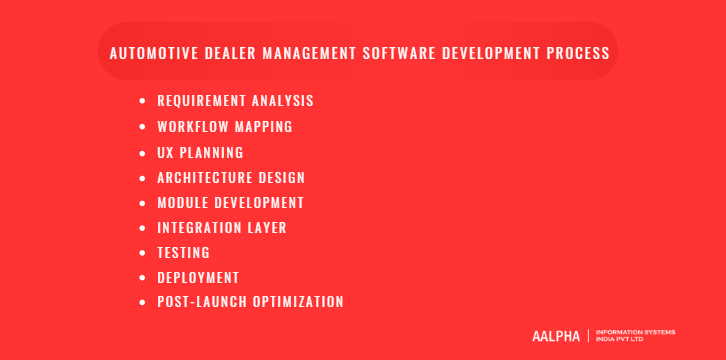
Requirement Analysis
The development of Automotive Dealer Management Software begins with a detailed analysis of dealership operations. This stage focuses on identifying how sales, service, inventory, finance, and customer engagement functions currently operate and where inefficiencies exist. Inputs from sales teams, service managers, finance staff, and leadership help define system expectations. The objective is to ensure that the platform supports real dealership workflows rather than introducing rigid structures that disrupt daily operations.
-
Workflow Mapping
After gathering requirements, dealership processes are translated into structured digital workflows. Vehicle procurement, sales cycles, service scheduling, parts consumption, and payment processing are mapped to understand how tasks move across departments. This step ensures that operational dependencies are reflected within the system, allowing teams to function in a coordinated environment.
-
UX Planning
Since multiple roles interact with a DMS daily, usability is a critical consideration. UX planning focuses on designing task-specific interfaces for sales executives, workshop teams, and finance departments. Clear dashboards, simplified task flows, and role-based views improve system adoption and reduce operational friction.
-
Architecture Design
Architecture design establishes the structural foundation of the platform. It defines how modules interact, how data flows across departments, and how the system supports multi-location operations. A well-defined architecture ensures that the platform can scale as dealership networks grow and operational complexity increases.
-
Module Development
With the architecture in place, core modules are developed based on dealership workflows. These typically include inventory management, sales tracking, service operations, finance handling, and customer lifecycle management. Each module functions independently while remaining integrated within the broader system.
-
Integration Layer
An integration layer connects the DMS with external tools such as CRM systems, ERP platforms, payment gateways, and manufacturer databases. These connections enable real-time data exchange and ensure that dealership operations remain synchronized across internal and external systems.
-
Testing
Testing validates system performance, workflow accuracy, and data consistency. Functional testing ensures that tasks operate as expected, while performance testing verifies that the platform can handle operational loads. This stage minimizes disruptions once the system is deployed.
-
Deployment
Deployment transitions the platform from development to a live operational environment. This includes configuring user roles, migrating legacy data, and ensuring accessibility across dealership locations.
-
Post-Launch Optimization
After deployment, ongoing monitoring and feedback help refine system performance. Enhancements based on user input improve usability and align the platform with evolving dealership needs. This stage supports long-term operational efficiency and system sustainability.
AI and Automation in Modern Automotive Dealer Management Software
Automotive Dealer Management Software has evolved from being a transactional system into an intelligent operational platform. Modern dealerships are no longer relying solely on structured workflows and reporting. Instead, they are incorporating artificial intelligence and automation to anticipate needs, improve efficiency, and enhance customer engagement. These capabilities allow dealerships to move beyond reactive operations toward proactive decision-making.
-
Predictive Service Reminders
AI enables the system to analyze vehicle usage patterns, service history, and ownership timelines to anticipate maintenance needs. Instead of waiting for customers to initiate service requests, the platform can generate timely reminders for upcoming servicing requirements. This improves workshop utilization while strengthening customer engagement through proactive communication.
-
AI-Based Inventory Forecasting
Inventory management benefits significantly from predictive analysis. By examining sales trends, seasonal demand patterns, and historical movement data, AI-driven forecasting helps dealerships maintain optimal stock levels. This reduces the risk of overstocking slow-moving models while ensuring availability of high-demand vehicles. Improved forecasting supports better capital utilization and enhances turnover efficiency.
-
Lead Scoring
Modern DMS platforms use AI to evaluate potential buyers based on engagement behavior, inquiry history, and interaction patterns. By assigning lead scores, the system helps sales teams prioritize prospects who are more likely to convert. This structured prioritization improves conversion rates and ensures that sales efforts are directed toward the most promising opportunities.
-
Customer Churn Prediction
Customer retention is a major concern for dealerships operating in competitive markets. AI models analyze service frequency, purchase history, and communication patterns to identify customers who may disengage. By detecting early signals of churn, dealerships can initiate targeted engagement strategies such as service offers or upgrade proposals to maintain long-term relationships.
Together, these AI-driven capabilities transform Automotive Dealer Management Software into a forward-looking operational system. Instead of simply managing transactions, the platform helps dealerships anticipate demand, personalize interactions, and improve operational planning. This shift toward intelligent automation aligns with the growing emphasis on data-driven dealership management in the modern automotive landscape.
Cost Breakdown of Automotive Dealer Management Software Development
The software development costs of Automotive Dealer Management Software vary based on dealership scale, required functionality, deployment approach, and long-term operational goals. Understanding these cost dimensions helps dealerships make informed investment decisions rather than underestimating the full financial scope of implementation.
-
Cost by Dealership Size
The size of the dealership significantly influences development cost.
For small dealerships operating from a single location with limited inventory and service operations, a basic DMS typically ranges between $15,000 to $30,000. These systems usually include core modules such as inventory tracking, customer management, and basic sales workflows.
Mid-sized dealership groups managing multiple locations and higher transaction volumes require more advanced capabilities such as finance workflows, service scheduling, and reporting dashboards. Development costs for such systems typically fall between $30,000 to $70,000 depending on operational complexity.
Large dealership networks operating across regions or handling OEM integrations often require centralized dashboards, role-based permissions, and real-time multi-branch synchronization. Development for such enterprise-level systems can range from $70,000 to $150,000+ due to the need for scalability and performance optimization.
-
Cost by Feature Complexity
Feature sophistication directly affects investment.
A system focused only on operational management will cost less than one designed to support advanced automation and analytics.
Basic feature sets including inventory, sales tracking, and service scheduling may cost between $15,000 to $40,000.
Advanced feature sets that include predictive inventory management, AI-based lead prioritization, and real-time reporting typically range from $40,000 to $100,000+ due to additional development and testing effort.
Highly customized platforms supporting automation, integrations, and analytics may exceed $120,000 depending on scope.
-
Custom Development vs Ready-Made Platforms
Ready-made DMS platforms are generally subscription-based and cost between $200 to $1,000 per month per location depending on feature availability and vendor pricing. These systems offer faster deployment but limited customization.
Custom-built platforms require higher upfront investment, typically ranging from $40,000 to $120,000+, but provide flexibility aligned with dealership workflows. Over time, custom platforms can reduce dependency on licensing costs and improve operational alignment.
-
Ongoing Maintenance Costs
After deployment, ongoing support and system upkeep become necessary.
software maintenance typically costs 15% to 25% of the initial development cost annually. This includes updates, performance monitoring, integration support, and system enhancements.
Cloud hosting and infrastructure may add $500 to $2,000 per month depending on user load and data volume.
Continuous improvement through feature upgrades and performance tuning may require additional investment based on evolving dealership needs.
A clear understanding of these cost components enables dealerships to plan realistically and ensure that the DMS investment supports both immediate operational efficiency and long-term growth.
How to Choose the Right Development Partner for Automotive DMS
Selecting the right software development partner is a critical decision when building Automotive Dealer Management Software. The effectiveness of the system depends not only on its features but also on how well it aligns with dealership operations, integrates with existing platforms, and scales as the business grows. A capable partner brings both technical capability and industry understanding to ensure that the platform supports long-term operational goals.
-
Automotive Domain Expertise
A development partner with experience in the automotive ecosystem understands dealership workflows such as vehicle procurement, sales cycles, service operations, and finance handling. This domain familiarity helps translate business requirements into practical system functionality. Without this understanding, the resulting platform may fail to reflect real-world dealership needs.
-
Integration Capability
Modern dealerships rely on multiple external systems including CRM platforms, ERP tools, payment gateways, and manufacturer databases. The ability to integrate these systems into a unified environment is essential for maintaining operational continuity. A development partner should demonstrate proven experience in building integration layers that enable seamless data exchange.
-
Scalability Experience
As dealership networks expand across locations or product lines, the system must accommodate increased data volumes and operational complexity. A partner with experience in designing scalable architectures ensures that the platform continues to perform reliably as the business grows.
-
Long-Term Support
Automotive DMS platforms require ongoing enhancements and performance monitoring to remain effective. Choosing a partner that offers post-deployment support ensures that the system evolves alongside changing dealership needs.
Working with an experienced technology provider such as Aalpha Information Systems can help dealerships build scalable, integration-ready DMS platforms tailored to their operational requirements while ensuring long-term sustainability.
Final Thoughts
Automotive Dealer Management Software has become a foundational system for modern dealerships seeking operational efficiency, customer engagement, and data-driven growth. From managing inventory and sales to enabling intelligent automation and scalable workflows, a well-designed DMS supports both daily execution and long-term business expansion.
If you are planning to build a custom Automotive DMS aligned with your dealership’s operational needs, connect with Aalpha Information Systems to explore how a tailored solution can support your growth journey.