


TL;DR: Hiring an AI Architect
What is an AI Architect?
An AI architect is a senior technical expert who designs complete AI systems before development begins. They differ from AI engineers (who implement) and machine learning engineers (who focus on models). AI architects define system architecture across data pipelines, model layer, application layer, APIs, cloud infrastructure, security, integrations, and deployment. They turn AI ideas into buildable, secure, scalable systems.When You Need One:
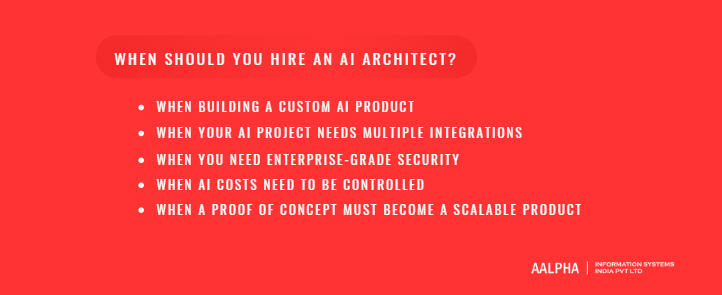
- Building custom AI products (SaaS platforms, AI agents, enterprise tools)
- Connecting AI with multiple business systems (CRM, ERP, ERPs, databases)
- Handling sensitive data (healthcare, finance, legal, customer records)
- Controlling AI costs across token usage, infrastructure, and storage
- Scaling from proof-of-concept to production
- Managing security, compliance, and audit requirements
Key Responsibilities:
- Design complete system architecture (data flow, models, APIs, cloud setup)
- Select appropriate AI models and tools (not always the most advanced)
- Plan data pipelines and knowledge systems (ingestion, cleaning, retrieval)
- Define security, privacy, and governance controls
- Guide development teams through implementation
Skills to Look For:
- Strong AI/ML fundamentals and LLM/generative AI experience
- Backend architecture and API design
- Cloud infrastructure and DevOps
- Data engineering and database knowledge
- Security and compliance understanding
- Business problem-solving and communication
Types of AI Architects:
- Generative AI Architect: LLMs, chatbots, RAG systems, AI agents
- Machine Learning Architect: Predictive models, fraud detection, forecasting
- Enterprise AI Architect: Multi-department AI roadmaps, governance
- Cloud AI Architect: Infrastructure, scaling, GPU planning, cost management
- AI Automation Architect: Workflow automation, business process integration
Hiring Models & Cost:
- Freelance: $75–$500/hour for audits, discovery, or reviews
- In-house: Six-figure salary for long-term, full-time leadership
- Dedicated remote: Balanced cost and flexibility for startups/mid-market
- Consulting firm: Strategy, feasibility studies, enterprise roadmaps
- Development partner: Architecture + full execution (best for custom products). Aalpha is an experienced AI architecture and development partner (4.9/5 Clutch rating, 5,500+ completed projects) that can help design, build, deploy, and support AI systems end-to-end.
Common Mistakes:
- Hiring after development already started
- Evaluating only for model knowledge, not system design
- Not defining clear business use cases
- Ignoring data readiness
- Not planning post-launch maintenance
Bottom Line:
AI architects prevent expensive mistakes by designing systems correctly before development. For projects involving custom AI, sensitive data, multiple integrations, or production scaling, architecture should be planned first, not as an afterthought. The cost of a skilled architect is much lower than the cost of rebuilding weak foundations later. Working with an experienced partner like Aalpha combines architecture expertise with full development capability, reducing technical risk and accelerating delivery.
Artificial intelligence has moved from experimental innovation to a serious business capability. Companies are now using AI across customer support, sales, marketing, finance, HR, operations, logistics, healthcare, legal, education, cybersecurity, and software development. In many organizations, AI is no longer limited to one data science team. It is being added to customer-facing products, internal workflows, decision-support systems, analytics dashboards, document processing pipelines, fraud detection systems, recommendation engines, and employee productivity tools. IBM’s Global AI Adoption Index reported that 42% of enterprise-scale companies surveyed had already actively deployed AI in their business, showing that AI adoption has moved beyond early experimentation for many larger organizations.
This wider use of AI has also changed what businesses need from technical leadership. A simple chatbot, automation script, or AI proof of concept may be built by a small team, but a production-grade AI system needs much more than model access. It needs a clear architecture that defines how data moves through the system, which models are used, where business rules are applied, how outputs are reviewed, how users access the system, how sensitive information is protected, how APIs connect with existing tools, and how the system will scale as usage grows. For example, an AI document processing solution may need OCR, document classification, data extraction, validation rules, human review, audit logs, export workflows, role-based access, cloud storage, and integration with an ERP or CRM. Without strong architecture, the same project can become slow, expensive, inaccurate, insecure, and difficult to maintain.
This is where an AI architect becomes critical. An AI architect is responsible for designing the technical foundation of an AI solution before full development begins. The role connects business goals with AI models, software architecture, data engineering, cloud infrastructure, APIs, security, governance, and long-term product planning. Instead of asking only which AI model should be used, an AI architect asks how the complete system should work, how it will be tested, how it will handle errors, how it will control costs, how users will interact with it, and how the business will measure success. This is important because many AI projects fail not because the model is weak, but because the surrounding architecture is poor. Gartner has warned that many generative AI projects are abandoned after proof of concept due to issues such as poor data quality, inadequate risk controls, escalating costs, and unclear business value. Gartner has also predicted that through 2026, organizations will abandon 60% of AI projects that are not supported by AI-ready data.
The demand for AI architects is rising because businesses now need AI systems that are secure, useful, scalable, and connected to real workflows. A company building an AI customer support assistant must think about knowledge base quality, response accuracy, escalation rules, CRM integration, user permissions, analytics, and compliance. A healthcare company building an AI clinical documentation tool must consider patient privacy, review workflows, audit trails, data retention, and regulatory requirements. A fintech company using AI for fraud detection must design for real-time data processing, explainability, monitoring, access control, and low-latency decisions. In each case, the success of the AI solution depends on architecture as much as the AI model itself.
This guide explains how to hire an AI architect in a practical, step-by-step way. It covers who an AI architect is, what responsibilities they handle, when your business should hire one, which technical and business skills to look for, what hiring models are available, how much AI architects cost, which interview questions to ask, and how to choose the right candidate or development partner. The goal is to help businesses avoid expensive AI mistakes and hire the right expertise before building serious AI systems.
Who Is an AI Architect?
-
AI Architect Definition
An AI architect is a senior technical expert who designs the complete structure of an artificial intelligence system. The role is not limited to choosing an AI model or recommending a machine learning tool. An AI architect defines how the entire AI solution should work, from data collection and model selection to application logic, infrastructure, security, integrations, deployment, monitoring, and long-term maintenance. In practical terms, the AI architect creates the technical blueprint that development teams follow when building AI-powered software, internal automation systems, enterprise platforms, AI agents, predictive analytics tools, or generative AI applications.
A good AI architect looks at the full system, not just the model layer. For example, if a business wants to build an AI-powered customer support assistant, the architect must decide how the system will access company knowledge, how responses will be generated, how inaccurate answers will be controlled, how conversations will be logged, how the tool will connect with CRM software, how users will be authenticated, and when a human support agent should take over. Similarly, if a company wants to build a document intelligence platform, the AI architect must plan OCR, data extraction, validation workflows, database design, cloud storage, API integrations, role-based access, audit logs, and deployment infrastructure. This is why the role requires a combination of AI knowledge, software architecture skills, data engineering understanding, cloud experience, and business judgment.
-
AI Architect vs AI Engineer
An AI architect is different from an AI engineer. AI engineers are usually responsible for building and implementing AI features based on the approved design. They may integrate APIs, write code, connect models with applications, create prompts, build workflows, test outputs, and deploy components into production. The AI architect, on the other hand, defines the larger technical direction. They decide what should be built, how different parts of the system should connect, which models or AI services are suitable, what data the system needs, what security controls should be included, and how the solution can scale. In a well-structured project, the AI architect guides AI engineers, backend developers, frontend developers, data engineers, DevOps teams, and QA teams so that everyone builds toward the same technical goal.
-
AI Architect vs Machine Learning Engineer
An AI architect is also different from a machine learning engineer. A machine learning engineer usually focuses on model-related work such as training, fine-tuning, feature engineering, optimization, model evaluation, deployment, and performance improvement. This role is especially important when a company is building custom ML models for use cases such as fraud detection, demand forecasting, image recognition, recommendation engines, pricing models, or risk scoring. An AI architect may understand these areas, but their responsibility is broader. They decide whether a custom model is needed at all, whether an existing API or open-source model is more practical, how the model will fit into the product, how data will reach the model, how predictions will be reviewed, and how outputs will be used by business users.
-
AI Architect vs Solution Architect
The AI architect also differs from a general solution architect. A solution architect designs software systems across applications, databases, APIs, cloud services, user roles, and business workflows. This role is valuable in almost any software project. However, an AI architect brings deeper specialization in artificial intelligence, machine learning, large language models, embeddings, vector databases, retrieval-augmented generation, model evaluation, prompt workflows, AI agents, data pipelines, and AI governance. While a solution architect may design a standard SaaS platform or enterprise application, an AI architect must also account for issues that are unique to AI systems, such as model accuracy, hallucination risk, training data quality, inference cost, explainability, bias, human review, and continuous monitoring.
In simple terms, an AI architect is the person who turns an AI idea into a buildable, secure, scalable, and business-ready system design. Businesses hire AI architects when they need more than a prototype. They need this role when the project involves sensitive data, multiple integrations, custom workflows, production deployment, compliance requirements, or long-term product growth. A skilled AI architect helps the company avoid expensive technical mistakes, select the right tools, reduce unnecessary development effort, and build AI systems that can work reliably in real business conditions.
What Does an AI Architect Do?
An AI architect is responsible for turning a business AI idea into a clear technical plan that developers, data teams, cloud engineers, and business stakeholders can follow. Their work begins before coding starts and continues through development, testing, deployment, and improvement after launch. Unlike a developer who may focus on a specific feature, the AI architect looks at the complete system. They define how the AI model will work with the application, how data will move through the platform, how users will interact with the system, how outputs will be monitored, and how the solution will remain secure, scalable, and cost-efficient over time.
-
Designs the AI System Architecture
The first major responsibility of an AI architect is to design the AI system architecture. This includes the model layer, application layer, data layer, API layer, cloud infrastructure, monitoring setup, access control, and integration points. For example, if a company wants to build an AI-powered claims processing platform, the architect must define how documents will be uploaded, how OCR will read them, how AI models will extract key information, how business rules will validate the output, how users will review exceptions, and how final data will be pushed into an insurance management system.
The model layer includes the AI models, LLMs, embedding models, classification models, or custom machine learning models used in the solution. The application layer includes the user interface, admin dashboard, workflow screens, and business logic. The data layer includes structured databases, document storage, vector databases, logs, and reporting systems. The API layer connects the AI system with external tools such as CRMs, ERPs, EHRs, payment platforms, communication tools, or analytics software. The cloud infrastructure defines where the system will run, how it will scale, how it will be monitored, and how failures will be handled. A strong AI architect connects all these layers into one practical design.
-
Selects the Right AI Models and Tools
An AI architect also decides which AI models, tools, and platforms should be used for the project. This decision is important because not every AI use case needs the most advanced or expensive model. Some projects may work well with OpenAI, Claude, Gemini, Llama, or Mistral. Others may require a custom machine learning model, a domain-specific classifier, an OCR engine, a speech-to-text model, or a combination of multiple AI services.
For example, a customer support assistant may need an LLM, a vector database, a retrieval-augmented generation pipeline, and CRM integration. A medical document analysis tool may need OCR, entity extraction, human review, audit logs, and strict data privacy controls. A fraud detection system may need real-time transaction data, predictive ML models, anomaly detection, and rule-based alerts. The AI architect evaluates the use case, accuracy needs, data sensitivity, latency requirements, cost limits, and deployment environment before recommending a stack.
They may choose OCR tools such as AWS Textract, Google Document AI, Azure AI Document Intelligence, or open-source OCR depending on document complexity and cost. They may recommend vector databases such as Pinecone, Weaviate, Milvus, Chroma, or FAISS for semantic search and RAG systems. They may also use orchestration frameworks such as LangChain, LangGraph, LlamaIndex, AutoGen, CrewAI, or custom workflow engines for AI agents and multi-step reasoning workflows. The key responsibility is not just choosing popular tools, but choosing the right tools for the business problem.
-
Plans Data Pipelines and Knowledge Systems
AI systems depend heavily on data quality. An AI architect plans how data will be collected, cleaned, transformed, stored, indexed, retrieved, and used by the AI system. This includes data ingestion from internal databases, PDFs, emails, websites, spreadsheets, CRM records, ERP systems, support tickets, call transcripts, product catalogs, or third-party APIs. Raw data is often messy, duplicated, incomplete, outdated, or stored in different formats, so the architect must define how it will be prepared before the AI system uses it.
For generative AI and LLM applications, knowledge system planning is especially important. If a business wants an AI assistant to answer questions from company documents, policies, contracts, product manuals, or support articles, the architect must design a retrieval-augmented generation pipeline. This involves document processing, text chunking, embedding generation, vector indexing, metadata tagging, semantic search, ranking, source citation, and response generation. Poorly planned knowledge systems lead to weak answers, missing context, hallucinations, and unreliable user experience.
The architect also decides how structured and unstructured data will work together. Structured data may come from SQL databases, analytics tools, transaction systems, or business applications. Unstructured data may include PDFs, scanned documents, emails, images, audio, chat logs, and support notes. In real-time workflows, the architect may plan event-driven data pipelines using queues, webhooks, streaming platforms, or scheduled sync jobs. This is necessary when AI decisions depend on fresh information, such as fraud alerts, delivery routing, inventory forecasting, or customer support escalation.
-
Defines Security, Privacy, and Governance
Security, privacy, and governance are core responsibilities of an AI architect, especially when the AI system handles sensitive business data, customer data, financial records, healthcare information, legal documents, or internal company knowledge. The architect defines who can access the system, what each user role can see, how data is encrypted, how requests are logged, how outputs are reviewed, and how long information should be retained.
Role-based access control is often required when different users need different permissions. For example, an admin may manage users and settings, a reviewer may approve AI outputs, a manager may see reports, and an end user may only access their assigned records. Audit logs are also important because businesses need to know who uploaded data, who viewed records, what the AI generated, what was edited, and who approved the final output. These logs are especially important in regulated industries such as healthcare, finance, insurance, and legal services.
AI governance also includes model output review, human approval workflows, data retention policies, prompt controls, usage tracking, and risk management. In many business cases, AI should not make final decisions without human oversight. For example, an AI system may summarize a medical record, flag a suspicious transaction, extract contract risks, or recommend a loan decision, but a qualified human may still need to review and approve the output. The AI architect designs these controls into the system from the beginning instead of adding them after problems occur.
-
Guides Development and Deployment
An AI architect does not usually build every part of the system alone. Instead, they guide the teams that turn the architecture into a working product. They work with backend developers to build APIs, databases, authentication, business logic, and integration workflows. They work with frontend developers to create user dashboards, review screens, admin panels, and reporting interfaces. They work with data engineers to build data pipelines, indexing systems, transformation workflows, and storage models. They work with ML engineers to train, fine-tune, evaluate, and deploy models where custom machine learning is required.
They also work closely with DevOps engineers to plan cloud deployment, CI/CD pipelines, containerization, logging, monitoring, scaling, backup, and infrastructure security. QA teams depend on the architect’s guidance to test AI workflows, edge cases, model outputs, permissions, integrations, and performance under load. Business stakeholders depend on the architect to explain trade-offs, clarify scope, manage technical risk, and align the system design with real operational goals.
In short, an AI architect acts as the technical bridge between business strategy and software delivery. They do not simply recommend AI tools. They design the full system around the company’s workflows, users, data, compliance needs, and growth plans. This makes the role essential for any business that wants to move beyond AI experiments and build reliable AI products, enterprise AI platforms, AI agents, document intelligence systems, predictive analytics tools, or workflow automation solutions that can run in production.
When Should You Hire an AI Architect?
A business should hire an AI architect when an AI project moves beyond a simple experiment and starts affecting real users, business operations, sensitive data, or long-term product plans. Many companies begin AI adoption with a small proof of concept, a chatbot, an automation workflow, or a model API integration. That is often enough to test an idea. However, once the AI system needs to work reliably inside a business environment, the project requires proper technical planning. An AI architect helps define that foundation before the company invests heavily in development, cloud infrastructure, integrations, and deployment.
-
When Building a Custom AI Product
You should hire an AI architect when building a custom AI product such as a SaaS platform, AI agent, enterprise AI tool, automation platform, internal assistant, or customer-facing AI application. These products usually need more than a single AI model. They require user roles, dashboards, authentication, workflows, reporting, APIs, databases, integrations, monitoring, billing logic, and cloud deployment. Without an architect, teams may build features quickly but struggle later when the product needs to scale, support multiple users, handle large data volumes, or meet enterprise security requirements.
For example, a company building an AI-powered SaaS platform for contract review may need document upload, OCR, clause detection, risk scoring, AI summaries, human review, approval workflows, user permissions, client workspaces, audit logs, and export options. Similarly, an AI agent platform may need memory, task execution, API calls, tool access, fallback rules, escalation flows, and usage tracking. In both cases, the architect defines how all parts of the product should connect before developers begin full-scale implementation.
-
When Your AI Project Needs Multiple Integrations
AI systems become more complex when they need to connect with existing business software. You should hire an AI architect when your AI project needs integrations with CRMs, ERPs, EHRs, accounting software, payment systems, databases, messaging tools, cloud applications, analytics platforms, or internal systems. Each integration affects data flow, security, access control, performance, and maintenance.
For example, an AI sales assistant may need to read CRM records, summarize customer conversations, generate follow-up emails, update deal stages, and notify sales teams through Slack or Microsoft Teams. A healthcare AI assistant may need to connect with EHR systems, appointment scheduling tools, patient records, insurance workflows, and secure messaging platforms. A finance automation tool may need accounting software, bank feeds, invoices, payment gateways, approval systems, and reporting dashboards. An AI architect maps these connections clearly so that the system does not become a fragile collection of disconnected tools.
-
When You Need Enterprise-Grade Security
Security is one of the strongest reasons to hire an AI architect early. Businesses in healthcare, finance, legal, insurance, education, logistics, and enterprise software often work with sensitive data. This can include patient records, payment details, contracts, identity documents, student records, shipment data, employee information, or confidential business files. If AI is added without a secure architecture, the company may expose private data, create unauthorized access risks, lose audit visibility, or violate compliance requirements.
An AI architect designs security into the system from the start. This includes role-based access, encryption, secure API design, data isolation, audit logs, consent workflows, human review, output validation, and data retention policies. In regulated industries, the architect may also plan compliance-friendly workflows for HIPAA, GDPR, SOC 2, ISO, or industry-specific requirements. This is especially important when using third-party AI models because the business must understand what data is sent to external services, how it is stored, whether it is used for training, and how user privacy is protected.
-
When AI Costs Need to Be Controlled
AI systems can become expensive when usage grows. Token consumption, model API calls, embedding generation, OCR processing, vector database storage, cloud infrastructure, GPU usage, logging, monitoring, and data storage can all increase operating costs. A small prototype may seem affordable, but the same design may become costly when thousands of users or millions of documents are processed every month.
An AI architect helps control these costs through better system design. They may use model routing, where simple tasks use lower-cost models and complex tasks use more advanced models. They may apply caching to avoid repeated AI calls for the same question or document. They may use batch processing for non-urgent workloads, optimize prompts to reduce token usage, compress context windows, control vector search depth, and set usage limits by role or customer plan. They may also plan cloud resources carefully so that the system runs reliably without overpaying for unused capacity. Cost control is not only a finance issue; it is an architecture issue.
-
When a Proof of Concept Must Become a Scalable Product
Many AI projects work well as demos but fail when they are moved into production. A proof of concept may use sample data, manual uploads, hardcoded prompts, limited users, no security layers, no monitoring, and no integration with real business systems. This is acceptable for early validation, but it is not enough for a scalable product.
You should hire an AI architect when your proof of concept needs to become a real system. The architect reviews what has already been built, identifies technical gaps, and designs the production version. This may include rebuilding the data pipeline, improving model evaluation, adding user roles, creating admin controls, setting up monitoring, strengthening security, improving response accuracy, reducing costs, and planning deployment. The goal is to move from “it works in a demo” to “it works reliably for users, teams, customers, and business operations.”
In simple terms, the right time to hire an AI architect is before complexity becomes expensive. If your project involves custom AI development, multiple systems, sensitive data, growing user demand, high AI usage costs, or a transition from prototype to product, an AI architect can save time, reduce risk, and create a stronger foundation for long-term success.
Key Skills to Look for in an AI Architect
Hiring an AI architect requires more than checking whether the person has worked with machine learning models or large language models. The role demands a mix of AI expertise, software architecture knowledge, data engineering experience, cloud planning, security awareness, and business communication skills. A strong AI architect should be able to understand the business problem, design the right technical foundation, guide engineering teams, and explain important trade-offs to non-technical stakeholders. The best candidates are not only model experts. They are system thinkers who understand how AI fits into real products, workflows, users, databases, APIs, and compliance requirements.
-
Strong AI and Machine Learning Knowledge
An AI architect should have a solid understanding of core artificial intelligence and machine learning concepts. This includes supervised learning, unsupervised learning, deep learning, natural language processing, computer vision, recommendation systems, large language models, embeddings, and model evaluation metrics. These skills help the architect decide which type of AI approach is suitable for each business use case.
For example, supervised learning may be useful for fraud detection, risk scoring, churn prediction, and demand forecasting when labeled historical data is available. Unsupervised learning may be useful for anomaly detection, clustering customers, or identifying unusual behavior in transaction data. Deep learning may be required for image analysis, speech processing, advanced NLP, or large-scale pattern recognition. Recommendation systems may be required for ecommerce, media platforms, learning platforms, and marketplaces. An AI architect should understand these approaches well enough to know when to use them, when to avoid them, and when a simpler rules-based or API-driven approach may be more practical.
Evaluation knowledge is equally important. The architect should understand metrics such as accuracy, precision, recall, F1 score, latency, confidence score, relevance, retrieval quality, hallucination rate, and human review acceptance rate. Without evaluation criteria, an AI project can appear impressive in a demo but fail in real business use.
-
Experience With LLMs and Generative AI
Modern AI projects often involve large language models and generative AI. An AI architect should have hands-on experience with prompt engineering, retrieval-augmented generation, fine-tuning, agentic workflows, function calling, model evaluation, guardrails, and hallucination control. These skills are especially important when building AI assistants, AI agents, document analysis tools, customer support bots, knowledge base systems, legal review tools, or internal productivity platforms.
Prompt engineering is useful, but it is only one part of the work. A good architect should know how to design structured prompts, control outputs, manage context windows, route requests to the right model, and reduce unnecessary token usage. In RAG systems, they should understand document processing, chunking, embeddings, vector search, metadata filtering, ranking, and source citation. In agentic workflows, they should know how to define tool access, task planning, memory, fallback rules, approval flows, and safe execution boundaries.
They should also know how to reduce hallucinations and unreliable outputs. This may include grounding answers in verified data, using retrieval systems, setting confidence thresholds, adding human approval, restricting unsupported claims, logging outputs, and testing results across realistic user scenarios. Generative AI can be powerful, but without the right design controls, it can create inaccurate, expensive, or risky systems.
-
Backend and API Architecture Skills
An AI architect must understand backend systems because AI features rarely operate alone. Most AI applications need APIs, databases, authentication, business logic, user permissions, background jobs, and integration workflows. Strong candidates should be comfortable with backend technologies such as Python, Node.js, FastAPI, Django, Flask, REST APIs, GraphQL, microservices, event-driven systems, queues, and authentication methods.
For example, an AI document processing platform may need APIs for file upload, OCR processing, extraction, review, approval, export, and reporting. A customer support AI assistant may need APIs to connect with CRM records, support tickets, chat tools, and user profiles. A finance AI system may need secure integrations with accounting tools, payment systems, and internal databases. The architect should know how these backend services should be designed so that the AI layer works reliably with the rest of the product.
Microservices, queues, and event-driven systems become important when AI workloads are heavy or asynchronous. OCR processing, embedding generation, report creation, fraud checks, and large document analysis may not be suitable for direct request-response flows. In such cases, the architect must plan background jobs, retry logic, failure handling, rate limits, and monitoring.
-
Cloud and DevOps Knowledge
Cloud and DevOps knowledge is essential for deploying AI systems into production. An AI architect should understand AWS, Azure, Google Cloud, Docker, Kubernetes, serverless computing, CI/CD pipelines, logging, monitoring, scaling, backup planning, and infrastructure planning. These skills help the business move from a working prototype to a stable production system.
AI workloads can vary greatly. Some applications may only need managed cloud APIs and lightweight backend services. Others may need GPU infrastructure, container orchestration, vector databases, real-time processing, private cloud deployment, or multi-region availability. The architect should know how to choose the right infrastructure based on performance needs, data sensitivity, budget, and user demand.
DevOps planning also affects reliability. The architect should define how code is deployed, how errors are tracked, how model performance is monitored, how logs are reviewed, how uptime is measured, and how the system recovers from failures. Without this planning, AI systems can become difficult to debug and expensive to operate.
-
Data Engineering Skills
AI systems depend on clean, accessible, and well-organized data. An AI architect should understand SQL, NoSQL, ETL pipelines, streaming data, data lakes, data warehouses, vector databases, document processing, and data governance. These skills are necessary because many AI projects fail when the model is strong but the data foundation is weak.
The architect should know how to collect data from different sources, clean it, transform it, store it, index it, and make it available to AI models. For structured data, this may involve relational databases, warehouses, analytics systems, or business applications. For unstructured data, this may involve PDFs, scanned documents, emails, images, audio files, support conversations, and knowledge base articles. For semantic search and RAG systems, the architect must understand embeddings, vector storage, retrieval quality, and metadata design.
Good data governance is also important. The architect should define ownership, access rules, quality checks, retention policies, versioning, and auditability. AI systems cannot produce reliable outcomes if the underlying data is outdated, duplicated, incomplete, or poorly controlled.
-
Security and Compliance Understanding
Security and compliance should be core skills, not optional extras. An AI architect should understand encryption, access control, audit trails, HIPAA, GDPR, SOC 2, ISO standards, secure API usage, and secure model usage. This is especially important when AI systems handle healthcare records, financial data, legal documents, customer information, employee records, or confidential business knowledge.
The architect should know how to design role-based permissions, data isolation, secure storage, encrypted transmission, audit logs, approval workflows, and retention policies. They should also understand the risks of sending sensitive data to third-party AI providers and how to reduce those risks through data masking, private deployment, vendor review, usage policies, and strict access controls.
-
Business and Communication Skills
Finally, an AI architect must be able to translate business requirements into technical architecture. This is one of the most important skills to look for during hiring. The architect should understand what the business wants to achieve, which workflows are affected, who the users are, what risks exist, what success means, and which technical trade-offs matter.
For example, they should be able to explain why one model is cheaper but less accurate, why a custom model may not be needed for the first version, why human review is required for sensitive decisions, or why a product should start with one narrow workflow before adding more features. They should communicate clearly with founders, product managers, developers, compliance teams, operations managers, and executives.
A skilled AI architect brings technical depth and business clarity together. They help companies avoid unnecessary complexity, reduce development risk, control costs, and build AI systems that match real operational needs.
Types of AI Architects You Can Hire
Not every AI architect has the same specialization. Some are stronger in generative AI and LLM-based systems, while others focus on machine learning models, enterprise architecture, cloud infrastructure, or automation workflows. The right type of AI architect depends on what your business wants to build, how complex your data environment is, how much security is required, and whether the project is a product, internal tool, automation system, or enterprise-wide AI program. Before hiring, it is important to match the architect’s specialization with the actual problem you want to solve.
-
Generative AI Architect
A generative AI architect is the right choice when your project involves large language models, AI agents, chatbots, document intelligence, content automation, knowledge assistants, or retrieval-augmented generation systems. This type of architect understands how to design systems around models such as OpenAI, Claude, Gemini, Llama, Mistral, or other commercial and open-source LLMs. They also understand prompt workflows, embeddings, vector databases, tool calling, context management, response evaluation, and hallucination control.
For example, if a business wants to build an AI assistant that answers questions from internal documents, a generative AI architect will design the RAG pipeline, document ingestion flow, chunking strategy, embedding model, vector search setup, citation logic, permissions, and review process. If the project is an AI agent, the architect will define how the agent accesses tools, performs tasks, stores memory, handles errors, and escalates to humans when required. This specialization is best for companies building modern AI applications that depend heavily on language, reasoning, search, summarization, or document understanding.
-
Machine Learning Architect
A machine learning architect is best suited for projects that require predictive analytics, fraud detection, forecasting, recommendation engines, risk scoring, customer segmentation, computer vision, or custom ML models. This type of architect focuses on data science workflows, model design, feature engineering, training pipelines, evaluation metrics, deployment, retraining, and model performance monitoring.
For example, an ecommerce company may hire a machine learning architect to design a recommendation engine that suggests products based on browsing history, purchase behavior, and customer preferences. A fintech company may need this role to design fraud detection models that analyze transactions in real time. A logistics company may use a machine learning architect to build demand forecasting, route optimization, or delivery time prediction models. This role is especially valuable when the AI system depends on historical data, statistical accuracy, model training, and continuous performance improvement.
-
Enterprise AI Architect
An enterprise AI architect is ideal for large organizations with complex systems, multiple departments, strict compliance requirements, and long-term AI roadmaps. This type of architect does not focus only on one AI application. Instead, they design how AI should be adopted across the organization. They plan data access, governance, security, model usage policies, integration standards, user roles, vendor selection, and implementation priorities.
For example, a hospital network may need an enterprise AI architect to plan AI adoption across patient support, clinical documentation, claims processing, scheduling, reporting, and compliance workflows. A bank may need one to design AI systems for fraud detection, customer service, document processing, credit analysis, and internal productivity while maintaining strict security and audit controls. This type of architect is best when AI is not a single project but a wider business transformation requiring structure, governance, and phased execution.
-
Cloud AI Architect
A cloud AI architect focuses on AI infrastructure, deployment, scaling, GPU planning, cloud AI services, performance, and cost management. This role is important when the AI system has heavy processing needs, large datasets, real-time workloads, private deployment requirements, or high usage volume. They help businesses decide whether to use AWS, Azure, Google Cloud, private cloud, hybrid cloud, serverless infrastructure, managed AI services, container orchestration, or GPU-based deployments.
For example, a company building a high-volume document processing platform may need a cloud AI architect to plan storage, OCR processing, queue-based workloads, auto-scaling, monitoring, backups, and cost controls. A business running open-source LLMs may need help with GPU sizing, inference optimization, container deployment, security, and latency management. This specialization is best when infrastructure decisions can directly affect performance, security, reliability, and operating cost.
-
AI Automation Architect
An AI automation architect is best for workflow automation, internal tools, RPA with AI, approval flows, CRM automation, process intelligence, and business operations automation. This type of architect understands how to connect AI models with business processes, software tools, human decision points, and rule-based workflows. They are often useful for companies that want to reduce repetitive manual work without building a full AI product from scratch.
For example, an AI automation architect may design a workflow where incoming emails are classified, key details are extracted, records are created in a CRM, approvals are routed to managers, and follow-up messages are generated automatically. In finance, they may automate invoice processing, payment matching, expense review, and reporting. In HR, they may automate resume screening, onboarding workflows, policy Q&A, and employee support requests. This role is best when the company’s main goal is operational efficiency, faster turnaround time, fewer manual errors, and better workflow visibility.
Choosing the right type of AI architect depends on the project’s core requirement. If the project is built around LLMs, hire a generative AI architect. If it depends on custom prediction models, hire a machine learning architect. If it spans departments and compliance needs, hire an enterprise AI architect. If infrastructure and deployment are the main challenge, hire a cloud AI architect. If the goal is to automate business workflows, hire an AI automation architect.
Step-by-Step Process to Hire an AI Architect
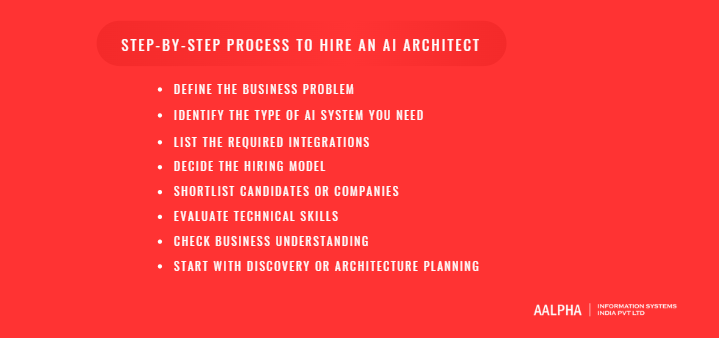
Hiring an AI architect should be a structured process, not a quick search for someone who has worked with AI tools. The role is too important to hire casually because the architect will influence the system design, data strategy, infrastructure choices, security controls, development roadmap, and long-term cost of the AI solution. A wrong hire can lead to an overbuilt system, weak data pipelines, poor model choices, high cloud bills, security gaps, and months of rework. A good hiring process helps you identify someone who understands both the technical side of AI and the business problem behind the project.
-
Define the Business Problem
The first step is to define the business problem clearly. Many companies make the mistake of starting with a model or tool instead of starting with the outcome they want. They may say, “We want to use GPT,” “We need an AI chatbot,” or “We want to add AI to our product.” These statements are too broad. A better starting point is to define the operational problem, user pain point, cost burden, or revenue opportunity.
For example, an insurance company may want to reduce manual claims processing time. A customer support team may want to reduce repetitive ticket handling. A legal firm may want to improve document review speed. A healthcare company may want to summarize clinical notes. A SaaS company may want to build an AI assistant that helps users complete tasks faster. Each of these problems may require a different architecture, data flow, model strategy, integration plan, and review workflow.
When defining the problem, include details such as who will use the AI system, what task it should complete, what data it needs, what decisions it will support, and what success should look like. Success may mean reducing processing time by 40%, improving support response speed, lowering manual review volume, increasing document extraction accuracy, reducing operational cost, or improving user engagement. The clearer the problem, the easier it becomes to hire the right AI architect.
-
Identify the Type of AI System You Need
Once the business problem is clear, identify the type of AI system you need. Different AI systems require different skills. An AI chatbot is not the same as an AI agent. A predictive model is not the same as a document analysis solution. A computer vision system is not the same as a voice AI tool. The type of system directly affects the kind of AI architect you should hire.
If your project is customer support or internal knowledge search, you may need an AI chatbot or RAG-based assistant. If the system must perform multi-step tasks, call tools, update records, send messages, or trigger workflows, you may need an AI agent. If your goal is forecasting, fraud detection, risk scoring, or churn prediction, you may need a predictive machine learning system. If the project involves images, video, quality inspection, or object detection, you may need a computer vision system. If the goal is ecommerce personalization, you may need a recommendation engine. If the project involves PDFs, scanned documents, invoices, contracts, claims, or medical records, you may need a document analysis solution. If the use case involves calls, transcription, speech commands, or voice-based support, you may need a voice AI system.
This step helps you avoid hiring the wrong specialization. For example, a generative AI architect may be ideal for an AI knowledge assistant, but a machine learning architect may be better for fraud scoring. A cloud AI architect may be needed if the project has heavy infrastructure requirements. An AI automation architect may be suitable if the main objective is to connect AI with internal business workflows.
-
List the Required Integrations
The next step is to list all systems the AI solution must connect with. Integrations are often where AI projects become complex. A prototype may work with sample data, but a production system usually needs to connect with real databases, existing software, APIs, CRMs, ERPs, EHRs, accounting tools, payment systems, authentication systems, analytics platforms, messaging tools, file storage systems, and internal applications.
For example, an AI sales assistant may need to connect with Salesforce, HubSpot, Gmail, calendar tools, Slack, and internal customer databases. An AI finance automation tool may need to connect with QuickBooks, Xero, Zoho Books, Stripe, bank feeds, invoice systems, and approval workflows. A healthcare AI system may need EHR integration, secure patient data access, appointment systems, insurance workflows, and audit logs. A SaaS AI assistant may need user authentication, subscription plans, in-app usage data, analytics, and role-based permissions.
Before hiring, prepare a simple integration list. Include the system name, the type of data required, whether an API is available, how often data should sync, who can access it, and whether the data is sensitive. This gives candidates a realistic view of the project and helps you evaluate whether they understand production-grade AI architecture.
-
Decide the Hiring Model
After defining the problem and integrations, decide which hiring model fits your project. You can hire a freelance AI architect, a full-time in-house architect, a dedicated remote AI architect, an AI consulting company, or a software development partner. Each option has advantages and limitations.
A freelance AI architect may be useful for short-term consulting, architecture review, technical audits, or early discovery. This model can work well when you already have an internal development team and only need expert guidance. A full-time in-house AI architect is suitable if AI is a long-term strategic focus and you plan to build multiple AI products or internal systems over several years. However, this option can be costly and may take longer to recruit.
A dedicated remote AI architect can offer strong technical capability with more flexibility than full-time local hiring. This model works well for startups, SaaS companies, and growing businesses that need ongoing architecture support without building a large internal team immediately. An AI consulting company is useful when you need strategy, feasibility analysis, governance planning, or an enterprise AI roadmap. A software development partner is the better choice when you need architecture plus full execution, including backend development, frontend dashboards, AI engineering, cloud deployment, QA, and long-term support.
-
Shortlist Candidates or Companies
Once the hiring model is clear, shortlist candidates or companies based on relevant experience, not generic AI claims. Review their portfolios, case studies, past AI projects, technical documentation, industry experience, and ability to explain their work clearly. Look for projects that are close to your use case. If you are building an AI document analysis tool, experience with OCR, extraction workflows, RAG, review dashboards, and data validation matters. If you are building an AI agent platform, experience with tool calling, workflow orchestration, API integrations, memory, fallback logic, and monitoring is more relevant.
Strong candidates should be able to explain the business problem they solved, the architecture they designed, the models or tools they selected, the data challenges they handled, and the outcome of the project. Be careful with candidates who only show demos, prompt examples, or generic chatbot screenshots. A real AI architect should be able to discuss trade-offs, security, cost, deployment, user roles, integrations, and maintenance.
Communication quality is also important. The architect will work with founders, product managers, developers, DevOps engineers, data teams, compliance teams, and business users. If they cannot explain technical decisions in clear language during the hiring process, they may struggle to lead architecture discussions later.
-
Evaluate Technical Skills
The technical evaluation should test system thinking, not only tool knowledge. A good way to evaluate an AI architect is through a system design interview or architecture discussion based on your actual use case. Ask the candidate how they would design the system, what data they would need, which models they would consider, how they would handle integrations, how they would control costs, and how they would monitor performance.
For example, if you are building a RAG-based AI assistant, ask how they would handle document ingestion, chunking, embeddings, vector search, source citations, user permissions, hallucination reduction, and feedback loops. If you are building a claims automation platform, ask how they would design OCR processing, data extraction, validation, exception handling, human review, audit trails, and ERP integration. If you are building a predictive model, ask how they would approach data preparation, feature engineering, model evaluation, deployment, retraining, and monitoring.
The goal is to understand how the candidate thinks through architecture. A strong AI architect should be able to compare different model options, explain why one approach is better than another, identify risks, and suggest a practical MVP path. They should not recommend tools without first understanding data, users, workflows, security, and business goals.
-
Check Business Understanding
Technical ability alone is not enough. An AI architect must understand business context. They should be able to think about ROI, user roles, operational workflows, compliance, cost control, and product scalability. The best architects do not build AI for the sake of using AI. They design systems that solve measurable business problems.
Ask the candidate how they would define project success. Ask what should be automated first and what should remain human-reviewed. Ask how they would reduce unnecessary model usage. Ask how they would design role-based access for different users. Ask how they would handle compliance if sensitive customer, financial, legal, or healthcare data is involved. Ask how they would scale the system from a small user group to thousands of users.
A business-aware AI architect will also challenge weak assumptions. For example, they may tell you that fine-tuning is not required for the first version, that a simpler RAG system is enough, that the data is not ready for custom ML, or that human approval is needed before automating decisions. This kind of judgment is valuable because it prevents unnecessary cost and reduces delivery risk.
-
Start With Discovery or Architecture Planning
Before moving into full development, it is wise to start with a paid discovery or architecture planning phase. This phase allows the AI architect to understand the business problem, review available data, identify integrations, define system requirements, assess risks, and prepare a realistic implementation plan. It also helps both sides evaluate working compatibility before committing to a larger project.
A strong discovery phase should produce clear deliverables. These may include an architecture document, technical roadmap, MVP scope, infrastructure plan, integration plan, data flow diagram, security approach, model selection strategy, cost estimate, development timeline, and team requirement. For complex projects, it may also include a proof-of-concept plan, evaluation framework, compliance checklist, and post-launch monitoring strategy.
This step reduces uncertainty before major development begins. It helps the business understand what should be built first, what can wait, how much the project may cost, what technical risks exist, and what team will be required. It also gives the architect an opportunity to prove their thinking through a concrete plan rather than general discussion.
The right hiring process helps you choose an AI architect who can do more than discuss AI trends. You need someone who can turn a business problem into a practical, secure, scalable, and cost-aware system design. By defining the problem, identifying the system type, listing integrations, choosing the right hiring model, evaluating technical and business skills, and starting with discovery, you can make a stronger hiring decision and reduce the risk of expensive AI mistakes.
Best Hiring Models for AI Architects
There is no single best way to hire an AI architect. The right hiring model depends on the size of the project, the level of technical complexity, available internal resources, budget, timeline, and whether the business needs only architecture guidance or full AI product development. Some companies need a short-term expert to review an AI plan. Others need a full-time architect to lead long-term AI product development. Many businesses need a team that can design, build, deploy, and support the entire AI solution. Before hiring, companies should understand the strengths and limitations of each model.
-
Freelance AI Architect
A freelance AI architect is a good option when a business needs short-term expertise, a second opinion, or a focused architecture review. Freelancers can help assess a proof of concept, review an existing AI system, prepare a technical roadmap, evaluate model choices, identify risks, or create an initial architecture document. This model is often suitable for startups, small businesses, and companies that already have developers but need senior AI guidance before moving ahead.
The main benefit of hiring a freelance AI architect is flexibility. Businesses can bring in an expert for a limited period without committing to a full-time salary or long-term contract. Freelancers can also be useful when the requirement is specific, such as reviewing a RAG pipeline, reducing LLM costs, improving a document processing workflow, or auditing AI security risks.
However, the freelance model has limitations. A freelancer may not be available throughout the full development lifecycle. They may provide architecture advice but not manage implementation closely. If the internal team lacks AI development experience, the company may still struggle to execute the plan. There is also a risk of fragmented ownership when one person designs the system and another team builds it. Freelance AI architects are best for audits, advisory work, technical validation, short discovery projects, and architecture reviews, not for complex end-to-end delivery unless supported by a strong internal team.
-
In-House AI Architect
An in-house AI architect is suitable for companies that see AI as a long-term strategic capability. This model works well for businesses building core AI products, enterprise AI platforms, or multiple AI systems across departments. Having an AI architect inside the company gives the business continuous access to senior technical leadership. The architect can understand internal systems deeply, guide multiple projects, work closely with leadership, and create long-term AI standards.
The main advantage of this model is ownership. An in-house AI architect can shape the company’s AI roadmap, define internal architecture standards, manage vendor decisions, support engineering teams, and improve systems over time. This is especially valuable for SaaS companies, fintech platforms, healthcare technology businesses, enterprise software providers, and large organizations investing heavily in AI.
The challenge is cost and availability. Experienced AI architects are expensive and difficult to recruit. The hiring process can take time because the role requires a rare mix of AI knowledge, software architecture, cloud experience, data engineering, security understanding, and communication skills. Retention can also be difficult because demand for senior AI talent is high. An in-house architect may also need a supporting team of AI engineers, backend developers, data engineers, DevOps engineers, and QA specialists. This model is best when the company has a long-term AI roadmap and enough work to justify a senior full-time hire.
-
Dedicated Remote AI Architect
A dedicated remote AI architect offers a balance between flexibility, cost control, and technical depth. In this model, the architect works with the business on a dedicated basis, either full-time or part-time, but may be hired through a remote staffing company, development partner, or long-term engagement model. This is often more affordable than hiring a full-time local architect, especially for companies in regions where senior AI talent is costly or difficult to find.
This model is useful for startups, SaaS companies, mid-sized businesses, and agencies that need ongoing AI architecture support but do not want to build a large internal AI team immediately. A dedicated remote AI architect can help define system design, guide developers, review architecture decisions, plan integrations, control AI costs, and support deployment. The business gets continuity without the full burden of local recruitment, payroll, benefits, and retention.
The success of this model depends on communication, documentation, time zone overlap, and project management. The architect should be available for architecture discussions, sprint planning, code reviews, technical decisions, and stakeholder calls. This model works best when expectations are clearly defined and the architect is treated as part of the delivery team rather than an occasional external advisor.
-
AI Consulting Company
An AI consulting company is a good fit when the business needs strategy, feasibility analysis, technical audits, governance planning, or enterprise AI roadmap development. Consulting companies can help identify the right AI use cases, assess data readiness, evaluate build-versus-buy decisions, review security risks, and define phased implementation plans. This model is useful before making a major investment in AI development.
For example, an enterprise may hire an AI consulting company to assess whether AI can improve claims processing, customer support, compliance review, or internal analytics. A consulting team may interview stakeholders, review systems, analyze data sources, define use cases, recommend tools, estimate costs, and prepare an implementation roadmap. This approach helps leadership make informed decisions before committing to development.
The limitation is that consulting engagements may focus more on strategy than execution. Some consulting companies provide excellent documentation but do not build the actual product. Others may hand off the implementation to a separate development team. This can create gaps if the architecture is not practical or if the development team interprets it differently. Businesses should choose this model when they need clarity, validation, audits, feasibility studies, or enterprise AI planning, but they should confirm whether the consulting company can also support implementation.
-
AI Software Development Partner
An AI software development partner is often the strongest model when the business needs both architecture and execution. This model is suitable for companies building custom AI products, AI agents, enterprise AI tools, SaaS platforms, document intelligence systems, automation platforms, or AI-powered internal portals. In this approach, the partner provides not only an AI architect but also AI engineers, backend developers, frontend developers, UI/UX designers, data engineers, DevOps engineers, QA testers, and project managers.
This model is useful when the business does not already have a full technical team. The AI architect designs the system, while the development team builds and deploys it. This reduces the gap between planning and execution because the same team understands the architecture, technical roadmap, integrations, user workflows, infrastructure, and testing requirements. It also gives the business access to long-term support after launch.
An AI software development partner can help with discovery, architecture planning, MVP development, backend systems, API integrations, admin dashboards, cloud deployment, model integration, testing, monitoring, and maintenance. This is especially valuable when the project requires custom workflows, sensitive data handling, role-based access, cloud infrastructure, and multiple third-party integrations.
The main consideration is choosing the right partner. Businesses should review AI case studies, technical depth, team structure, delivery process, communication quality, security practices, and long-term support capability. The right partner should not simply agree to build every requested feature. They should help refine the scope, recommend a practical MVP, control costs, and design the system for future growth.
In short, the best hiring model depends on where the business stands. A freelancer may be enough for a short audit. An in-house architect is suitable for long-term AI product ownership. A dedicated remote architect offers flexible senior expertise. An AI consulting company is useful for strategy and feasibility. An AI software development partner is the best fit when the business needs architecture, development, deployment, and support under one delivery model.
How Much Does It Cost to Hire an AI Architect?
The cost to hire an AI architect depends on the hiring model, location, seniority, project complexity, and the level of responsibility expected from the role. A short architecture review will cost much less than hiring a senior AI architect to design a full enterprise AI platform. Similarly, an architect who only advises on model selection will cost less than one who plans data pipelines, cloud infrastructure, integrations, security controls, governance, deployment workflows, and long-term scaling. Businesses should treat AI architecture as a high-impact investment because the quality of early technical decisions can directly affect development cost, AI accuracy, infrastructure spend, security risk, and product reliability.
-
Cost by Hiring Model
A freelance AI architect is usually hired on an hourly or short-term contract basis. For general AI consulting and architecture reviews, businesses may pay around $75 to $200 per hour depending on experience and region. Highly specialized AI consultants in areas such as generative AI, enterprise AI governance, private LLM deployment, AI agents, healthcare AI, fintech AI, or advanced machine learning architecture may charge $200 to $500 or more per hour. This model is suitable for audits, discovery workshops, technical roadmap preparation, RAG review, LLM cost optimization, or second opinions before full development.
A full-time in-house AI architect is usually the most expensive model but gives the company long-term ownership. In the US, senior AI architect or AI solution architect roles can often reach six-figure salaries, with higher compensation in major technology markets or enterprise companies. In the UK and Western Europe, salaries are usually lower than top US levels but still high for senior AI roles. In India, Southeast Asia, and Eastern Europe, full-time hiring can be more cost-effective, but experienced AI architects are still premium talent. The full cost should include salary, hiring time, benefits, bonuses, tools, cloud access, training, and the supporting engineering team needed to execute the architect’s plan.
A dedicated remote AI architect is often a balanced option for startups and mid-sized businesses. This model may cost less than hiring a full-time local architect while still giving access to senior technical expertise. Depending on region and engagement structure, dedicated remote AI architects may be hired monthly, part-time, or full-time through a technology partner. This works well when the business needs ongoing architecture support but does not want the cost and recruitment burden of a permanent senior hire.
AI consulting companies often charge by project, workshop, audit, or strategy engagement. A small discovery or feasibility study may cost a few thousand dollars, while enterprise AI strategy, data readiness audits, governance planning, and multi-department AI roadmaps can cost much more. Project-based architecture planning may include requirement analysis, data flow diagrams, infrastructure planning, security review, model selection, integration planning, MVP scope, and cost estimates. This model is useful when leadership needs clarity before committing to development.
-
Cost by Region
Location has a major effect on AI architect pricing. In the US, senior AI architects and AI consultants are typically among the highest-cost options because of strong demand, high salaries, and competition from technology companies. Western Europe and the UK are also premium markets, though rates vary widely between countries and industries. Eastern Europe often offers strong technical talent at lower rates than Western Europe, making it attractive for companies looking for senior engineering depth at a lower cost.
India is one of the most cost-effective regions for AI architecture and software development, especially when businesses need AI architecture along with backend development, cloud deployment, API integrations, and long-term support. Southeast Asia can also offer competitive pricing, although talent depth may vary depending on the specialization required. As a broad planning guide, businesses may see hourly AI architecture rates from around $25 to $75 in India and parts of Southeast Asia, $50 to $120 in Eastern Europe, $100 to $220 in Western Europe and the UK, and $125 to $300 or more in the US for senior AI architecture and consulting work. These are general estimates, not fixed market prices.
-
Cost by Project Complexity
The complexity of the AI system has a direct impact on architecture cost. A simple AI assistant or chatbot may require limited architecture work if it only answers basic questions, connects to a small knowledge base, and has few user roles. A RAG-based system is more complex because it requires document ingestion, chunking, embeddings, vector search, retrieval quality testing, permissions, citations, and hallucination control.
AI agents usually need deeper architecture planning because they may perform tasks, call APIs, access business tools, update records, trigger workflows, and escalate to humans. Predictive models require data preparation, feature design, model evaluation, deployment planning, retraining workflows, and performance monitoring. Computer vision systems may involve image storage, annotation workflows, model training, edge deployment, GPU usage, and accuracy testing. Enterprise AI platforms are the most complex because they may involve multiple departments, sensitive data, compliance, custom dashboards, integrations, governance policies, audit logs, and long-term support planning.
For this reason, a small architecture engagement may take a few days or weeks, while a full enterprise AI architecture phase may take several weeks or months. The more data sources, user roles, workflows, integrations, and compliance requirements involved, the more time and expertise the architect must bring into the project.
-
Hidden Costs to Consider
The cost of hiring an AI architect is only one part of the total AI project cost. Businesses should also budget for cloud infrastructure, vector databases, model APIs, LLM token usage, OCR tools, data preparation, security reviews, monitoring tools, testing, compliance work, and ongoing optimization. Many companies underestimate these costs during the proof-of-concept stage because early demos usually run on small datasets with limited users.
LLM usage can become expensive when prompts are long, context windows are large, documents are processed repeatedly, or users send high volumes of requests. Vector databases may add storage and query costs. OCR tools may charge per page. Cloud infrastructure may increase when workloads require GPUs, background jobs, queues, storage, logging, backups, or auto-scaling. Security and compliance work can also add cost, especially in healthcare, finance, legal, insurance, and enterprise environments.
Ongoing optimization is another important cost. AI systems need monitoring, prompt refinement, model evaluation, feedback loops, bug fixes, data updates, cost tracking, and workflow improvements after launch. A serious AI project should not be budgeted as a one-time build only. It should include post-launch support and improvement.
-
Why the Cheapest Option Can Become Expensive
Choosing the cheapest AI architect or skipping architecture completely can create larger costs later. Weak architecture can lead to rework, poor model performance, slow response times, high API bills, security issues, unclear data flows, broken integrations, and systems that cannot scale. A project that looks affordable in the beginning may become expensive when the team has to rebuild the data pipeline, change the model strategy, fix access control, redesign APIs, reduce token costs, or move from a fragile prototype to a production-grade system.
For example, a company may build a chatbot quickly using a large LLM without planning retrieval, permissions, caching, or monitoring. It may work during a demo, but once real users start using it, the company may face inaccurate answers, high token costs, data exposure risks, and poor response quality. Fixing these issues later can cost more than designing the system properly at the start.
A skilled AI architect may seem expensive upfront, but the right technical planning can reduce development waste, avoid unnecessary tools, control infrastructure costs, improve security, and create a stronger foundation for long-term growth. For businesses building serious AI products, enterprise AI platforms, AI agents, document intelligence systems, or predictive analytics tools, architecture should be treated as a core project investment rather than an optional expense.
Interview Questions to Ask an AI Architect
Interviewing an AI architect should focus on how they think, not only which tools they have used. A strong AI architect should be able to explain system design, model selection, data pipelines, security, cost control, scalability, and business trade-offs in a clear and practical way. The interview should test whether the candidate can design a real AI system, identify risks, choose suitable technologies, and guide a development team. The best questions are scenario-based because they reveal how the architect would approach your actual business problem.
-
AI System Design Questions
System design questions help you understand whether the candidate can think beyond one model or one feature. Ask them how they would design a retrieval-augmented generation system for a company knowledge base. A strong answer should cover document ingestion, cleaning, chunking, embeddings, vector search, metadata filtering, source citations, access control, response generation, user feedback, and hallucination reduction.
You can also ask how they would design an AI agent workflow that performs multi-step tasks. The candidate should explain tool access, API calls, task planning, memory, fallback rules, approval checkpoints, logging, and human escalation. For a document processing use case, ask how they would design a pipeline for invoices, contracts, insurance claims, or medical records. A good response should include OCR, classification, extraction, validation, review screens, audit logs, and export workflows. If your project involves ecommerce or media, ask how they would design a real-time recommendation engine and how they would handle user behavior data, ranking, latency, and personalization.
-
Model Selection Questions
Model selection questions show whether the architect understands practical trade-offs. Ask how they decide between GPT-4.1, Claude, Gemini, Llama, Mistral, a custom machine learning model, or managed cloud AI services. A weak candidate may simply recommend the most popular or most powerful model. A strong AI architect will ask about the use case, data sensitivity, accuracy needs, latency, budget, deployment preferences, compliance requirements, and expected usage volume before choosing a model.
You can ask when they would use a commercial LLM API instead of an open-source model. You can also ask when fine-tuning is needed and when a RAG system is enough. For predictive use cases, ask when they would build a custom ML model instead of using an LLM. Their answer should show that they understand cost, performance, control, privacy, maintainability, and long-term flexibility.
-
Data Architecture Questions
AI systems are only as reliable as the data behind them, so data architecture questions are essential. Ask how the candidate would design data pipelines for structured and unstructured data. They should be able to explain ingestion, cleaning, transformation, validation, storage, indexing, and retrieval. For structured data, they may discuss SQL databases, data warehouses, analytics systems, transaction records, and APIs. For unstructured data, they may cover PDFs, scanned files, emails, support tickets, chat transcripts, images, audio, and knowledge base articles.
For LLM-based systems, ask how they would design vector search and embeddings. A strong candidate should explain chunking strategy, embedding model selection, metadata design, ranking, retrieval quality testing, and source attribution. You should also ask how they handle outdated, duplicated, incomplete, or conflicting data. Their response should include data governance, versioning, access control, quality checks, retention policies, and ownership.
-
Security and Compliance Questions
Security and compliance questions are critical when AI systems handle customer data, healthcare records, financial information, contracts, internal documents, or business-sensitive knowledge. Ask how the candidate would protect sensitive data in an AI system. They should discuss encryption, role-based access control, secure APIs, data masking, audit logs, private storage, vendor review, and clear data retention policies.
Ask how they would prevent unauthorized users from accessing restricted documents in a RAG system. A good answer should include permission-aware retrieval, user-level access controls, tenant isolation, logging, and testing. You can also ask how they would design human review for AI outputs in high-risk workflows. In healthcare, finance, legal, insurance, and education, the architect should understand why AI outputs often need review before action is taken. If compliance applies, ask about HIPAA, GDPR, SOC 2, ISO standards, and secure model usage. The goal is not necessarily to hire a legal expert, but the architect should know how compliance affects system design.
-
Cost and Scalability Questions
AI systems can become expensive if they are poorly designed. Ask how the candidate would reduce token usage in an LLM application. Strong answers may include prompt optimization, shorter context windows, caching, model routing, summarization, retrieval tuning, batching, and usage limits. Ask how they would decide which tasks should use advanced models and which can use smaller or cheaper models.
You should also ask how they would manage cloud costs, monitor latency, handle usage spikes, and design for scale. The candidate should discuss auto-scaling, queues, background jobs, rate limits, caching, observability, load testing, database performance, and infrastructure planning. For large document workflows, ask how they would process thousands or millions of documents without slowing down the system. For customer-facing AI applications, ask how they would maintain response speed during peak usage.
A strong AI architect will not treat cost as an afterthought. They will design cost controls into the system from the beginning, especially for LLM usage, OCR processing, vector databases, cloud storage, logging, and monitoring.
-
Practical Case Study Question
The most important interview question is a practical case study based on your own business use case. Ask the candidate to design a simple AI system for your company and explain the architecture step by step. For example, you can say: “We want to build an AI assistant that helps our support team answer customer questions using our product documentation, CRM data, and past support tickets. How would you design it?”
A strong candidate should first ask clarifying questions. They may ask who the users are, what data sources are available, whether the system is internal or customer-facing, what accuracy level is required, which tools need integration, what compliance rules apply, and how success will be measured. Then they should explain the architecture in clear stages: data ingestion, document processing, embedding generation, vector search, model selection, API layer, user interface, access control, logging, monitoring, feedback, deployment, and cost control.
This case study reveals more than a resume can. It shows whether the architect can understand your business, structure a solution, identify risks, communicate clearly, and design a realistic MVP. The right AI architect should be able to move from business problem to technical blueprint without jumping directly to tools. That ability is what separates a true AI architect from someone who only knows how to use AI APIs.
Common Mistakes Companies Make When Hiring AI Architects
Hiring an AI architect can significantly improve the success of an AI project, but many companies approach the role too late or evaluate candidates using the wrong criteria. AI architecture is not only about knowing the latest models or tools. It involves system design, data strategy, cloud planning, security, integrations, governance, cost control, and long-term product thinking. When companies misunderstand the role, they often make hiring decisions that lead to weak systems, delayed launches, avoidable rework, and higher operating costs.
-
Hiring Too Late
One of the most common mistakes is hiring an AI architect after development has already started or after a proof of concept has failed. Many businesses first ask developers to build a quick AI prototype, then bring in an architect only when the system becomes difficult to scale, unreliable, expensive, or insecure. This approach usually creates more work because the architect may need to redesign data flows, replace tools, restructure APIs, rebuild integrations, add security layers, or rethink the model strategy.
Architecture should come before full development, not after the team has already made major technical decisions. Early architecture planning helps define the right model approach, data pipeline, infrastructure, access control, monitoring setup, integration flow, and MVP scope. It also helps the business avoid overbuilding features that are not needed in the first version. Hiring an AI architect early does not slow the project down. It reduces confusion and gives the development team a clearer path to execution.
-
Hiring Only for Model Knowledge
Another mistake is hiring someone only because they understand AI models. Model knowledge is important, but it is not enough for an AI architect role. A person may understand LLMs, fine-tuning, embeddings, or machine learning algorithms, but still lack the broader skills required to design a production-grade AI system. AI architects also need strong knowledge of software architecture, backend systems, APIs, cloud infrastructure, data engineering, security, compliance, testing, monitoring, and business workflows.
For example, a candidate who knows how to use GPT or build a simple chatbot may not be able to design a secure enterprise AI platform with user roles, audit logs, CRM integration, document storage, cost controls, and deployment workflows. A real AI architect must understand how AI fits inside the complete software system. Companies should evaluate candidates for end-to-end thinking, not only model familiarity.
-
Not Defining the Use Case Clearly
Vague business goals lead to weak hiring decisions. Many companies start with statements such as “we want to use AI,” “we need an AI agent,” or “we want to automate our process.” These goals are too broad to guide hiring properly. Without a clear use case, it becomes difficult to know whether the company needs a generative AI architect, machine learning architect, cloud AI architect, enterprise AI architect, or AI automation architect.
A clearer use case would be: “We want to reduce manual invoice processing by extracting data from PDFs, validating it against purchase orders, and sending approved records to our accounting system.” Another example would be: “We want to build an internal AI assistant that answers employee questions using HR policies, IT documents, and company knowledge base articles.” These use cases make it easier to evaluate the required skills, integrations, security requirements, data sources, and success metrics. Before hiring, companies should define the business problem, users, workflows, data sources, expected outputs, and measurable outcomes.
-
Ignoring Data Readiness
AI systems depend on data, but many companies underestimate how much data preparation is needed before AI can work reliably. Poor data quality, missing data pipelines, outdated records, duplicated files, unstructured documents, inconsistent formats, and disconnected systems can weaken even the best AI architecture. If the company does not know where its data is stored, who owns it, how accurate it is, or how the AI system will access it, the project can become difficult to deliver.
This is especially important for document intelligence, RAG systems, predictive analytics, recommendation engines, and enterprise AI platforms. A company may have thousands of PDFs, emails, spreadsheets, support tickets, CRM records, and database tables, but that does not mean the data is ready for AI. The architect must assess how data will be ingested, cleaned, transformed, indexed, secured, and updated. Companies should not hire an AI architect without being ready to discuss their data sources, access limitations, quality issues, and governance requirements.
-
Not Planning for Long-Term Maintenance
AI systems need continuous improvement after launch. Another common mistake is treating AI development as a one-time project. Unlike traditional software features, AI systems may require regular model updates, prompt refinement, data refreshes, performance monitoring, cost optimization, feedback loops, security patches, workflow changes, and new feature development. User behavior changes, business rules change, documents get updated, APIs change, and model providers release new versions.
If maintenance is not planned from the beginning, the system may become less accurate, more expensive, or harder to manage over time. For example, an AI support assistant may start giving outdated answers if the knowledge base is not refreshed. A document processing tool may lose accuracy when new document formats are introduced. A predictive model may require retraining when customer behavior or market conditions change. A production AI system should include monitoring, evaluation metrics, user feedback, error tracking, and a roadmap for ongoing improvement.
The best way to avoid these mistakes is to treat AI architecture as a core part of the project, not an optional advisory step. Companies should hire early, evaluate broad system skills, define the use case clearly, assess data readiness, and plan for long-term support. A strong AI architect helps the business avoid weak foundations and build AI systems that can perform reliably in real operating conditions.
Why Work With an AI Architecture and Development Partner
Hiring an AI architect is an important first step, but many businesses need more than architecture advice. A strong AI solution usually requires planning, development, integration, deployment, testing, monitoring, and long-term support. This is why many companies choose to work with an AI architecture and development partner instead of hiring only one consultant or one internal resource. The right partner can help convert an AI idea into a working product by bringing together architecture expertise, engineering capability, cloud knowledge, data skills, and delivery management under one team.
-
AI Architecture Needs More Than Strategy
AI architecture is not only a strategy document or a technical diagram. Most AI projects need actual implementation across multiple layers of the system. A production-ready AI solution may require backend development, frontend dashboards, APIs, authentication, database design, cloud deployment, DevOps, third-party integrations, automated testing, manual QA, monitoring, and post-launch improvement. If these parts are not planned and built properly, even a strong AI model may fail to deliver business value.
For example, a RAG-based knowledge assistant needs more than an LLM. It needs document upload, content extraction, chunking, embeddings, vector search, metadata filtering, source references, user permissions, admin controls, usage logs, and feedback capture. A document processing platform needs OCR, classification, extraction, validation rules, review screens, export workflows, audit logs, and secure storage. An AI agent needs tool access, workflow logic, API actions, fallback rules, approval steps, and monitoring. These systems require a technical team that can build the complete product, not only advise on the AI layer.
-
Custom AI Systems Need Cross-Functional Teams
Custom AI systems usually require different specialists working together. An AI architect defines the technical blueprint and decides how the system should work. AI engineers integrate models, build prompts, configure RAG pipelines, design agent workflows, test AI outputs, and connect AI services with the application. Backend developers build APIs, databases, authentication, business logic, and integration workflows. Frontend developers and UI/UX designers create dashboards, user interfaces, review screens, admin panels, and reporting views.
Data engineers are needed when the project involves large datasets, document processing, ETL pipelines, vector databases, data warehouses, or real-time data flows. DevOps engineers handle cloud deployment, CI/CD, containers, monitoring, logging, backups, scaling, and infrastructure security. QA testers validate user flows, permissions, integrations, model outputs, edge cases, and performance. Project managers coordinate timelines, scope, communication, milestones, and delivery risks.
This cross-functional approach is important because AI projects often fail when one part of the system is strong but the rest is weak. A powerful model will not help if the data pipeline is poor. A well-designed backend will not help if the AI outputs are unreliable. A useful AI assistant will not be adopted if the user dashboard is confusing. A development partner with a complete team can align these moving parts and reduce delivery gaps.
-
Long-Term Support Matters
AI systems require ongoing support after launch. Unlike static software features, AI systems need continuous model evaluation, prompt refinement, workflow updates, bug fixes, data refreshes, infrastructure monitoring, security updates, and cost optimization. User questions may change, business rules may change, documents may be updated, APIs may change, and model providers may release newer versions. Without support, the system can become inaccurate, expensive, slow, or difficult to maintain.
Long-term support is especially important for AI agents, enterprise AI platforms, document intelligence systems, customer support assistants, and predictive analytics tools. For example, an AI support assistant may need regular knowledge base updates and response quality checks. A document extraction system may need new templates when vendors change invoice formats. An AI agent may need workflow adjustments when internal processes change. A predictive model may need retraining when user behavior, transaction patterns, or market conditions shift.
A reliable development partner can monitor system performance, track AI usage costs, improve response quality, fix bugs, update integrations, review logs, and add new features as the business grows. This helps the AI system remain useful after the initial launch.
-
Working With an Experienced AI Development Partner
Businesses planning to hire an AI architect or build a custom AI solution can work with experienced software development teams such as Aalpha, especially when the project requires AI system architecture, backend development, cloud deployment, API integrations, admin dashboards, data workflows, and long-term technical support. This type of partnership is useful when a company does not only need advice, but also needs a team that can design, build, deploy, and maintain the solution.
For businesses building AI agents, RAG systems, enterprise AI tools, document processing platforms, AI-powered SaaS products, or automation systems, the right partner can reduce technical risk and speed up execution. The partner can help define the MVP, select the right models and tools, design data pipelines, build secure APIs, create dashboards, integrate business systems, deploy the platform, test workflows, and support the system after launch. This gives businesses a clearer path from AI concept to production-ready software.
In short, an AI architecture and development partner is valuable when the project requires both strategic thinking and hands-on execution. AI success depends on the quality of the architecture, the strength of the engineering team, the reliability of the data foundation, the security of the system, and the ability to improve the product over time. Working with the right partner helps businesses build AI systems that are not only technically impressive, but also practical, secure, scalable, and aligned with real business needs.
Conclusion
Hiring an AI architect is one of the most important steps before building a serious AI system. The right architect helps define the system design, select suitable models, plan data workflows, manage integrations, control AI costs, strengthen security, and prepare the product for long-term growth. Without proper architecture, AI projects can become expensive prototypes that are difficult to scale, monitor, or maintain.
Businesses should hire an AI architect when the project involves custom AI development, sensitive data, multiple integrations, AI agents, RAG systems, predictive models, document processing, or enterprise automation. A skilled architect brings clarity before development begins and helps the team avoid costly technical mistakes.
If you are planning to hire an AI architect or build a custom AI solution, connect with Aalpha. Our team can help you design, build, deploy, and support AI systems that are secure, scalable, and aligned with your business goals.