



Next.js, an open-source React framework developed by Vercel, is widely used for building fast, scalable, and search-optimized web applications. It combines server-side rendering (SSR), static site generation (SSG), and performance optimizations in a single framework. These capabilities make it suitable for applications that require both high user engagement and strong SEO performance.
What is Next.js and Why It’s Popular for Modern Web Apps
Next.js extends React with features such as server-side rendering, static generation, API routes, image optimization, and internationalization. It automatically splits code for faster loading, supports hybrid rendering approaches, and integrates well with headless CMS platforms.
For example, an online retailer can use SSR to serve personalized product recommendations with minimal delay, while a SaaS provider can pre-render marketing pages to improve load times and user retention. These built-in capabilities allow development teams to deliver optimized experiences without building these systems from scratch.
TL;DR Summary: How to Outsource Next.js Development
Outsourcing Next.js development can accelerate delivery, reduce costs, and give businesses access to specialized skills without building large in‑house teams. Success depends on setting clear goals, choosing the right outsourcing model, and selecting vendors with proven expertise in SSR, SSG, ISR, API routes, and modern deployment pipelines. Costs vary by region, with India offering exceptional value through skilled developers and competitive rates. Best practices include defining KPIs, using agile sprints, and ensuring code quality through reviews and testing. With trends like AI-assisted workflows, serverless deployments, and Jamstack adoption shaping the future, partnering with an experienced Next.js development company like Aalpha Information Systems ensures high‑performance, scalable, and maintainable applications.
Why Companies Choose Outsourcing Over In-House Development
Building production-ready Next.js applications requires expertise in JavaScript, React, backend integration, DevOps, and performance optimization. Many organizations do not have this full range of skills internally. Outsourcing allows them to access experienced developers immediately, without the lead time of hiring and training.
Outsourced teams can include specialists in complementary areas such as UI/UX design, quality assurance, and cloud deployment. This eliminates the need to recruit multiple in-house roles and allows the project to move forward without delays. Once the work is complete, the external team can be scaled down, avoiding long-term staffing costs.
Core Business Goals of Outsourcing
- Cost Control: Skilled developers in certain regions offer the same technical capabilities at lower hourly rates compared to local hiring.
- Scalability: The ability to increase or decrease team size based on project phases.
- Speed: Outsourced teams with established Next.js workflows can shorten the time from concept to launch.
Scenarios Where Outsourcing Works Well
- Startup MVP Development: A founder without a technical team can outsource to build a market-ready MVP within weeks.
- Feature Expansion for Existing Apps: A SaaS product can add new modules without diverting its in-house team from core priorities.
- Technology Migration: Moving from WordPress or another framework to Next.js for performance and maintainability.
- Campaign or Microsite Launches: Temporary, high-traffic websites developed quickly to meet fixed launch dates.
By matching the strengths of Next.js with the operational advantages of outsourcing, companies can deliver projects that meet performance, cost, and schedule requirements.
Understanding Next.js Development Fundamentals
Outsourcing Next.js development requires a solid understanding of the framework’s architecture, capabilities, and how it fits into different technology stacks. This knowledge helps business leaders define realistic project scopes, select the right outsourcing partner, and evaluate technical proposals.
Overview of Next.js Architecture and Ecosystem
Next.js is a React-based framework designed for building production-ready applications. Its architecture combines client-side rendering with server-side rendering (SSR) and static site generation (SSG). This hybrid approach gives developers flexibility in deciding how each page should be rendered based on performance, SEO, and content requirements.
At its core, Next.js applications are composed of:
- Pages Directory – Each file in the pages/ directory corresponds to a route. Next.js automatically handles routing without additional configuration.
- Server-Side Rendering Layer – Allows pre-rendering of pages on the server at request time, improving SEO and initial page load speed.
- Static Generation Layer – Generates HTML at build time for pages that do not require frequent updates, reducing server load and improving delivery times.
- API Routes – Built-in API endpoints within the same codebase, enabling serverless functions without separate backend hosting.
- Middleware – Logic that runs before a request is completed, useful for authentication, redirects, and conditional content delivery.
The Next.js ecosystem is tightly integrated with Vercel, the platform that created it, but can also be deployed on AWS, Azure, DigitalOcean, and other hosting providers. It supports TypeScript, CSS Modules, Sass, and integrates seamlessly with various state management tools like Redux or Zustand.
Core Features That Impact Outsourcing Decisions
When outsourcing a Next.js project, certain features influence both vendor selection and cost structure:
- Server-Side Rendering (SSR)
SSR pre-renders pages on the server for each request, delivering complete HTML to the browser. This improves SEO, benefits users on slow networks, and supports personalization. Developers must be skilled in handling SSR’s performance trade-offs, caching strategies, and API latency.
- Static Site Generation (SSG)
SSG generates pages at build time, making them load faster and reducing server processing requirements. Outsourcing teams need to determine which pages should be static versus dynamic based on content update frequency.
- Incremental Static Regeneration (ISR)
ISR allows pages to be updated after deployment without a full rebuild. This is essential for eCommerce, blogs, and news sites where content changes often but needs to remain fast.
- API Routes
Outsourcing vendors can build lightweight backend logic directly inside the Next.js app, avoiding the need for a separate backend service for small to medium API requirements. This can lower development complexity and cost.
- Dynamic Routing
Next.js supports both static and dynamic routes, enabling flexible URL structures. Outsourced teams should have experience in implementing dynamic content delivery, especially for multi-language or multi-region projects.
- Image Optimization
The built-in <Image> component automatically optimizes images for different devices and screen sizes. This impacts hosting considerations and CDN integration.
- Middleware and Edge Functions
Middleware can handle authentication, logging, and request transformation before a page is rendered. This is critical for projects requiring complex access control or region-specific content delivery.
Read: Difference Between SPAs, SSGs, and SSR
How Next.js Differs from React and Other Frameworks in Outsourcing Contexts
React is a UI library, not a full framework. While React handles rendering components in the browser, it does not provide routing, server-side rendering, or built-in performance optimizations. Next.js builds on React by adding these missing capabilities, making it a full-stack framework for modern web development.
Compared to other frameworks:
- Next.js vs. Gatsby
Gatsby focuses heavily on static site generation and a plugin-driven architecture. It is ideal for content-heavy sites but less flexible for large-scale dynamic applications. Outsourcing Next.js offers more flexibility for hybrid rendering and API-driven data fetching.
- Next.js vs. Nuxt.js
Nuxt.js is the Vue.js equivalent of Next.js. Choosing between them depends on whether the outsourced team has stronger expertise in React or Vue.
- Next.js vs. Angular Universal
Angular Universal supports SSR for Angular applications but requires a more complex setup. Outsourcing Next.js generally provides a faster ramp-up time due to React’s broader developer pool.
From an outsourcing perspective, Next.js reduces the need for separate frontend and backend projects in many cases, as API routes and serverless functions can be part of the same codebase. This consolidation can reduce project management overhead.
Typical Tech Stack Combinations with Next.js
Outsourced Next.js projects often include complementary technologies to meet business and performance requirements:
- Backend Options
- Node.js / Express.js – Common for custom API services that handle business logic not covered by Next.js API routes.
- NestJS – A structured Node.js framework suitable for enterprise-grade applications.
- Node.js / Express.js – Common for custom API services that handle business logic not covered by Next.js API routes.
- Databases
- PostgreSQL or MySQL for relational data.
- MongoDB for document-based storage.
- Supabase or PlanetScale for serverless database hosting.
- PostgreSQL or MySQL for relational data.
- Headless CMS
- Contentful, Sanity, Strapi, or DatoCMS to manage structured content while Next.js handles rendering.
- Contentful, Sanity, Strapi, or DatoCMS to manage structured content while Next.js handles rendering.
- Authentication
- Auth0, NextAuth.js, or custom JWT solutions for secure user login flows.
- Auth0, NextAuth.js, or custom JWT solutions for secure user login flows.
- Styling Frameworks
- Tailwind CSS for utility-first styling.
- Chakra UI or Material UI for pre-built, accessible components.
- Tailwind CSS for utility-first styling.
- Hosting and Deployment
- Vercel for first-class Next.js support.
- AWS Amplify, Netlify, or DigitalOcean App Platform for broader cloud integration.
- Vercel for first-class Next.js support.
- Performance and Monitoring
- Sentry for error tracking.
- Datadog or New Relic for performance analytics.
- Sentry for error tracking.
By understanding these components, business decision-makers can better evaluate proposals from outsourcing vendors and confirm whether the suggested tech stack aligns with project goals.
Benefits of Outsourcing Next.js Development
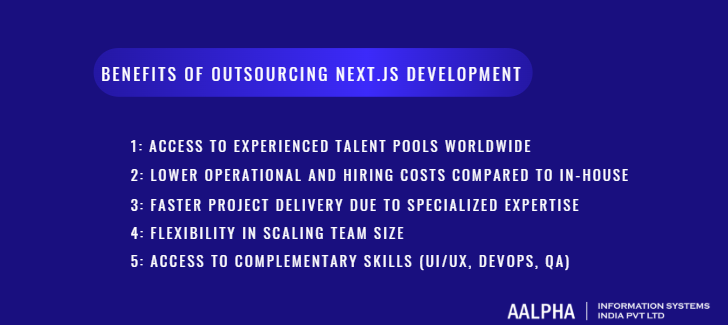
Outsourcing Next.js development offers several Next.js advantages, including enhanced performance, SEO optimization, and server-side rendering. When combined with outsourcing, companies gain measurable benefits in cost, speed, and technical capability. By leveraging external expertise, businesses can address skill gaps, reduce overhead, and deliver projects more efficiently.
-
Access to Experienced Talent Pools Worldwide
Next.js has a global developer community with strong adoption across North America, Europe, Asia, and Latin America. Outsourcing opens access to developers who have worked on a variety of projects, from small marketing sites to enterprise-grade applications.
Experienced Next.js professionals are proficient not only in React but also in related technologies such as server-side rendering, static generation, and API integrations. Many have expertise in modern deployment environments like Vercel, AWS, and serverless architectures. This level of skill can be difficult to assemble quickly in a purely local hiring market.
For example, a European eCommerce company might outsource to a Indian agency with a portfolio of SSR-optimized retail platforms, benefiting from both proven experience and lower rates compared to Western Europe.
-
Lower Operational and Hiring Costs Compared to In-House
Hiring in-house developers involves recruitment expenses, salaries, benefits, office infrastructure, and training. In regions with high demand for JavaScript talent, these costs can be significant. Outsourcing converts many of these fixed costs into variable costs, paid only for the duration of the project.
India, in particular, stands out for combining competitive rates with a vast pool of experienced Next.js developers, many of whom have delivered enterprise-grade projects for global clients. This allows businesses to maximize budgets, directing more resources toward design, testing, or marketing without sacrificing development quality.
Additionally, outsourcing removes the risk of retaining underutilized staff after the project ends, as external teams can be scaled down immediately after delivery.
-
Faster Project Delivery Due to Specialized Expertise
Outsourced teams specializing in Next.js often have established workflows, code libraries, and deployment processes that shorten development timelines. These teams are familiar with common challenges in Next.js projects, such as implementing incremental static regeneration, optimizing image delivery, or configuring internationalization.
A team with previous experience in similar projects can bypass the trial-and-error phase, moving directly into implementation. This is particularly valuable for businesses working against fixed launch dates, such as product announcements, marketing campaigns, or seasonal promotions.
For example, a U.S.-based SaaS provider outsourcing to a dedicated Next.js team in Asia could have an MVP ready in 10 weeks instead of the 16–20 weeks it might take to assemble and onboard a new in-house team.
-
Flexibility in Scaling Team Size
One of the key operational benefits of outsourcing is the ability to scale team size based on project needs. During early stages, a small core team can handle setup and architecture. As development accelerates, more developers, designers, and QA specialists can be added temporarily.
This scalability works in reverse after launch, allowing businesses to maintain a smaller support team for ongoing maintenance without paying for unused capacity. It is especially effective for projects with fluctuating workloads or multiple development phases.
-
Access to Complementary Skills (UI/UX, DevOps, QA)
Successful Next.js projects often require more than frontend development. Outsourcing firms typically provide access to:
- UI/UX Designers – To create user-friendly interfaces and maintain visual consistency.
- DevOps Engineers – To set up CI/CD pipelines, optimize server performance, and manage cloud deployments.
- Quality Assurance Specialists – To test application functionality, performance, and compatibility across devices.
These roles are difficult to staff in-house for small to mid-sized companies, especially if they are not needed full-time. Outsourcing consolidates these skills under one contract, simplifying management and coordination.
Potential Risks and How to Mitigate Them
Outsourcing Next.js development offers cost, speed, and scalability benefits, but it also carries operational and strategic risks. Understanding these risks and applying structured mitigation strategies is essential for achieving a successful outcome.
Communication Barriers in Remote Collaboration
Risk:
Distributed teams may experience misunderstandings due to language differences, lack of shared context, or varying levels of technical fluency. Misinterpreted requirements can lead to incorrect implementations, rework, and delays.
Mitigation Strategies:
- Clear Documentation: Provide detailed functional and technical specifications before development begins. Use shared documents for updates.
- Structured Communication Tools: Use platforms like Slack, Microsoft Teams, or Mattermost for real-time updates, and Confluence or Notion for documentation.
- Regular Video Calls: Schedule weekly sprint reviews and planning meetings via Zoom or Google Meet to clarify requirements and align on progress.
- Visual References: Use wireframes, mockups, and prototypes to reduce ambiguity.
Time Zone Differences and Productivity Issues
Risk:
Working across time zones can slow down decision-making, extend feedback loops, and delay resolution of blocking issues.
Mitigation Strategies:
- Overlap Hours: Identify at least 2–4 hours of daily overlap where both parties can collaborate in real-time.
- Asynchronous Communication: Use detailed written updates in project management tools (Jira, Trello, ClickUp) to keep work progressing without waiting for meetings.
- Defined Response Times: Agree on expected turnaround times for messages, code reviews, and approvals.
- Shift Scheduling: For critical phases, consider aligning part of the outsourced team’s hours with the client’s time zone.
Quality Assurance and Code Maintainability Concerns
Risk:
Without proper controls, outsourced code may not meet maintainability or performance standards. Inconsistent coding practices, lack of automated testing, or insufficient documentation can increase long-term costs.
Mitigation Strategies:
- Code Standards Agreement: Define coding conventions, linting rules, and commit practices before development starts.
- Code Reviews: Require pull request reviews by senior developers or the client’s technical lead.
- Automated Testing: Implement unit, integration, and end-to-end testing early in the project.
- Staging Environment: Maintain a staging server to review features before production deployment.
- Knowledge Transfer: Require well-structured documentation and walkthrough sessions before handover.
Security and IP Protection Risks
Risk:
Outsourcing introduces exposure to sensitive information, proprietary code, and business logic. Without proper agreements and access control, there is a risk of unauthorized use or data breaches.
Mitigation Strategies:
- Legal Agreements: Use Non-Disclosure Agreements (NDAs) and Intellectual Property Assignment clauses in contracts.
- Access Management: Grant the minimum required access to repositories, databases, and production environments. Use role-based permissions.
- Secure Repositories: Host code in private Git repositories with activity logging.
- Data Compliance: Ensure the vendor follows relevant data protection regulations (GDPR, HIPAA, or local equivalents).
- Security Audits: Perform regular security scans and code audits during development.
Vendor Lock-In or Dependency Risks
Risk:
If all knowledge and infrastructure remain with the outsourcing vendor, the client may face difficulties switching providers or taking development in-house.
Mitigation Strategies:
- Source Code Ownership: The contract should clearly state that the client owns all source code, assets, and documentation.
- Documentation Requirements: Maintain up-to-date technical and functional documentation in a format accessible to any new developer.
- Infrastructure Access: Ensure all hosting, domain, and account credentials are registered under the client’s control.
- Escrow Agreements: For long-term projects, use code escrow services that store source code securely and release it if the vendor cannot fulfill obligations.
Applying Structured Risk Management
Mitigation is most effective when embedded into the outsourcing process from the start:
- Contracts: Define scope, deliverables, timelines, payment terms, and penalties for missed deadlines or quality failures. Include IP and confidentiality clauses.
- Agile Sprints: Break the project into short, manageable iterations with regular deliverables, making it easier to catch and address issues early.
- Code Reviews and Continuous Integration: Ensure every piece of code passes review and automated testing before merging.
- Performance Metrics: Use measurable KPIs, such as build performance, page load times, and Core Web Vitals scores, to track technical quality.
- Escrow and Exit Strategy: Prepare a transition plan in case the vendor relationship ends, ensuring continuity without disruption.
By anticipating risks and putting clear controls in place, businesses can outsource Next.js development with greater confidence, maintaining both quality and operational stability.
Outsourcing Next.js Development – Step-by-Step Guide
Outsourcing a Next.js project is not just about hiring developers; it’s a structured process that requires careful planning, selection, and ongoing oversight. Each stage builds on the previous one, ensuring that both the technical execution and business outcomes align with your goals. Below is a nine-step process that covers everything from defining your requirements to final deployment and handover.
Step 1: Define Project Scope and Goals
Before engaging with any outsourcing vendor, the first step is to clearly define what you want the application to achieve. A vague brief will almost always lead to misunderstandings, rework, and missed deadlines. Your project scope should detail the core functionality, design requirements, performance targets, and timelines.
This involves:
- Setting clear objectives: Define measurable goals such as the number of features to be built, expected Core Web Vitals scores, or maximum page load times. Specify if SEO is a priority, whether the app will need multi-language support, or if there will be third-party API integrations.
- Describing the user journey: Outline primary user flows from first visit to goal completion. For example, in an eCommerce site, this could include browsing products, filtering results, adding to cart, and completing checkout.
- Detailing performance metrics: Set clear benchmarks such as “Time to Interactive under 2.5 seconds” or “First Contentful Paint under 1.8 seconds” to ensure both parties are aligned on performance expectations.
- Creating a requirements document: Include both functional requirements (e.g., “product search must support fuzzy matching”) and technical project requirements (e.g., “use ISR for category pages, host on Vercel, database in PostgreSQL”).
A well-prepared scope will not only guide the development process but also make it easier to compare proposals from multiple outsourcing vendors.
Step 2: Choose the Right Outsourcing Model
The next step is deciding which outsourcing model best suits your project. The choice affects costs, control, communication, and delivery speed. There are three main models:
- Freelancers:
Suitable for small, well-defined tasks or short-term enhancements, such as integrating a headless CMS or improving image optimization. While they typically cost less, they require hands-on management, especially if multiple freelancers are working on different parts of the application.
- Dedicated Remote Teams:
Ideal for larger projects or ongoing development. You get a consistent team of developers, designers, and testers working exclusively on your project, which improves continuity and knowledge retention.
- Full-Service Agencies:
Best for end-to-end delivery, including design, frontend, backend, DevOps, and QA. Agencies provide project managers to oversee timelines and budgets, reducing the client’s coordination workload.
When selecting a model, also consider geographical alignment:
- Onshore: Easier communication and cultural alignment, but higher costs.
- Nearshore: Balanced cost and time zone overlap.
- Offshore: Lowest hourly rates, but may require more structured communication and overlap hours to offset time zone gaps.
Read: Onshore vs Offshore vs Nearshore
Step 3: Research and Shortlist Vendors
Once the model is chosen, begin identifying potential outsourcing partners. The goal here is to filter out vendors who lack relevant Next.js experience or who cannot meet your quality standards.
Evaluation involves:
- Portfolio review: Look for projects with similar complexity, scale, and functionality. A vendor’s work on high-traffic, SEO-optimized websites is a good indicator of SSR/SSG expertise.
- Client testimonials: Verified feedback on platforms like Clutch can reveal strengths and weaknesses in project management, technical quality, and communication.
- Public code samples: Reviewing GitHub repositories or open-source contributions can give insight into coding style, best practice adherence, and familiarity with modern JavaScript tooling.
You can use discovery platforms such as:
- Clutch for verified agency reviews.
- Upwork for hiring freelancers with documented work histories.
- Toptal for pre-vetted, senior-level developers.
Step 4: Evaluate Technical Expertise
At this stage, the focus shifts to verifying that your shortlisted candidates have the required Next.js skills and complementary technical knowledge. This is where involving an experienced technical consultant—or working with a top-rated web development company like Aalpha for complex builds—can help ensure you’re assessing the right capabilities.
Core Next.js expertise should include:
- Proficiency in SSR and SSG for different performance and SEO needs.
- Implementing Incremental Static Regeneration (ISR) for pages that need periodic updates.
- Setting up API routes for serverless backend logic within Next.js.
- Building middleware for authentication, redirects, and request handling.
- Managing deployment pipelines using Vercel, AWS, or Docker.
Complementary skills that often prove essential:
- TailwindCSS for rapid, consistent styling.
- TypeScript for type safety and maintainable large-scale applications.
- GraphQL for efficient API data fetching and schema-based development.
- Integration with headless CMS platforms such as Contentful, Sanity, or Strapi.
Step 5: Conduct Interviews and Technical Tests
Even when portfolios and testimonials look promising, a live technical assessment helps confirm competence.
Key areas to cover in interviews:
- Experience with performance optimization in SSR environments.
- Approach to state management (Redux, Zustand, SWR) in Next.js applications.
- Strategies for handling error boundaries and fallback UIs.
Sample interview questions:
- “How would you implement ISR for a blog with frequently updated articles?”
- “What steps do you take to optimize Core Web Vitals in a Next.js app?”
- “How do you secure API routes in a production deployment?”
For practical tests, you might assign:
- Building a multi-language landing page with SSR and image optimization.
- Implementing a dynamic route with parameter-based content loading from an API.
Step 6: Set Clear Contract and Payment Terms
Contracts should remove ambiguity and protect both parties. Key inclusions:
- Milestone-based payments linked to deliverables rather than hours.
- IP ownership clauses stating that all code, assets, and documentation belong to the client.
- Confidentiality agreements (NDAs) to protect sensitive business information.
Also define timelines, delivery expectations, and the process for handling scope changes.
Step 7: Establish Communication and Project Management Framework
A well-structured communication plan prevents delays and misunderstandings.
- Project management tools: Jira, Trello, or ClickUp for sprint planning and task tracking.
- Daily or weekly updates: Regular progress reports help identify issues early.
- Feedback loops: Scheduled sprint reviews ensure features are built to spec before moving forward.
Step 8: Monitor Progress and Quality
Quality control must be continuous, not an afterthought.
- Code reviews: Every pull request should be reviewed before merging.
- Automated testing: Implement unit, integration, and end-to-end tests early.
- Staging environments: Test all features in staging before production deployment.
- Bug tracking: Use tools like Linear or Jira for structured bug reporting and resolution.
Step 9: Deployment and Handover
The final step is to launch the application and transfer ownership of all assets.
- Hosting: Vercel offers seamless deployment for Next.js, while AWS and DigitalOcean provide more customizable options.
- Documentation: Deliver complete documentation covering architecture, deployment steps, and operational guidelines.
- Knowledge transfer sessions: Conduct handover meetings to walk through the codebase and answer any operational questions.
Cost of Outsourcing Next.js Development
The cost of outsourcing Next.js development varies widely depending on location, project complexity, required expertise, and engagement model. Understanding these factors upfront allows businesses to budget accurately and choose an outsourcing partner that delivers value without compromising quality.
Hourly Rates by Region
Developer rates are influenced heavily by geography, local market demand, and cost of living.
- United States and Canada
Senior Next.js developers in North America typically charge between $80–$150 per hour. This premium reflects higher labor costs, strong demand for skilled JavaScript engineers, and the advantage of working in the same time zone as U.S.-based clients. These rates are often justified for projects requiring close collaboration, high security standards, or deep integration with other U.S.-based teams. - Western Europe (UK, Germany, France, Netherlands)
Rates generally range from $60–$120 per hour, with London and Berlin at the higher end due to competitive tech ecosystems. Western European vendors often bring strong design and UX capabilities in addition to technical skills, making them attractive for projects where brand experience is a priority. - Eastern Europe (Poland, Ukraine, Romania, Serbia)
A popular choice for outsourcing due to a strong pool of React and Next.js developers, with rates between $40–$70 per hour. Eastern European teams are known for solid technical education, good English proficiency, and overlapping working hours with both Europe and North America. - Asia (India, Vietnam, Philippines)
India in particular has become one of the most trusted outsourcing destinations for high-quality Next.js development at competitive rates. Skilled developers in India often charge $25–$50 per hour, with senior architects and specialized engineers on the higher end. The country’s long history in IT services means many firms have established workflows for agile development, quality assurance, and timely delivery. Vietnam and the Philippines also offer competitive rates, though India stands out for its combination of technical expertise, English fluency, and ability to handle complex, enterprise-grade projects.
Factors Affecting Cost
Several variables determine the final outsourcing budget beyond just the hourly rate:
- Project Complexity
A simple marketing website with a few static pages costs far less than a full-scale SaaS platform with real-time data updates, user authentication, and multi-language support.
- Third-Party Integrations
Connecting Next.js applications to payment gateways, headless CMS platforms, CRM systems, or analytics tools adds development time. The complexity of these integrations directly impacts cost.
- Custom Design Requirements
Using standard UI frameworks like Tailwind CSS reduces design time, while fully custom, pixel-perfect UI/UX work increases cost due to additional design, front-end development, and testing effort.
- Performance and Scalability Needs
Applications requiring advanced performance optimization, CDN integration, or multi-region deployment will involve additional DevOps work.
- Compliance Requirements
Projects in regulated industries (finance, healthcare) may require security audits, compliance testing, and specialized hosting, adding to the budget.
Fixed-Price vs. Time-and-Materials Contracts
The pricing model you choose will also affect overall cost control and flexibility:
- Fixed-Price Contracts
- Advantages: Predictable costs, suitable for projects with clearly defined scopes and minimal expected changes.
- Risks: Any scope change usually triggers renegotiation or change orders, which can slow progress.
- Best for: Smaller projects or MVPs with well-documented requirements.
- Advantages: Predictable costs, suitable for projects with clearly defined scopes and minimal expected changes.
- Time-and-Materials (T&M) Contracts
- Advantages: Flexibility to adjust scope as the project evolves, allowing for iterative development and feature prioritization.
- Risks: Costs can exceed initial estimates without strong project management.
- Best for: Complex, evolving projects where requirements may shift based on user feedback or market changes.
- Advantages: Flexibility to adjust scope as the project evolves, allowing for iterative development and feature prioritization.
Read: Time and Material vs. Fixed Price Contract : Comparison
Many companies use a hybrid approach—a fixed price for the initial discovery and design phase, followed by T&M for development and iterations.
Hidden Costs to Watch For
Outsourcing can deliver cost savings, but unexpected expenses often arise when not planned for:
- Project Management Overhead
Even with an outsourcing partner, clients need to allocate internal time for meetings, feedback, and reviews.
- Communication Delays
Time zone differences or unclear specifications can result in longer feedback loops, indirectly increasing cost.
- Scope Creep
Adding “just one more feature” without adjusting timelines or budgets can lead to substantial overruns.
- Post-Launch Maintenance
Bug fixes, security patches, and feature updates after deployment often require an ongoing retainer or support contract.
- Licensing Fees
Some third-party integrations, UI libraries, or analytics tools require paid licenses not included in the development estimate.
Why India Offers a Strong Value Proposition
India remains a top outsourcing destination for Next.js development for several reasons:
- Large Talent Pool: Millions of skilled software developers, many with deep experience in React, Next.js, and full-stack JavaScript development.
- Competitive Pricing: High-quality work at rates significantly lower than North America and Western Europe, allowing clients to stretch their budgets further.
- English Proficiency: Strong communication skills with global clients, minimizing misunderstandings.
- Proven Delivery Models: Established processes for agile sprints, code reviews, and QA ensure predictable quality and timelines.
- Enterprise Experience: Many Indian firms have experience delivering for Fortune 500 companies, startups, and mid-sized businesses, making them adaptable to different project scales.
Best Practices for Successful Outsourcing
Outsourcing a Next.js project is most effective when managed with clear performance targets, strong communication, and a process that supports continuous improvement. The following best practices help maximize return on investment, minimize risk, and create a foundation for successful collaboration.
-
Setting Measurable KPIs
Without measurable performance indicators, it’s difficult to track progress or hold an outsourcing partner accountable. Key Performance Indicators (KPIs) ensure both parties share the same definition of success and provide a factual basis for decision-making.
Examples of effective KPIs for Next.js projects include:
- Delivery Milestones: Percentage of features completed against the project timeline.
- Performance Benchmarks: Core Web Vitals scores such as Largest Contentful Paint (LCP) under 2.5 seconds, Cumulative Layout Shift (CLS) below 0.1.
- Code Quality: Number of critical bugs identified in testing phases, adherence to ESLint/Prettier standards.
- Testing Coverage: Percentage of code covered by automated unit and integration tests.
- SEO Metrics: Organic traffic growth or page ranking improvements post-launch for SSR-rendered pages.
KPIs should be set at the start of the project, monitored regularly, and adjusted if priorities shift.
-
Building Trust with Remote Teams
Trust is a critical element in outsourced development. Without it, collaboration suffers, decision-making slows, and quality declines. Building trust starts with transparency and mutual accountability.
Strategies to foster trust include:
- Regular Communication: Weekly or bi-weekly video calls for sprint reviews and planning.
- Transparent Reporting: Access to project management boards (Jira, Trello, ClickUp) so progress is visible in real time.
- Clear Role Definition: Ensuring every team member understands their responsibilities and deliverables.
- Cultural Awareness: Recognizing and respecting time zones, public holidays, and work habits.
Trust also grows when outsourcing partners demonstrate reliability over time—delivering on commitments, meeting deadlines, and proactively solving problems rather than waiting for the client to raise issues.
-
Maintaining Long-Term Relationships for Future Projects
A one-off engagement can solve an immediate need, but building an ongoing relationship with a capable outsourcing partner delivers greater benefits over time. Familiarity with your business, codebase, and workflow reduces ramp-up time for future projects and accelerates delivery.
Advantages of long-term partnerships include:
- Reduced Onboarding Time: Returning developers already understand your tech stack, coding standards, and communication preferences.
- Consistent Quality: Proven teams can maintain code quality across multiple projects, ensuring a cohesive product ecosystem.
- Better Cost Management: Long-term contracts or retainers may secure preferential rates.
- Scalability on Demand: A partner who understands your business can quickly allocate more resources when needed.
Maintaining these relationships requires regular performance reviews, fair compensation, and acknowledgment of quality work. Outsourcing partners that feel valued are more likely to prioritize your projects.
-
Iterative Development and Agile Methodologies
Agile methodologies such as Scrum or Kanban are well-suited to outsourced Next.js development because they encourage incremental progress, frequent feedback, and the ability to adapt to changing requirements.
Benefits of agile outsourcing include:
- Short Development Cycles: Features are delivered in sprints (typically 1–2 weeks), allowing for regular review and adjustment.
- Early Problem Detection: Regular sprint reviews highlight issues before they affect the entire project.
- Flexibility in Priorities: Backlogs can be reprioritized based on user feedback or business needs.
- Continuous Improvement: Retrospectives after each sprint identify process improvements for the next cycle.
In practice, agile outsourcing might look like this:
- Sprint planning on Monday to define tasks for the next two weeks.
- Daily standups (15 minutes) to track progress and address blockers.
- Sprint review at the end to present completed work.
- Retrospective to evaluate successes and challenges.
For clients who want both speed and accountability, combining agile practices with KPIs provides a clear roadmap and measurable results.
-
Integrating Best Practices into Daily Operations
To ensure these best practices are not just theoretical, embed them into the day-to-day workflow from the outset:
- Include KPI tracking as part of sprint reports.
- Use shared dashboards for project visibility.
- Schedule regular check-ins focused on both technical and relationship health.
- Encourage open feedback channels for both the client and the outsourcing team.
A well-managed outsourcing relationship, built on measurable goals, mutual trust, and iterative development, can deliver faster releases, higher-quality code, and a collaborative environment that benefits both parties.
How to Choose Between Outsourcing and In-House Development
Choosing between outsourcing and in-house development for a Next.js project is a strategic decision that affects cost, delivery speed, control, and technical capabilities. The right choice depends on business priorities, available resources, and the nature of the project.
Comparative Analysis: Cost, Speed, Control, and Expertise
- Cost
Outsourcing can reduce development costs by tapping into lower-rate talent markets without sacrificing quality, especially when working with regions like India or Eastern Europe. It converts fixed costs such as salaries, benefits, and infrastructure into variable costs tied directly to the project duration. In-house development, however, involves ongoing expenses even when project demand is low, but it offers predictable staffing costs for long-term roadmaps.
- Speed
A vetted outsourcing partner can start immediately, often with a team that has prior experience building projects similar to yours. This avoids the hiring and onboarding delays common with in-house recruitment. In-house teams may move slower initially but can accelerate once established, especially if the same product requires continuous iteration over years.
- Control
In-house teams offer greater day-to-day oversight, instant decision-making, and alignment with internal culture. Outsourcing provides less direct control, but this can be offset with structured communication, sprint reviews, and project management tools.
- Expertise
Specialized technical skills such as incremental static regeneration, API route optimization, or advanced deployment strategies may be easier to find in outsourcing markets where agencies and freelancers have broad exposure to varied projects. In-house teams may lack certain niche skills unless the company invests in training or hires for very specific roles.
Decision Matrix for Founders and CTOs
While there is no one-size-fits-all approach, the decision becomes clearer when focusing on the following questions:
- How urgent is the launch?
- If timelines are tight and hiring would take weeks or months, outsourcing offers faster ramp-up.
- If timelines are tight and hiring would take weeks or months, outsourcing offers faster ramp-up.
- Is the project scope well-defined?
- Well-scoped projects are easier to outsource with fixed timelines and costs. Evolving requirements may benefit from an in-house team’s ability to adapt rapidly.
- Well-scoped projects are easier to outsource with fixed timelines and costs. Evolving requirements may benefit from an in-house team’s ability to adapt rapidly.
- Does the project require ongoing, continuous development?
- Long-term maintenance with frequent updates often justifies building an in-house team, while short-term or seasonal projects align better with outsourcing.
- Long-term maintenance with frequent updates often justifies building an in-house team, while short-term or seasonal projects align better with outsourcing.
- What is the available budget structure?
- If the budget is suited for short-term engagement, outsourcing keeps costs contained. For products with steady revenue, in-house investment might be sustainable.
- If the budget is suited for short-term engagement, outsourcing keeps costs contained. For products with steady revenue, in-house investment might be sustainable.
- Are specialized skills needed?
- If your current team lacks critical Next.js expertise, outsourcing provides immediate access without the learning curve.
- If your current team lacks critical Next.js expertise, outsourcing provides immediate access without the learning curve.
A founder or CTO should weigh these questions alongside company growth plans. For startups aiming to validate an MVP quickly, outsourcing is often the most efficient choice. For mature products with stable revenue and a roadmap extending years ahead, in-house development can deliver long-term stability and control.
Hybrid Models: In-House Leadership + Outsourced Execution
A hybrid model often combines the strengths of both approaches and is especially effective for Next.js projects that require rapid delivery without sacrificing alignment with business strategy.
How the hybrid model works:
- The in-house team handles strategic direction, architecture decisions, and high-priority features.
- The outsourced team executes well-defined development tasks, handles secondary features, or takes on specialized modules such as performance optimization, CMS integration, or localization.
- Both teams work within a shared agile framework, using the same project management tools, sprint schedules, and code repositories.
Advantages of the hybrid approach:
- Speed with oversight: Outsourced teams accelerate delivery while in-house leadership ensures technical and business alignment.
- Skill diversity: Access to specialized outsourcing skills without fully replacing internal capabilities.
- Scalability: Easily add outsourced capacity during product launches or feature spikes, then scale down afterward.
- Knowledge retention: In-house leads document processes and maintain core code knowledge, reducing dependency on external vendors.
For example, a SaaS company might keep its core engineering team focused on platform stability and backend services while outsourcing the development of a Next.js-based marketing site and onboarding dashboard. This preserves in-house resources for mission-critical work while still accelerating feature delivery.
Making the Final Decision
Ultimately, the choice between outsourcing, in-house development, or a hybrid approach depends on the company’s goals, timelines, and capacity to manage distributed teams. Outsourcing offers speed, flexibility, and access to global expertise, making it ideal for MVPs, redesigns, migrations, or projects with fixed deadlines. In-house teams deliver consistent oversight and cultural alignment, best suited for long-term core product development.
In many cases, a phased strategy works best:
- Phase 1: Outsource the initial build to validate the concept and reach the market quickly.
- Phase 2: Transition core development in-house once the product has proven traction and stable revenue.
- Phase 3: Maintain a hybrid setup, outsourcing specialized or non-core modules as needed.
This layered approach balances speed, cost, and long-term control, ensuring that technical decisions remain aligned with the company’s evolving objectives.
Future Trends in Next.js Development and Outsourcing
Next.js continues to evolve rapidly, not only in its technical capabilities but also in how it’s used within outsourced development projects. Understanding where the technology and the outsourcing market are headed helps businesses future-proof their applications and select vendors that can deliver long-term value.
-
AI-Assisted Next.js Development Workflows
Artificial intelligence is becoming increasingly integrated into the development lifecycle, from planning to deployment. For outsourced projects, AI-assisted workflows can speed delivery, improve code quality, and reduce repetitive work.
Key developments include:
- AI-powered code generation: Tools like GitHub Copilot and Codeium can accelerate component creation, unit test generation, and boilerplate setup for Next.js projects.
- Automated code review: AI-driven review tools analyze pull requests for performance issues, security risks, and coding standard violations before human review.
- Content personalization: Outsourced teams can integrate AI models into Next.js to deliver personalized content at render time, combining SSR capabilities with real-time recommendations.
- Predictive project management: AI-based analytics in tools like Jira can forecast bottlenecks and optimize sprint planning.
For outsourcing, this means vendors who embrace AI workflows will deliver faster, more consistent results while maintaining high code quality standards.
-
Increasing Use of Serverless Architectures
Serverless infrastructure is becoming the default choice for many Next.js deployments, particularly in outsourced environments where efficiency and scalability are critical.
Why serverless matters for outsourcing:
- Lower infrastructure management overhead: Outsourced teams can deploy API routes, middleware, and server-side functions without provisioning or managing servers.
- Automatic scaling: Serverless platforms handle sudden traffic spikes without manual intervention, crucial for eCommerce, media, and marketing projects with unpredictable demand.
- Cost efficiency: Pay-as-you-go pricing means clients only pay for actual usage, which is ideal for MVPs and projects in early growth phases.
Popular serverless platforms for Next.js include:
- Vercel (native Next.js support, edge functions).
- AWS Lambda (integrated into broader AWS ecosystems).
- Netlify Functions and Cloudflare Workers for edge deployments.
Vendors experienced with serverless solutions can offer faster deployments, easier scaling, and reduced operational costs.
-
Next.js and Jamstack Adoption in Enterprise Projects
Jamstack (JavaScript, APIs, and Markup) has shifted from a niche approach to a mainstream enterprise architecture, with Next.js playing a central role. For enterprises outsourcing frontend development, Next.js offers the flexibility to combine static and dynamic rendering strategies within the same application.
Why enterprises are adopting Next.js within Jamstack:
- Performance and SEO: Combining SSG with SSR in a single codebase ensures optimal load times and search rankings for both static marketing pages and dynamic application views.
- Security advantages: Decoupling the frontend from backend services reduces the attack surface, a priority for enterprise IT teams.
- Scalability: Jamstack architectures can scale globally using CDNs and edge networks, making them suitable for multi-region operations.
Outsourcing implications:
Enterprises increasingly seek vendors with experience in hybrid rendering, API orchestration, and multi-CMS integration. Vendors proficient in Jamstack and Next.js can deliver solutions that meet both performance and compliance requirements at scale.
-
The Rise of Microservices and Edge Computing for Web Apps
Next.js applications are increasingly being deployed within distributed architectures that combine microservices and edge computing.
Trends driving this shift:
- Microservices: Breaking applications into smaller, independently deployable services allows faster updates, improved fault isolation, and technology flexibility. For example, a Next.js frontend might consume APIs from multiple backend services—each owned and maintained by different teams or vendors.
- Edge computing: Executing functions closer to the user (via Cloudflare Workers, Vercel Edge Functions, AWS CloudFront) reduces latency and improves responsiveness for global audiences.
- Geo-specific personalization: Edge logic can customize content based on user location before the page is rendered, improving relevance without sacrificing speed.
Benefits for outsourced development:
- Outsourced teams can build and deploy discrete microservices without impacting other parts of the system, allowing parallel development.
- Edge deployment reduces dependency on centralized infrastructure, making it easier for globally distributed vendors to optimize performance for specific markets.
What This Means for Businesses Outsourcing Next.js Development
Businesses looking to outsource should prioritize vendors who:
- Actively use AI tools to improve speed and quality.
- Have proven experience deploying on serverless and edge platforms.
- Understand hybrid Jamstack architectures for enterprise-grade applications.
- Can design applications within microservices frameworks for long-term scalability.
These future trends signal that Next.js outsourcing will increasingly focus on performance at scale, intelligent automation, and global-first deployment strategies. Selecting a partner aligned with these capabilities will position your application to stay competitive over the next five years.
Why Outsource Next.js Development to Aalpha
Choosing the right outsourcing partner can determine whether your Next.js project launches on time, meets performance benchmarks, and remains maintainable in the long term. Aalpha offers a combination of technical expertise, process maturity, and client-focused delivery that makes it a strong choice for businesses looking to outsource Next.js development.
Proven Expertise in Next.js and Related Technologies
Aalpha’s development teams have extensive experience with all major Next.js capabilities, including:
- Server-Side Rendering (SSR) for SEO and performance-critical pages.
- Static Site Generation (SSG) for high-speed content delivery.
- Incremental Static Regeneration (ISR) to update content without full redeploys.
- API Routes and Middleware for secure, scalable backend logic within Next.js.
They also bring complementary skills in TypeScript, Tailwind CSS, GraphQL, and headless CMS integrations like Contentful, Sanity, and Strapi, ensuring a full-stack delivery capability.
Flexible Engagement Models
Aalpha understands that every project has unique requirements, timelines, and budgets. They offer:
- Dedicated Teams for long-term, continuous development.
- Fixed-Scope Projects with clear deliverables and timelines.
- Hybrid Collaboration where in-house leadership sets direction and Aalpha executes delivery.
This flexibility allows startups, SMEs, and enterprises to engage on terms that fit their operational needs.
Focus on Performance and Maintainability
Aalpha places strong emphasis on performance optimization and long-term code maintainability:
- Uses automated testing, linting, and CI/CD pipelines to maintain code quality.
- Adopts agile sprints with measurable KPIs for consistent delivery progress.
- Delivers full documentation and conducts knowledge transfer sessions to avoid vendor lock-in.
Global Delivery Experience with Local Understanding
With experience delivering projects for clients in the U.S., Europe, and Asia, Aalpha combines global delivery standards with adaptability to local market needs. Their teams are accustomed to working across time zones and maintaining transparent communication through regular sprint reviews, progress reports, and shared project boards.
Client-Centric Approach
Aalpha’s approach goes beyond coding. They aim to understand the business objectives behind each project, aligning technical execution with measurable outcomes such as improved load times, increased conversion rates, or higher search rankings.
By outsourcing Next.js development to Aalpha, businesses gain a partner capable of delivering technically advanced, performance-focused applications while maintaining flexibility, transparency, and long-term maintainability. This combination makes them an ideal choice for companies seeking both speed to market and sustainable quality.
Conclusion: Strategic Outsourcing for Next.js Success
Outsourcing Next.js development offers businesses a proven way to accelerate delivery, access specialized expertise, and optimize budgets. Throughout this guide, we explored how outsourcing can deliver measurable results when approached with a structured process—starting from defining clear project goals, choosing the right outsourcing model, and shortlisting capable vendors, to ensuring robust quality control, managing risks, and planning for long-term scalability.
Key themes emerged across the steps:
- Clear scope and measurable KPIs are the foundation of a successful outsourcing engagement.
- Vendor selection should be based on demonstrated Next.js expertise, relevant industry experience, and the ability to meet both technical and business requirements.
- Structured communication and agile methodologies help maintain alignment and catch issues early.
- Future-readiness—through serverless deployment, AI-assisted workflows, Jamstack adoption, and microservices integration—ensures your Next.js application remains competitive.
Strategic planning is essential before committing to outsourcing. Rushing into vendor selection without defined objectives, performance benchmarks, and an understanding of the required technical capabilities often leads to delays, cost overruns, or substandard results. Businesses should approach outsourcing as a collaborative partnership rather than a simple transactional arrangement. This means:
- Documenting all functional and technical requirements before engagement.
- Setting realistic timelines that allow for iterative feedback and refinement.
- Building a relationship based on transparency, mutual accountability, and trust.
For many organizations, especially those without deep in-house frontend expertise, outsourcing to a seasoned partner is the most efficient way to build high-performance, scalable Next.js applications. This is where Aalpha stands out. With years of experience delivering complex React and Next.js projects for startups, SMBs, and enterprises, Aalpha offers:
- A proven track record in SSR, SSG, ISR, and advanced Next.js optimizations.
- Expertise in integrating Next.js with headless CMS platforms, GraphQL APIs, and modern deployment pipelines.
- Flexible engagement models—whether you need a dedicated remote team, a fixed-scope build, or a hybrid collaboration alongside your in-house staff.
- A commitment to code quality, performance benchmarks, and long-term maintainability through detailed documentation and knowledge transfer.
By selecting the right outsourcing partner, aligning on shared goals, and adopting future-ready practices, businesses can not only deliver successful Next.js projects today but also position themselves for continued innovation and market competitiveness. Strategic outsourcing isn’t just about reducing costs—it’s about accelerating growth, improving technical capabilities, and building products that perform at the highest level.
FAQs – Outsourcing Next.js Development
Why choose Aalpha for Next.js outsourcing?
Aalpha delivers high-performance Next.js projects with expertise in SSR, SSG, ISR, API integrations, and modern deployments. They offer flexible engagement models, transparent communication, and maintain strict code quality standards, making them a trusted choice for startups and enterprises.
How long does it take to outsource a Next.js project from start to finish?
Small sites can be built in 3–6 weeks, mid-sized apps in 8–14 weeks, and complex platforms in 4–6 months. Timelines shorten if you have clear requirements and work with a team experienced in similar projects.
Can I switch vendors midway through a Next.js project
Yes, but plan the transition carefully. Secure source code, documentation, and credentials before moving. Have the new team audit the existing codebase to identify issues and ensure a smooth handover.
How do I protect my idea when outsourcing development?
Sign an NDA, include IP ownership clauses in contracts, use private repositories, and give role-based access. Choose vendors in countries with strong IP protection laws.
What’s the best country to outsource Next.js development to
India offers skilled developers, competitive rates, and strong English communication. Eastern Europe provides high technical expertise with time zone overlap to Europe and North America. Southeast Asia and Latin America are also growing outsourcing hubs.
How do I ensure quality code from outsourced developers?
Set coding standards early, require regular code reviews, use automated testing, and work in sprints with deliverable-based milestones. Keep code in your own repository for oversight.
Can small startups afford outsourced Next.js development
Yes. Outsourcing often costs less than hiring in-house. Startups can begin with a small outsourced team or fixed-scope project to control costs while still accessing top talent.
Ready to build a high‑performance Next.js application? Partner with Aalpha for expert development, faster delivery, and long‑term maintainability — get in touch today.