


1. Introduction on Multi-Vendor Ecommerce Marketplace
The global rise of online marketplaces has permanently altered the dynamics of commerce. From Amazon and Alibaba to Flipkart and Etsy, multi-vendor ecommerce platforms now account for a significant share of digital transactions across both B2C and B2B sectors. As the barrier to entry lowers due to advancements in software-as-a-service (SaaS), cloud computing, and API-based infrastructure, a growing number of startups, established businesses, and niche entrepreneurs are exploring how to build and operate their own multi-vendor marketplaces. This guide is written to serve as a comprehensive, step-by-step blueprint for building such a platform from scratch—covering everything from market validation and platform architecture to monetization models, scaling strategies, and compliance frameworks.
This guide addresses the full lifecycle of multi-vendor ecommerce marketplace development, from ideation to launch and beyond. It provides a detailed breakdown of the technical, business, legal, and operational aspects involved in creating a scalable platform that supports multiple sellers, manages buyer interactions, automates workflows, and ensures trust and transparency between all parties.
What sets a multi-vendor ecommerce marketplace apart is its complexity: it must simultaneously cater to three distinct user types—platform administrators, vendors, and end customers—each with their own needs and expectations. This guide walks you through how to build a platform that accommodates all three with efficiency and flexibility.
By the end of this guide, you will understand how to define clear requirements, structure your product development roadmap, and deploy a secure, scalable, and conversion-optimized marketplace.
Whether your interest lies in launching a consumer-facing fashion marketplace, a B2B wholesale network, or a hyperlocal services aggregator, this guide offers the structural knowledge to begin with clarity and confidence.
Multi-vendor marketplaces are not just websites—they are complex, multi-actor ecosystems. If poorly implemented, the result is a disjointed, unscalable platform plagued by vendor churn, buyer distrust, and operational overhead. On the other hand, a well-designed marketplace can achieve network effects that allow it to grow exponentially while delivering superior value to all users.
With 2025 shaping up to be a pivotal year for digital commerce platforms due to AI integration, embedded finance, and localized fulfillment innovations, this guide helps ensure you’re making informed decisions backed by current best practices and real-world examples.
In short, this guide exists to demystify the process of building a modern multi-vendor ecommerce marketplace—giving you the knowledge foundation to make smart, cost-effective, and scalable decisions at every step of the journey.
2. Market Size & Growth Projections
The global ecommerce ecosystem is undergoing a profound transformation—both in scale and in structure. As digital commerce becomes the default mode of transaction across retail, wholesale, and service sectors, multi-vendor marketplaces are emerging as the dominant model for scalable, capital-efficient platforms. This section breaks down the market’s size, future projections, and the unique position multi-vendor models occupy within the broader ecommerce landscape.
2.1 Global Ecommerce Landscape
The worldwide ecommerce market continues to grow at a double-digit pace, driven by increasing internet penetration, improvements in logistics infrastructure, and changing consumer behavior across emerging markets. According to recent data from eMarketer and Statista, global retail ecommerce sales are projected to reach USD 7.4 trillion in 2025, accounting for approximately 24% of total global retail sales [source: eMarketer, 2024].
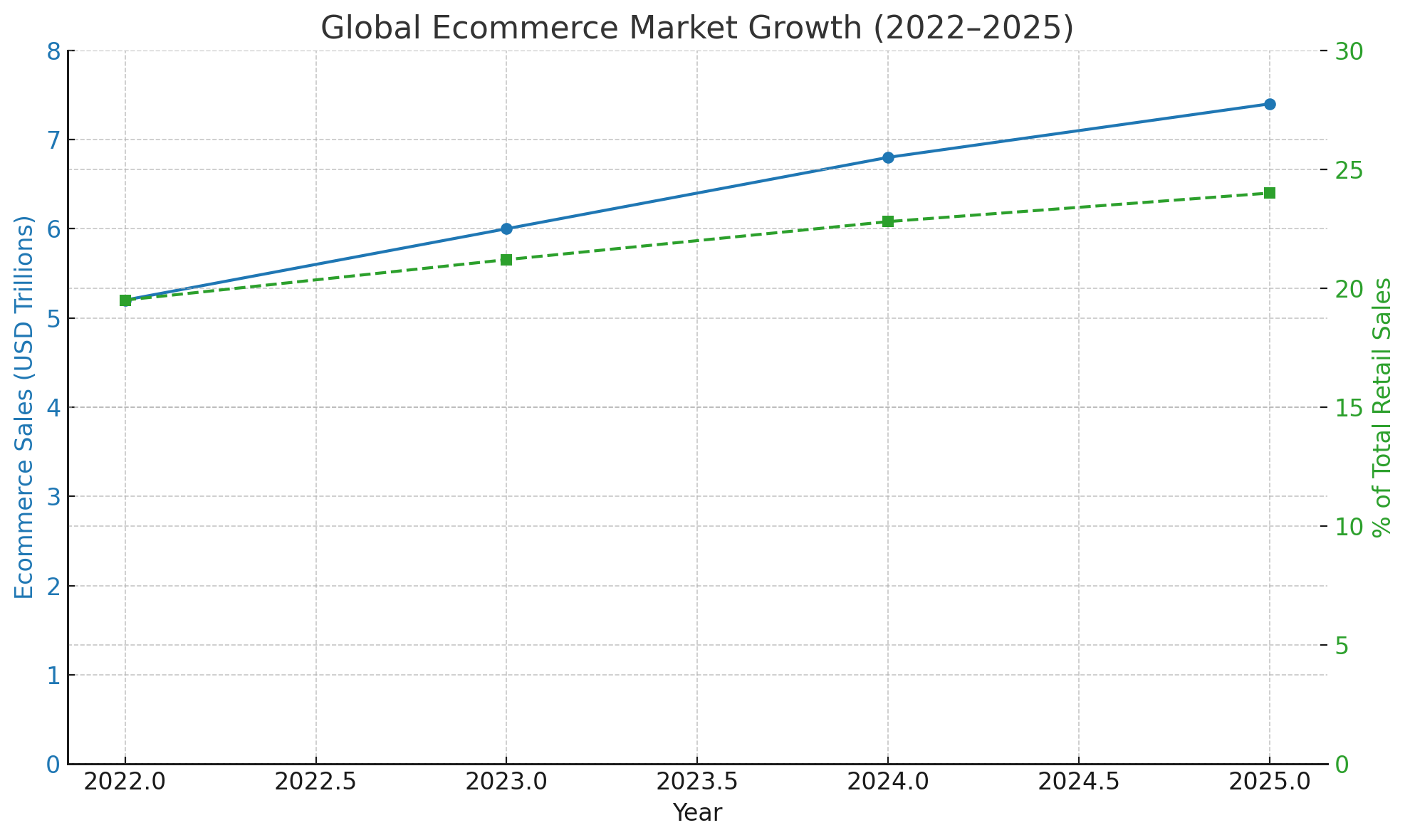
A major contributor to this growth is mobile commerce (mCommerce), which is expected to generate USD 2.51 trillion in 2025, representing a year-over-year increase of over 21%. The increasing adoption of mobile-first checkout, wallet integrations (like Apple Pay, UPI, and Google Wallet), and social commerce features has made mobile devices the primary channel for ecommerce transactions, especially in Asia-Pacific and Africa.
Ecommerce growth is not uniform, however. Mature economies like the US, UK, and Germany are seeing saturation in traditional ecommerce formats, while emerging economies—particularly India, Indonesia, Nigeria, and Brazil—are driving the next billion users into the marketplace ecosystem. This context sets the stage for the rise of multi-vendor ecommerce marketplaces, which allow for faster onboarding of sellers, minimal inventory ownership, and rapid scale through network effects.
2.2 Multi-Vendor Marketplace Segment
Within the broader ecommerce sector, multi-vendor marketplaces have emerged as the preferred model for scaling digital retail. Platforms such as Amazon, Etsy, Flipkart, Shopee, Meesho, and Zalando have built multi-billion-dollar ecosystems by serving as intermediaries between independent sellers and consumers.
According to Statista, marketplace sales now account for more than one-third of US ecommerce transactions. This share is growing at an estimated 10% compound annual growth rate (CAGR) through 2027, significantly outpacing traditional single-vendor ecommerce models.
Key factors behind this shift:
- Lower operational burden for platform owners due to decentralized inventory and fulfillment
- Broader product variety, leading to higher customer retention and average order value
- Incentivized vendor base, where each seller brings its own marketing push, audience, and product innovation
India’s ecommerce landscape is particularly illustrative. The country’s marketplace sector is valued at USD 147 billion as of 2024 and is expected to grow at a CAGR of 18.7% through 2028 [source: Wikipedia; Invest India]. Platforms like Flipkart, Meesho, and JioMart dominate local commerce by offering multilingual, mobile-first, and tier-2 city-focused experiences.
The rise of social commerce marketplaces—such as Meesho in India and Pinduoduo in China—demonstrates that the multi-vendor format is not limited to enterprise or general retail. It can be tailored to hyperlocal, community-driven buying behaviors that leverage peer trust, influencer recommendations, and group buying incentives.
From a platform owner’s perspective, the model’s attractiveness lies in its scalability. Once the base infrastructure is built—vendor onboarding, product listing, payments, and logistics—the incremental cost of adding new vendors and products is minimal, enabling exponential growth.
3. Business Model and Value Drivers
The success of a multi-vendor ecommerce marketplace lies not only in its technology but in its business model—the framework through which it generates revenue, delivers value to buyers and sellers, and sustains long-term scalability. Unlike traditional ecommerce businesses that rely on inventory turnover or direct retail margins, marketplaces are platforms. They facilitate transactions between buyers and independent sellers, extracting value by enabling, organizing, and monetizing these interactions.
This section examines the foundational business model of multi-vendor marketplaces, explores monetization mechanisms, analyzes advantages over single-vendor setups, and addresses the inherent trade-offs involved in running a platform business.
3.1 Revenue Mechanisms
A multi-vendor marketplace earns revenue primarily through platform-enablement fees rather than direct product sales. Common monetization strategies include:
1. Transaction Commissions
This is the most widely used model. The platform takes a percentage cut from each successful transaction—ranging from 5% (typical in wholesale marketplaces) to 20% or more (as seen in Etsy or Amazon). This model aligns the marketplace’s revenue with vendor success, incentivizing the platform to support high-performing sellers and drive traffic.
- Example: Amazon charges 8%–20% per sale depending on category. Etsy takes 6.5% on item price + shipping and a 3% payment processing fee.
- Best for: General merchandise, fashion, electronics, B2C and B2B retail.
2. Listing Fees
Platforms may charge vendors a flat fee for each product listed, regardless of whether it sells. While less common in modern consumer marketplaces, listing fees are still used in high-value or B2B sectors where lead quality is crucial.
- Example: Alibaba charges listing fees for verified suppliers in premium categories.
- Best for: Industrial goods, wholesale, real estate, automotive, job marketplaces.
3. Subscription Tiers
Offering monthly or annual vendor subscriptions in exchange for platform access, premium features, or lead prioritization. This stabilizes cash flow and rewards serious sellers.
- Example: IndiaMART charges sellers ₹4,000–₹30,000/month based on tier, giving access to buyer inquiries and priority placement.
- Best for: B2B marketplaces, SaaS-style platforms, niche verticals.
4. Advertising and Sponsored Listings
As marketplaces grow, they become advertising platforms. Vendors can pay to boost product visibility through sponsored placements, banner ads, or personalized targeting.
- Example: Amazon’s advertising revenue surpassed $38 billion in 2023. Etsy and Flipkart also offer in-platform ad tools.
- Best for: High-traffic platforms with competitive product categories.
5. Value-Added Services
Platforms can offer logistics (FBA-style warehousing), payment escrow, returns management, analytics dashboards, catalog optimization, or even marketing support—all monetized as optional paid services.
- Example: Meesho in India offers fulfillment and returns support to vendors for a service fee. Faire (B2B) charges 25% commission plus net-60 payment support.
- Best for: Platforms with operational infrastructure or vertical SaaS capabilities.
6. Take Rates in Context
The take rate (total revenue as a % of GMV) is a key KPI. Most marketplaces target a 10–20% blended take rate across all monetization streams. Lower-margin categories (e.g., electronics) rely more on ads and services; higher-margin (e.g., beauty, fashion) support higher commissions.
3.2 Advantages Over Single-Vendor Models
Multi-vendor marketplaces offer several compelling advantages compared to traditional single-seller ecommerce businesses.
1. Product Variety and Long-Tail Reach
By aggregating multiple vendors, marketplaces can offer a wider selection of products across diverse categories—without maintaining inventory. This attracts more buyers and improves retention, as consumers are more likely to find what they need on a platform with breadth.
2. Scalability via Network Effects
Each new vendor increases the platform’s value to buyers by adding more products; each new buyer increases vendor value by raising demand. This two-sided network effect enables self-sustaining growth once critical mass is reached.
- Example: Etsy reached over 100 million product listings from 8+ million sellers in 2024, scaling with minimal overhead.
3. Zero Inventory, Lower Capital Risk
Unlike retail businesses that need to purchase and store goods, marketplace operators typically do not own inventory. This reduces capital requirements, limits supply chain exposure, and allows for faster pivots across categories or geographies.
4. Distributed Fulfillment Models
In multi-vendor setups, shipping and returns can be vendor-managed or outsourced to third-party logistics providers. This enables regional fulfillment and faster delivery without centralized warehousing costs.
5. Category Expansion Flexibility
Marketplaces can expand horizontally into new product lines without sourcing challenges. New vendors bring their own catalog, pricing, and expertise—lowering the cost and time to enter new verticals.
6. Data and Intelligence Advantage
Marketplaces collect extensive data across buyer behavior, pricing trends, vendor performance, and regional demand. This enables intelligent decision-making, algorithmic merchandising, and data-driven vendor coaching.
3.3 Risks and Trade-Offs
While the marketplace model is powerful, it introduces unique operational and strategic challenges that must be carefully managed.
1. Vendor Quality Control
With open onboarding comes variability. Poor product quality, counterfeit goods, slow shipping, and unprofessional seller behavior can damage brand trust. Without strong governance and automated rating systems, buyer churn increases.
- Mitigation: Implement vendor scorecards, automated quality checks, and performance-linked ranking systems.
2. Platform Complexity and Overhead
Unlike a single storefront, a multi-vendor platform must support catalog merging, seller dashboards, commission logic, payment splits, tax reconciliation, and dispute resolution at scale. This increases development time and operational oversight.
3. Commission Wars and Margin Pressure
As marketplaces scale and face competition, vendors demand lower fees or switch platforms. This leads to commission rate erosion, especially in commoditized product categories.
- Example: Many Indian marketplaces reduced commission rates in 2023 to retain vendors in price-sensitive categories like electronics and fashion.
4. Disintermediation Risk
Successful vendors may try to bypass the platform by redirecting repeat customers to their own websites or WhatsApp channels to avoid fees. This undermines the platform’s revenue model.
- Mitigation: Use platform-exclusive benefits, enforce communication policies, and offer better discovery or analytics than independent sites.
5. Return and Dispute Management
Complex return policies, buyer fraud, or vendor misrepresentation can result in costly dispute resolution. Unlike single-vendor stores, liability is shared and harder to assign without clear SLAs and escrow protections.
6. Balancing Seller and Buyer Incentives
Platform policies must strike a balance. Too buyer-friendly (e.g., unrestricted returns) alienates sellers. Too vendor-friendly (e.g., weak policing of fakes) reduces buyer trust. Governance must be calibrated through data and feedback loops.
The business model of a multi-vendor marketplace offers a compelling blend of scalability, flexibility, and capital efficiency. With diversified revenue streams—from transaction fees to advertising and services—platforms can achieve strong unit economics without owning inventory or taking on inventory risk. However, success depends on the operator’s ability to balance platform complexity, maintain high vendor standards, and sustain trust with both sides of the marketplace.
4. Key Stakeholders & Their Requirements
A multi-vendor ecommerce marketplace is a multi-actor ecosystem where each stakeholder has unique needs, expectations, and functional roles. Unlike a single-seller ecommerce store, a marketplace must concurrently manage the interests of sellers, buyers, platform operators, and third-party service providers—ensuring all interactions are seamless, fair, and aligned with long-term platform health. This section outlines the core stakeholder groups and their specific requirements.
4.1 Marketplace Owner (Platform Operator)
The platform owner is responsible for the infrastructure, governance, revenue model, and strategic growth of the marketplace. Their focus is on building a scalable, secure, and monetizable digital environment where transactions can occur efficiently between buyers and sellers.
Key responsibilities and requirements include:
- Platform Management:
Building and maintaining the technical architecture (frontend, backend, APIs, admin panel) while ensuring high uptime, mobile responsiveness, and secure data handling. Features like vendor dashboards, dispute systems, and analytics portals are mandatory.
- Governance & Compliance:
Enforcing platform rules such as KYC verification, return policies, product authenticity, and acceptable seller behavior. The operator must comply with data protection regulations (e.g., GDPR, PCI DSS, IT Act in India) and e-invoicing/tax requirements.
- Monetization:
Implementing and optimizing multiple revenue streams: commissions, subscriptions, listing fees, advertising, and service charges. The owner must monitor take rate, seller profitability, and user lifetime value (LTV) to drive platform sustainability.
- Growth Strategy:
Driving both sides of the network—acquiring vendors and buyers—through digital marketing, SEO, referral programs, and marketplace incentives. Monitoring CAC (customer acquisition cost), conversion rates, and GMV (gross merchandise value) is crucial.
4.2 Vendors (Sellers, Suppliers, Merchants)
Vendors are the supply-side participants of the marketplace. Their goal is to reach new customers, manage product listings, process orders, and receive timely payments. A vendor-centric experience is vital for seller retention and catalog growth.
Key requirements include:
- Onboarding & Verification:
Quick sign-up flow with identity verification (KYC), bank account linking, and GST/TIN validation (for B2B/B2C platforms). Training videos and guided setup reduce friction.
- Product Catalog Management:
Tools for bulk uploads (CSV, API), SKU management, attribute mapping, variant selection (size, color, brand), and media handling (images, videos). Real-time inventory updates are crucial.
- Order & Fulfillment Interface:
Dashboard to view and manage orders, print shipping labels, confirm dispatch, and track delivery status. Integrations with 3PLs or in-house logistics may be needed for end-to-end fulfillment.
- Customer Communication:
Secure, trackable in-platform messaging with buyers (pre- and post-sale), along with templated responses, FAQs, and escalation pathways. Sellers also need access to buyer reviews.
- Payments & Reports:
Transparent payout structure with fees breakdown, settlement timelines (e.g., T+7), invoice generation, tax compliance documentation, and wallet history. Optional credit lines or financing offers can improve retention.
- Performance Analytics:
Access to seller scorecards, cancellation rates, return ratios, conversion metrics, and sales trends to optimize listings and marketing.
4.3 Buyers (Consumers or Business Buyers)
Buyers represent the demand side of the marketplace. Their expectations revolve around trust, convenience, choice, and post-sale support. A poor buyer experience—slow search, unresponsive sellers, hidden charges—directly impacts retention and platform reputation.
Key requirements include:
- Product Discovery:
Fast and intuitive search with filtering (by price, brand, seller, delivery time), sorting, autosuggest, and personalized recommendations. Category navigation, trending items, and AI-driven suggestions enhance UX.
- Trust Signals:
Verified reviews, star ratings, vendor reputation badges, and delivery guarantee tags build buyer confidence. AI moderation helps prevent review fraud.
- Smooth Checkout:
Guest checkout, wallet/coupon support, saved addresses, multiple payment methods (cards, UPI, BNPL), and upfront cost visibility (including shipping & tax) are standard.
- Order Tracking & Notifications:
Real-time updates via email, SMS, app notifications, and chatbots—covering payment confirmation, dispatch, delivery ETA, and return status.
- Support & Dispute Resolution:
Escalation paths, AI-driven support (FAQ bots), human chat, return pickups, and refund SLAs must be clearly communicated. Buyer protection policies matter especially in low-trust markets.
- Loyalty Programs:
Cashback, tiered memberships, early access to deals, and referral rewards drive retention and repeat orders.
4.4 Ecosystem Participants (Logistics, Payments, Tech Integrations)
Beyond the core user groups, a successful marketplace depends on third-party service providers who enable operations, compliance, and experience enhancements. These partners must be tightly integrated via APIs or platform modules.
Logistics Providers (3PLs):
- Real-time rate calculations, label generation, shipment tracking, return handling, reverse logistics, cash-on-delivery reconciliation.
- Examples: Delhivery, Shiprocket, ShipStation, FedEx, eKart.
Payment Gateways & Fintech APIs:
- PCI-DSS compliance, multi-currency processing, payment split APIs, escrow handling, and instant settlements.
- Examples: Stripe Connect, RazorpayX, PayU, Adyen MarketPay.
Tax, Compliance, and Invoicing Tools:
- GST/VAT auto-calculators, invoice generation, B2B GST filing integration (e.g., ClearTax, Avalara).
- E-signature, KYC and AML verification APIs for vendor onboarding.
AI & Personalization Engines:
- Product recommendations, smart search, fraud detection, and dynamic pricing models.
- Examples: Algolia, Bloomreach, Segment.
Other Integrations:
- Email marketing tools (Mailchimp, SendGrid), live chat (Freshchat, Intercom), CRM, ERP sync, returns management (Loop Returns, AfterShip).
A multi-vendor ecommerce platform succeeds only when each stakeholder’s needs are met through thoughtful design, robust workflows, and seamless integrations. The marketplace operator must balance these interests—maximizing vendor success, protecting buyers, and orchestrating third-party services.
By aligning incentives, standardizing interactions, and leveraging automation, the platform becomes more than a website—it becomes a trusted commercial ecosystem.
5. Platform Architecture & Technical Stack
Building a successful multi-vendor ecommerce marketplace requires more than a feature-rich frontend or an attractive user interface. At its core, the platform must be architected to support multi-tenancy, transaction workflows, scalability, security, and integration with third-party services. This section provides a detailed breakdown of the technical infrastructure necessary to launch and scale a modern multi-vendor platform.
5.1 Core Components of Multi-Vendor Architecture
A robust ecommerce marketplace should be composed of modular, API-first services. Below are the foundational components required for a multi-vendor architecture:
Website development plays a foundational role in enabling this architecture. Beyond aesthetics, effective development ensures that each module—whether it’s the vendor dashboard, product catalog, or payment engine—is seamlessly integrated, secure, and optimized for user experience across devices. Strategic website development also lays the groundwork for performance tuning, scalability, and future extensibility as new features and third-party services are added.
1. Multi-Tenant Product Catalog
This is the heart of the marketplace. It must support multiple sellers listing overlapping or unique SKUs, with each listing tied to vendor-specific attributes—pricing, stock levels, variants, shipping rules, etc.
- Support for configurable and grouped products
- Vendor-specific fulfillment and availability logic
- Structured data schema with category-specific attributes
- Media library integration (images, videos, 3D previews)
2. Vendor Dashboard
A vendor-facing admin interface enabling sellers to manage their operations:
- Product and inventory management
- Order and return tracking
- Real-time revenue reports and settlement summaries
- Messaging with buyers and platform support
- Performance metrics, alerts, and promotional tools
3. Order Management Engine
This system orchestrates all transactional flows between buyers and sellers:
- Shopping cart, checkout, and order placement
- Split orders by vendor
- Tax calculation and invoice generation
- Order status updates and tracking
- Cancellation, return, and exchange workflows
4. Payment Gateway & Settlement System
Supports multi-party payment handling:
- Integration with PCI-DSS-compliant payment gateways (Stripe Connect, Razorpay, PayPal, Adyen MarketPay)
- Escrow or split-payment logic
- Refund automation and reconciliation
- Vendor payout scheduling (e.g., T+7 days)
- Ledger system for disputes and transaction audits
5. Review & Reputation Engine
Trust drives conversion. A scalable review system includes:
- Verified buyer reviews and star ratings
- Product-level and vendor-level feedback
- Review moderation tools and fraud detection
- Seller response and dispute resolution mechanisms
- Weighted ranking in search results based on seller score
6. Admin Panel (Back Office)
For the marketplace operator to govern the ecosystem:
- Seller onboarding and KYC approval
- Category and content moderation
- Dispute management
- Fee and commission setup
- Reporting dashboards (GMV, churn, CAC, LTV, etc.)
5.2 Platform Choices: Build vs Buy
Before diving into technical stack decisions, platform owners must choose between off-the-shelf, open-source, or fully custom-built solutions.
1. SaaS Marketplaces (Buy)
Pre-built platforms like Sharetribe, Arcadier, Shopify Plus (with Multi-Vendor Marketplace plugin) offer faster go-to-market, lower initial investment, and reduced devops overhead.
Pros:
- Quick deployment (2–4 weeks)
- Integrated hosting, payments, and support
- Ideal for MVPs or validation
Cons:
- Limited customization
- Vendor lock-in
- Scalability issues beyond a certain user/load threshold
2. Open-Source Platforms (Modify)
Solutions like Magento with Multi-Vendor Extension, Bagisto, Saleor, or Medusa.js offer codebase control while accelerating development.
Pros:
- Greater flexibility and extensibility
- Community-driven plugins and integrations
- One-time license cost (if self-hosted)
Cons:
- Requires experienced development team
- Long-term maintenance and updates are internal responsibility
3. Custom-Built Platforms (Build)
Using frameworks like Next.js + Node.js + PostgreSQL or React + Django + Redis, you can tailor every component. A top-rated Marketplace development company like Aalpha Information Systems can help you build solutions tailored to your business needs and requirements.
Pros:
- Total control over features, performance, and architecture
- Better alignment with unique business logic
- Long-term cost optimization if scale justifies
Cons:
- High initial cost and time-to-market (3–6+ months)
- Higher devops and QA demands
5.3 Scalable Tech Stack Examples
A modern multi-vendor platform should be designed for modularity, elasticity, and fault tolerance. Below is a recommended eCommerce tech stack:
Frontend:
- React.js / Next.js (for PWA or mobile-first responsive UI)
- TailwindCSS or Material UI for scalable component styling
- Storybook for component development and documentation
Backend:
- Node.js + Express or Python + Django for REST/GraphQL API orchestration
- NestJS or Spring Boot (Java) for structured microservices
- gRPC or GraphQL for service-to-service communication
Database:
- PostgreSQL or MySQL for transactional data (ACID-compliant)
- MongoDB or DynamoDB for semi-structured product metadata
- Redis for session storage and caching
- ElasticSearch for search and faceted navigation
Cloud Hosting & DevOps:
- AWS (EC2, S3, RDS, CloudFront) or Google Cloud Platform (App Engine, Firestore, Pub/Sub)
- Docker containers and Kubernetes for orchestration
- CI/CD pipelines using GitHub Actions, GitLab CI, or Jenkins
Messaging & Notifications:
- Kafka or RabbitMQ for order and status event streams
- WebSockets for real-time dashboard updates
- Firebase, Twilio, SendGrid for notifications (email, SMS, push)
Search and Discovery:
- ElasticSearch or Algolia for product search
- AI-driven recommendations using collaborative filtering or ML models (e.g., TensorFlow, PyTorch)
Analytics:
- Segment or RudderStack for behavioral data collection
- Looker or Metabase for internal dashboards
- Google Analytics 4 for traffic, conversion, and cohort tracking
5.4 Security, Compliance, and Internationalization
Security Requirements:
- Data encryption (TLS 1.2+, HTTPS-only) for all communications
- OAuth2 / JWT for user authentication and session control
- Rate limiting, WAFs, and API gateways to prevent abuse
- CSRF and XSS protection, especially for vendor and admin panels
- Role-Based Access Control (RBAC) for vendors, buyers, admins
Compliance Frameworks:
- PCI-DSS for handling card transactions
- GDPR and CCPA for data privacy
- KYC/AML processes for vendor verification in B2B or financial categories
- E-invoicing, GST, VAT support based on geographies
Internationalization (i18n):
- Currency conversion APIs (OpenExchangeRates, Fixer.io)
- Local language support using i18next or react-intl
- Region-specific tax calculation, shipping zones, and compliance
- Multi-timezone support for reports and timestamps
The technical foundation of a multi-vendor marketplace is complex by necessity. It must support distributed data ownership (vendor catalogs), high transactional throughput, multi-party payment reconciliation, and modular third-party integrations. By choosing the right architecture—whether through Software as a service (SaaS) acceleration, open-source customization, or full-stack development—and implementing scalable, secure infrastructure, marketplace operators can future-proof their platforms for growth.
6. Multi-Vendor eCommerce Marketplace Development Workflow & Project Phases
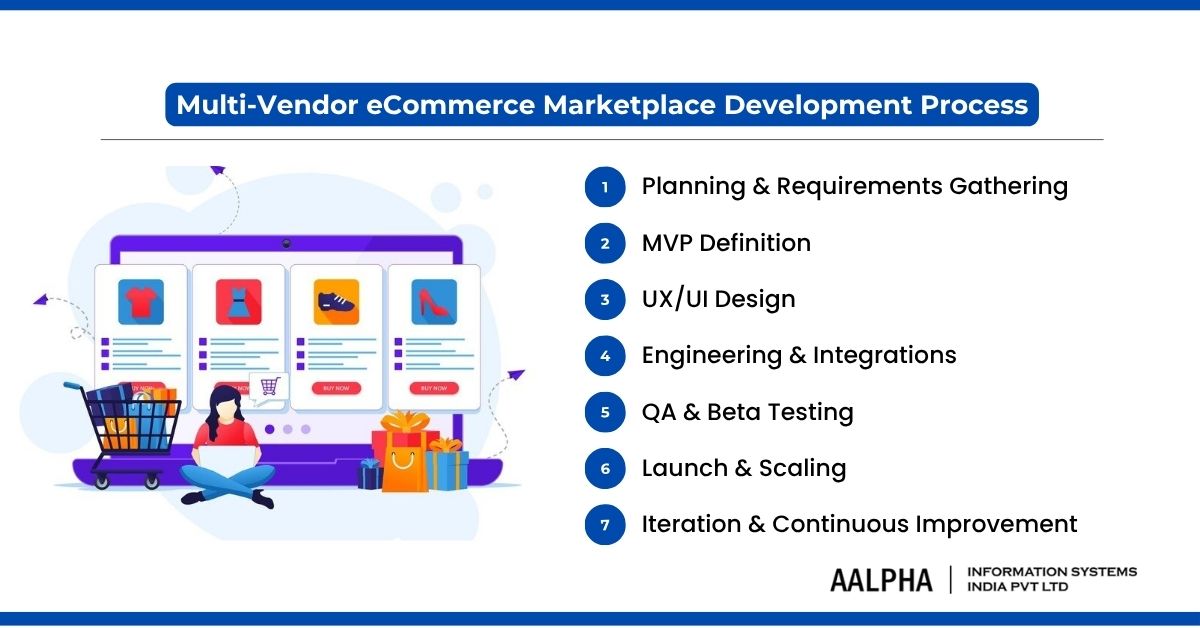
Building a multi-vendor ecommerce marketplace is a multi-phase process that demands methodical execution. From ideation to go-live and beyond, each phase of development requires alignment across strategy, technology, and user experience. This section presents a comprehensive development workflow broken down into seven key phases, guiding you from planning to post-launch optimization.
Phase 1: Planning & Requirements Gathering
Every successful platform begins with a strong foundation—clear goals, stakeholder alignment, and data-driven planning.
1.1 Research & Competitive Analysis
Start by mapping the landscape of existing marketplaces—both global (Amazon, Etsy, Alibaba) and local or niche players. Identify:
- Target vertical (e.g., fashion, electronics, handicrafts, wholesale)
- Key feature differentiators
- Monetization models used (commissions, subscriptions, ads)
- Traffic sources and SEO strategy
- App and web UX patterns
1.2 Buyer & Vendor Persona Development
Develop personas to reflect the needs and behaviors of your two main user groups:
- Buyers: price sensitivity, discovery habits, shipping expectations
- Vendors: technical literacy, onboarding barriers, platform incentives
1.3 Business Case Definition
Outline your value proposition, operating model, and go-to-market plan. Core considerations:
- How will your marketplace differentiate?
- What will your initial take-rate and margins be?
- What is your CAC (Customer Acquisition Cost) vs LTV (Lifetime Value)?
- What’s your break-even point and required runway?
Phase 2: MVP Definition
Rather than attempting to build a feature-complete platform upfront, go with the MVP development (minimum viable product) that solves the most essential problems for both vendors and buyers.
Core MVP Features:
- Vendor Onboarding: Registration, KYC, basic product listing
- Catalog & Product Pages: Searchable product listings, structured data, image uploads
- Checkout & Orders: Cart, payment gateway integration, order confirmation
- Admin Panel: Order logs, user management, payout scheduling, support tools
- Basic Buyer Flows: Search, add to cart, pay, review order history
Avoid overengineering logistics or marketing modules in the MVP—these can be phased in post-launch.
Technical Scope Checklist:
- Decide between SaaS, open-source, or custom stack (as discussed in Section 5)
- Define data models (users, products, orders, reviews, etc.)
- Sketch basic service boundaries (authentication, catalog, payments, notifications)
Phase 3: UX/UI Design
A marketplace must satisfy multiple actors—sellers, buyers, and platform admins—each requiring intuitive and efficient interfaces.
3.1 Wireframes & User Flows
- Define all navigation paths across mobile and desktop:
- Buyer: Homepage → Category → Product → Cart → Checkout
- Seller: Dashboard → Upload Product → Track Orders → Withdraw Funds
- Admin: Approve Vendor → Resolve Dispute → Monitor KPIs
- Buyer: Homepage → Category → Product → Cart → Checkout
3.2 Design Systems
- Use scalable component libraries (Tailwind, Material UI) and establish a design token system (colors, typography, spacing).
- Build responsive, mobile-first pages (PWA or hybrid app) to support mCommerce.
3.3 Accessibility & Localization
- Ensure WCAG 2.1 compliance (keyboard nav, alt text, contrast ratios).
- Prepare UI for i18n (multi-language and multi-currency support).
3.4 Tools
- Figma or Adobe XD for prototyping
- Maze or Useberry for user testing
- Zeplin or Storybook for dev handoff
Phase 4: Engineering & Integrations
This is the most resource-intensive phase, where an eCommerce development company builds and integrates backend services, frontend components, and third-party APIs.
4.1 Modular Codebase Architecture
- Separate concerns via services or modules:
- User Service (auth, profiles)
- Vendor Service (catalog, orders)
- Payment Service (checkout, payouts)
- Review Service (ratings, comments)
- Notification Service (email, SMS)
- User Service (auth, profiles)
4.2 Database Design
- Use PostgreSQL or MySQL for relational data (products, orders)
- Use Redis for cache/session handling
- Use ElasticSearch or Algolia for product search
4.3 Integrations
- Payments: Stripe Connect, RazorpayX, PayPal Payouts
- Shipping APIs: Shiprocket, EasyPost, Delhivery
- Analytics: Segment, GA4, Mixpanel
- Email/SMS: SendGrid, Twilio
4.4 Infrastructure
- Host via AWS, GCP, or Azure
- Use Docker and Kubernetes for container orchestration
- Set up CI/CD pipelines using GitHub Actions or GitLab CI
- Use monitoring tools like Datadog, Prometheus, or New Relic
Phase 5: QA & Beta Testing
Thorough testing is essential before public launch. A multi-vendor platform must handle large data loads, concurrency, and edge-case workflows.
5.1 Testing Types
- Functional Testing: Vendor signup, product uploads, cart behavior, search accuracy
- Load Testing: Simulate concurrent users placing orders and uploads (using tools like JMeter or k6)
- Security Testing: Check for XSS, SQLi, broken access controls (OWASP Top 10)
- API Testing: Use Postman, Swagger, or Insomnia to validate endpoint reliability
- Cross-device Testing: Ensure PWA/app functions across iOS, Android, tablets, desktop
5.2 Vendor Pilot Testing
- Onboard 10–20 real vendors to upload listings, process test orders, and provide feedback
- Incentivize participation and gather improvement suggestions via structured surveys
5.3 Feedback Cycles
- Use Hotjar or FullStory to gather behavioral data
- Conduct user interviews for usability bottlenecks
- Iterate on flows with the highest drop-off
Phase 6: Launch & Scaling
Once your platform is stable, enter a controlled go-live phase. Focus on reliability, trust-building, and vendor/user acquisition.
6.1 Go-Live Readiness
- Confirm payment settlement flow is functional
- Ensure SSL, backups, monitoring, and uptime guarantees
- Prepare a support escalation matrix and ticketing system
6.2 Vendor Acquisition Campaign
- Target your pre-validated vendor base via email, phone, or ads
- Provide quick onboarding kits and listing support
- Run time-limited free commissions or credits to incentivize uploads
6.3 Buyer Growth Channels
- Google Shopping integration and SEO launch content
- Influencer marketing or affiliate referrals
- Paid ads (Google Ads, Meta Ads, YouTube)
6.4 Early Metrics to Track
- Daily active vendors (DAV)
- First-order conversion rate
- Checkout drop-off points
- Refund rate and ticket volume
- Customer acquisition cost (CAC) vs average order value (AOV)
Phase 7: Iteration & Continuous Improvement
No marketplace is complete at launch. Post-go-live, you enter the optimization phase, where product direction is driven by real usage data.
7.1 Feature Enhancements
Prioritize based on impact:
- Vendor bulk upload tools
- Chat between buyers and vendors
- AI-driven recommendations
- Personalized offers and bundling
- Vendor performance analytics dashboards
7.2 Analytics-Driven Roadmap
- Use Mixpanel, Amplitude, or GA4 to analyze conversion funnels
- Identify and fix high-bounce screens or confusing flows
- A/B test pricing, search layouts, or product cards
7.3 Support Automation
- Add helpdesk integrations (Freshdesk, Zendesk)
- Implement chatbots for Tier 1 support
- Integrate return automation (Loop, ReturnLogic)
7.4 Backend Scaling
- Shift to horizontal scaling (replica DBs, message queues)
- Refactor services into microservices if monolithic
- Improve caching layers for faster page loads
The journey from concept to a functioning, revenue-generating multi-vendor marketplace involves a disciplined, phased approach—starting with foundational planning, moving through product development and testing, and culminating in a scalable launch strategy. Each phase must be executed with attention to detail, user empathy, and long-term scalability in mind.
By following this development workflow, you ensure that the platform is technically sound, commercially viable, and user-centric from day one—ready to adapt and grow in a competitive ecommerce environment.
7. Vendor Onboarding & Network Orchestration
A multi-vendor ecommerce marketplace is only as strong as its supply-side network. Without a critical mass of high-quality, reliable vendors, a marketplace cannot offer the product diversity, pricing competitiveness, or fulfillment reliability needed to retain buyers. This makes vendor onboarding and network orchestration one of the most crucial operational pillars of any marketplace strategy.
This section explains how to systematically recruit, onboard, and manage vendors at scale—balancing automation with oversight to drive long-term seller performance and platform sustainability.
7.1 Vendor Recruitment Channels
Before onboarding vendors, the platform must acquire them through deliberate outreach strategies. These channels vary depending on your niche, geography, and growth phase.
- Inbound Channels:
- Self-service signups from your marketing website or landing pages
- Organic search via SEO-optimized content like “Sell on [YourPlatform]” guides
- Paid ads targeting supplier keywords (“wholesale suppliers for jewelry India”)
- Social media campaigns targeting small businesses and D2C brands
- App store listings (if your platform supports vendor-side mobile apps)
- Outbound Prospecting:
- Cold outreach via email, LinkedIn, or telesales, especially for strategic brands or niche product suppliers
- Trade show participation and booth sponsorships
- Direct sales via local field teams or channel partners
- Competitor scraping to identify sellers on Etsy, Amazon, IndiaMART, etc.
- Strategic Partnerships:
- Tie-ups with manufacturer associations, wholesaler cooperatives, or distributor networks
- White-label integrations with existing SaaS platforms (e.g., POS systems) to onboard their merchants
- Government or NGO partnerships for artisan or rural seller enablement
7.2 Vendor Onboarding Journey
Once vendors show interest, the onboarding journey must be intuitive, efficient, and structured to ensure readiness for selling. A well-designed onboarding process improves seller activation rates and reduces future operational friction.
Step 1: Registration & Verification
- Basic profile creation: company name, business type, contact info
- KYC & compliance checks: upload of legal documents (GST, PAN, business license), tax ID verification, bank account linking
- Terms of Service agreement: SLA terms, return policy adherence, platform commissions
Step 2: Catalog Setup
- Manual entry or CSV/API-based product upload tools
- Categorization, attribute mapping, variant configuration
- Image and video uploads
- Stock and pricing management
- Bulk editing, duplication, and import-export functions
Step 3: Logistics & Payment Configuration
- Shipping methods selection (self-fulfillment, 3PL, platform-managed)
- Return pickup zone setup and labeling integrations
- Payment schedule preferences (weekly/monthly), bank details confirmation
Step 4: Training & Enablement
- Onboarding webinars or pre-recorded videos
- Step-by-step platform navigation guide
- Help center with FAQs, glossary, SOPs
- Seller support contact points (email/chat)
Step 5: SLA & Policy Acknowledgement
- Clear acceptance of fulfillment timelines, return windows, response times, and cancellation thresholds
- Visibility into vendor performance metrics and compliance requirements
This journey should ideally take less than 30 minutes end-to-end, excluding KYC validation time. Complexity should be progressively disclosed, not front-loaded.
7.3 Tools & Automation
To enable scale, the vendor onboarding pipeline must be automated wherever possible, while still preserving human support for edge cases and large sellers.
- Self-Service Portals:
- Mobile-friendly dashboard for profile setup, catalog upload, and live status tracking
- Progress indicators (e.g., “Step 2 of 5 completed”) to guide users through onboarding
- Vendor Invitation Workflows:
- Admin dashboard to send invite links to bulk leads
- Customizable invite templates with tracking of open/click/signup rates
- Referral-based onboarding (existing vendors refer new sellers)
- API Integrations & Product Feed Uploads:
- Support for standardized catalog formats (Google Merchant Feed, Shopify Export, WooCommerce CSV)
- API endpoints for ERP/PIM system sync, useful for large vendors
- FTP-based batch uploads for wholesalers
- Interactive Learning Aids:
- In-app onboarding checklists
- Pop-up tooltips explaining each field during catalog creation
- Embedded video guides and walkthroughs
- Integration with product tours (e.g., Userlane, WalkMe, Intro.js)
7.4 Performance Monitoring & Network Governance
Recruiting vendors is only half the battle. To maintain marketplace quality and trust, platform operators must continuously monitor and govern vendor behavior.
- Performance KPIs:
Track key indicators for each seller:
- Fulfillment rate (orders shipped within SLA)
- Cancellation and return rates
- Average delivery time
- Response rate to buyer queries
- Star rating average
- Dispute incidence rate
- Scorecards & Tiering:
Assign performance tiers (e.g., Gold, Silver, Bronze) based on these KPIs, and show vendors how to improve. High-tier vendors can get better search visibility, lower commissions, or early access to platform features.
- Incentives & Penalties:
- Commission discounts for top performers
- Visibility boosts and promotional credits
- Penalties or temporary suspensions for SLA violations or review fraud
- Delisting Criteria:
Set clear and enforceable guidelines for when a vendor will be removed:
- Consistent underperformance
- Policy violations (e.g., selling prohibited goods, IP infringement)
- Fraudulent behavior or high dispute ratio
- Transparency & Communication:
Allow vendors to see their own performance data in real-time. Send automated nudges and alerts when thresholds are breached.
- Feedback Loops:
Regularly survey vendors to identify friction points in selling, fulfillment, or buyer interaction. Prioritize roadmap items that unlock growth for high-performing sellers.
Vendor onboarding and orchestration are not one-time events—they are ongoing functions that blend technology, education, and governance. A successful multi-vendor marketplace doesn’t just attract sellers; it activates, retains, and grows them through a structured ecosystem of tools, performance metrics, and support systems.
8. User Experience & Discovery
User experience (UX) and product discovery lie at the core of buyer engagement in any multi-vendor ecommerce marketplace. Unlike traditional single-brand ecommerce stores, a marketplace must accommodate vast product inventories, numerous vendors, and diverse buyer preferences—while keeping search, navigation, and checkout intuitive and fast. The goal is to reduce friction in the buyer journey and maximize conversion, repeat visits, and average order value (AOV).
This section explores how to design optimal consumer flows, integrate personalization, prioritize mobile-first usability, and establish trust through transparent seller feedback and content moderation.
8.1 Consumer Flows: From Search to Checkout
A well-designed user journey anticipates intent, minimizes effort, and guides users to purchase with minimal friction. Each step in the buyer flow must be optimized for usability and speed.
- Homepage & Entry Points
- Dynamic banners showcasing best-selling categories, vendor promotions, and seasonal offers
- Curated collections: “Trending Now,” “New From Local Sellers,” “Shop Under ₹500”
- Geo-targeted carousels and language toggles
- Product Search & Filters
- Autocomplete and autosuggest that prioritizes popular queries and recently viewed items
- Fuzzy search handling for spelling errors or synonyms (e.g., “saree” vs. “sari”)
- Faceted filtering: category, brand, price, color, shipping time, rating, seller
- Sort options: relevance, price low-to-high, newest, best-rated
- Product Listing Pages (PLPs)
- Clean card layout with thumbnails, truncated titles, price, rating, and delivery ETA
- Labels for discounts, badges (e.g., “Verified Seller,” “Ships in 24h”)
- Infinite scroll or paginated view with sticky filters
- Product Detail Pages (PDPs)
- High-quality images with zoom, 360° view, and video support
- Bullet-point descriptions, key specs, warranty info, and size guides
- Seller info section: response time, average rating, location, return policy
- Cross-sell and upsell modules: “Frequently Bought Together,” “Customers Also Viewed”
- Cart & Checkout
- Smart cart reminders and savings banners (“You saved ₹300!”)
- Option to split orders by vendor or consolidate shipping
- Express checkout with saved address/payment
- Dynamic delivery estimates per product
- Order Confirmation & Post-Purchase
- Real-time tracking with visual progress bar (Confirmed → Packed → Shipped → Delivered)
- Reorder, rate, and review options
- Cross-sell suggestions in order confirmation emails
8.2 Personalization
With large catalogs and a multi-vendor environment, discovery without personalization quickly becomes overwhelming. AI-driven personalization not only improves UX but boosts conversion rates and average session duration.
- Behavior-Based Recommendations
- Viewed history, cart additions, and purchase recency
- Personalized homepages and category pages based on past behavior
- Real-time triggers: “People who viewed this also bought…”
- Demographic & Contextual Targeting
- Tailor content by geography, device, time of day, and language preferences
- Show region-specific sellers or shipping options (especially important in mCommerce)
- Vendor & Category Tuning
- If a buyer prefers artisanal products or local vendors, boost their visibility
- Intelligent sorting that favors top-performing sellers in a given niche
- Search Result Optimization
- Rerank results based on user profile: past filters used, brands favored, shipping methods selected
- Promote sponsored listings only when they align with buyer behavior
AI Tools to Use:
- Amazon Personalize
- Recombee
- Bloomreach
- Algolia Recommend
8.3 Mobile & mCommerce Focus
Mobile commerce (mCommerce) already accounts for over 65% of ecommerce traffic globally, and in emerging markets like India, that number often exceeds 80%. A multi-vendor marketplace must be mobile-first in both design philosophy and performance optimization.
- Responsive Design vs. PWA vs. Native App
- Responsive Web: Fast to deploy, SEO-friendly
- Progressive Web App (PWA): Works offline, push notifications, app-like UX
- Native App: Deep device integration, app store presence, personalized alerts
- Mobile UX Considerations
- Larger touch targets and fewer input fields
- Thumb-accessible menus and buttons
- Sticky add-to-cart and search bars
- One-tap reorder, Apple Pay/Google Pay integration
- Performance Optimization
- Image lazy loading and WebP format
- Reduced JavaScript payload
- Accelerated Mobile Pages (AMP) for SEO-critical landing pages
- Push Notifications & Retention
- Cart abandonment reminders
- Deal alerts personalized to wishlist or search history
- Loyalty points and reward triggers
8.4 Trust Signals: Ratings, Reviews, Seller Badges
Trust is a critical conversion driver, especially when buyers interact with unknown vendors. Multi-vendor platforms must proactively surface trust signals across the user journey.
- Ratings & Reviews
- Verified purchase reviews only
- Separate ratings for product quality, delivery, and customer service
- Review sorting (most helpful, recent, with images)
- Allow buyers to upvote/downvote reviews
- Seller Reputation
- Seller profile with star rating, total orders fulfilled, response rate, fulfillment speed
- Tags like “Top Rated,” “New Seller,” “High Return Rate”
- Badging System
- Automatically assign badges based on KPIs (delivery SLA, rating, volume)
- Display badges on PLPs and PDPs for fast recognition
- Content Moderation
- AI moderation for offensive content, spam, fake reviews
- Flagging and reporting system for users
- Admin queue with trust score-based prioritization
- Customer Protections
- Clear policies on refunds, replacements, and dispute resolution
- Visibility of platform-level guarantees: “100% Buyer Protection,” “Easy Returns in 7 Days”
User experience and product discovery are the linchpins of marketplace success. In a multi-vendor setup, the challenge is not just showcasing products but doing so in a way that feels curated, trustworthy, and mobile-ready. Through optimized search flows, AI-powered personalization, mobile-first interfaces, and transparent trust signals, your marketplace can deliver the kind of seamless experience today’s buyers expect—and turn casual browsers into loyal customers.
9. Payments & Financial Settlement
Payments and financial settlements are the operational backbone of any multi-vendor ecommerce marketplace. A well-architected payment system ensures trust, transparency, and compliance—both for buyers who expect seamless checkout experiences and for vendors who rely on accurate, timely payouts. Given the involvement of multiple parties per transaction (buyer, vendor, platform), the financial architecture of a marketplace must support split payments, escrow management, tax calculation, and dispute resolution.
This section explains how payment infrastructure works in multi-vendor environments, the pros and cons of various integration models, and how to manage settlements, taxes, and financial compliance.
9.1 Payment Structure: Split Payments, Escrow, Wallet Systems
In contrast to single-seller stores, where the merchant is the sole payee, multi-vendor marketplaces must route payments to multiple vendors per order, calculate platform commissions, apply taxes, and sometimes hold funds in escrow until delivery confirmation.
1. Split Payments
Split payment systems automatically divide the total payment among relevant vendors and the platform operator.
- How it works: When a buyer places an order containing items from multiple vendors, the payment gateway processes the full amount, deducts the platform’s commission, and routes the net amount to each vendor’s account.
- Real-time or delayed: Splits can happen instantly or after a cooling-off period (e.g., after delivery).
- Platform cut: Calculated either as a percentage of item value or flat fee per transaction.
2. Escrow-Based Systems
To protect buyers and ensure seller accountability, many platforms hold funds in escrow until certain conditions are met.
- Release triggers: Delivery confirmation, buyer satisfaction (no return filed within X days), or system-based timeouts
- Benefits: Reduces chargebacks and fraud, improves buyer trust
- Common in: Services marketplaces, high-value goods, cross-border transactions
3. Wallet Systems
A digital wallet on the platform can streamline refunds, reward credits, and partial settlements.
- Buyer wallets: Store cashback, loyalty points, or refunds
- Seller wallets: Hold receivables before withdrawal
- Compliance: Must be licensed under relevant e-money regulations (e.g., RBI in India, PSD2 in EU)
9.2 Gateway vs. Platform-Wide Payment Solutions
Choosing the right payment infrastructure depends on your scale, geographic focus, and vendor compliance requirements. You’ll typically choose between a payment gateway with limited vendor support or a marketplace-optimized platform like Stripe Connect or RazorpayX.
Option 1: Traditional Payment Gateway
Examples: PayPal, PayU (standard), Authorize.net
- Pros:
- Fast integration
- Handles buyer-facing checkout reliably
- Fast integration
- Cons:
- Funds settle to marketplace only; manual vendor payouts needed
- Limited or no split payment support
- Funds settle to marketplace only; manual vendor payouts needed
Option 2: Marketplace Payment Platforms
- Stripe Connect
- Industry standard for marketplaces in the U.S., EU, and supported markets
- Offers Express and Custom accounts for sellers
- Automates KYC, tax handling, dispute resolution, and split payments
- Full API access for dynamic transaction control
- Adyen MarketPay
- Enterprise-grade, global compliance
- Used by platforms like eBay and Etsy
- Supports multi-currency settlements, local banking rails, and complex payouts
- RazorpayX (India-specific)
- Tailored for Indian marketplaces
- Compliant with Indian KYC norms and settlement laws
- Offers Payout Links, Virtual Accounts, and Vendor Ledgers
- PayU’s Marketplace Solution
- Useful for Latin America and Indian markets
- Custom modules for merchant onboarding, settlement cycles, and commission handling
Key Features to Evaluate:
- KYC automation (vendor-level)
- Refund APIs and chargeback workflows
- Dispute handling integrations
- Onboarding speed and localization
- FX management and international remittance support
9.3 Settlement Cycles & Dispute Management
Settlement refers to the process of disbursing payments to vendors after transactions are completed.
Settlement Timelines
- T+1, T+3, or T+7 models depending on platform policy
- Time buffer allows for order verification, returns, or cancellations
- Higher-value goods may warrant longer holding periods
Vendor Settlement Reports
- Payout dashboard showing gross sales, deductions (commissions, taxes, fees), net payable
- Invoice and GST report generation
- Exportable to Excel or via API for ERP integration
Disputes & Refunds
- When buyers raise a dispute or request a refund, the platform must:
- Freeze or reverse vendor payout
- Initiate reverse logistics workflow
- Process buyer refund (to original payment method or wallet)
- Freeze or reverse vendor payout
- Dispute types: delayed shipping, defective product, non-delivery, counterfeit
- Automated vs. manual resolution workflows (e.g., auto-resolve within 3 days if no vendor response)
Chargeback Handling
- Use tokenized payments and AVS checks to reduce fraud
- Set aside reserve funds for high-risk sellers
- Maintain audit logs and communication threads for evidence
9.4 Taxes & Regulatory Compliance
A marketplace must operate as a financial intermediary, ensuring compliance with national and international tax laws, e-commerce regulations, and payment processing mandates.
Tax Handling Per Jurisdiction
- India:
- GST calculation per item and per vendor
- Platform must deduct and remit TCS (Tax Collected at Source) under Section 52 of CGST Act
- Generate GSTR-1 compatible tax reports for sellers
- GST calculation per item and per vendor
- U.S.:
- Varies by state (economic nexus laws)
- Marketplace facilitator laws make platform responsible for sales tax collection
- Varies by state (economic nexus laws)
- EU:
- VAT handling via OSS (One-Stop Shop) for cross-border commerce
- VAT handling via OSS (One-Stop Shop) for cross-border commerce
Invoicing Systems
- Per-vendor invoice generation at time of order
- Buyer- and seller-facing tax breakdown
- Digital signature integration for authenticity
KYC & AML Requirements
- Government-issued ID, proof of business registration, and bank verification required
- Periodic re-verification for high-volume sellers
- Sanctions screening and fraud blacklists
Data Protection & Compliance
- PCI DSS compliance for all payment flows
- GDPR/CCPA readiness for buyer/vendor personal data
- Optional: ISO 27001 certification for marketplace infrastructure
Payments and financial settlements in a multi-vendor marketplace are complex but critical for maintaining ecosystem trust and regulatory integrity. The platform must ensure seamless checkout for buyers, timely payouts for vendors, and a transparent record of all commissions, fees, and taxes.
10. Logistics, Fulfillment & Operations
Logistics and fulfillment are at the heart of customer satisfaction in any multi-vendor ecommerce marketplace. From accurate delivery timelines and transparent tracking to seamless returns and low RTO (Return-to-Origin) rates, operational efficiency directly impacts the platform’s brand trust, vendor performance, and unit economics.
Unlike single-vendor stores, a marketplace must coordinate multiple sellers, carriers, and customer locations. This section outlines the core fulfillment models, integration options for shipping, return logistics, and how to govern performance using SLAs and analytics.
10.1 Fulfillment Models in Multi-Vendor Marketplaces
Choosing the right fulfillment strategy depends on your product categories, vendor maturity, and control preferences. Most marketplaces adopt one of three models—or a hybrid of them.
1. Drop-Shipping (Vendor-Managed Fulfillment)
Vendors are responsible for warehousing, packing, and dispatching orders directly to buyers.
- Pros: Low overhead for platform, faster scale, less capital locked in inventory
- Cons: Limited control over quality and timelines, higher variance in packaging and customer experience
Use case: Fashion, handicrafts, long-tail categories with diverse inventory
2. Marketplace-Owned Fulfillment (3PL or FBA-style)
Marketplace stores inventory in its own warehouses, packs, and ships through integrated carriers.
- Pros: Full control over delivery speed, standardized packaging, consolidated shipping
- Cons: High capital investment, inventory risks, requires WMS integration
Use case: High-volume categories (e.g., electronics, fast-moving consumer goods)
3. Hybrid Fulfillment
Mix of the above—platform fulfills top-selling SKUs or strategic vendors, while the rest drop-ship.
Use case: Platforms transitioning from drop-shipping to owned logistics; scaling with demand predictability
10.2 Shipping Integration: Carrier APIs and Automation
Seamless integration with courier partners is essential for vendor efficiency and buyer satisfaction. This is typically achieved through shipping APIs, rule engines, and logistics management modules.
1. Carrier Aggregators
Services like Shiprocket, ShipStation, EasyPost, NimbusPost, and Shyplite provide integrations with multiple national and international couriers through a single API.
- Features:
- Compare real-time shipping rates across carriers
- Print labels, generate pickup requests
- Live tracking updates with webhook callbacks
- NDR (Non-Delivery Report) and RTO management dashboards
- Compare real-time shipping rates across carriers
2. Rate Engine & Rules
Allow vendors or the platform to:
- Choose carriers based on price, delivery SLA, COD support
- Configure free shipping thresholds or tiered rates (e.g., ₹50 for <₹500 orders)
- Offer buyers delivery options during checkout (Standard vs. Express)
3. Order Lifecycle Automation
- Auto-generate shipping labels post-order confirmation
- Auto-schedule pickups based on seller pincode and carrier SLA
- Notify customers via SMS/email on every status update: “Order Packed,” “Shipped,” “Out for Delivery”
4. Tracking and Visibility
Integrate tracking APIs with your platform dashboard and mobile app. Buyers should be able to:
- Track all parcels with real-time ETAs
- Receive delay alerts
- Access support chat or helpdesk if shipment is stuck
10.3 Returns & RTO (Return-to-Origin) Handling
Efficient returns and RTO handling protect customer satisfaction and vendor profitability. Mishandled returns lead to disputes, refund delays, and vendor dissatisfaction.
1. Returns Workflow
- Return eligibility rules per vendor or category (e.g., 7 days, unworn only)
- Self-serve return panel for buyers with return reason tagging
- Automated pickup generation and status tracking
- Return confirmation, refund initiation, and inventory update
2. Refund Mechanisms
- Payment method-linked refunds (back to card, UPI, wallet)
- Partial refunds for multi-item orders
- Auto-refunds triggered after return pickup or delivery confirmation
3. RTO Management
RTO occurs when a shipment cannot be delivered and is returned to sender, increasing logistics costs.
- Preventive Measures:
- Verify buyer addresses and phone numbers
- OTP-based delivery confirmation
- Confirm COD orders via automated IVR or WhatsApp bot
- Verify buyer addresses and phone numbers
- Vendor Accountability:
- Share RTO data with vendors
- Penalize excessive RTOs from frequent cancellation or fake inventory
- Share RTO data with vendors
Key Metric: Keep RTO rates below 10–15%. Anything higher suggests systemic issues in address verification, buyer intent, or product misrepresentation.
10.4 Vendor Performance Tracking and SLAs
To maintain service quality and enforce accountability, platforms must define Service-Level Agreements (SLAs) and monitor vendor logistics performance using clearly defined KPIs.
1. Core Fulfillment KPIs
- Order Acceptance Time: Time taken to confirm and start processing an order
- Dispatch SLA Compliance: % of orders dispatched within committed timeframe (e.g., 24h, 48h)
- Delivery SLA Compliance: Actual delivery vs. estimated delivery date
- Return/Rejection Rate: % of orders returned or rejected due to quality or misrepresentation
- RTO Rate: % of shipments returned without delivery
- Package Damage Rate: % of deliveries marked damaged or defective
2. Performance Dashboards
- Vendor view: Real-time performance summary, alert system, and SLA breach history
- Admin view: Filter by vendor tier, region, category; auto-flagging poor performers
3. Scorecards and Consequences
- Automate tiering: Gold, Silver, Bronze
- Incentivize top performers with visibility boosts, reduced commissions
- Penalize non-compliant vendors with warnings, temporary listing suspensions, or account termination
4. Dispute Resolution
- Flag orders with conflicting buyer and seller claims (e.g., “Item not delivered” vs. “Proof of delivery”)
- Support ticket escalation to operations team with evidence logs (photos, timestamps, tracking)
An efficient, scalable logistics and fulfillment system is foundational to the success of any multi-vendor ecommerce marketplace. By selecting the right fulfillment model, integrating with shipping APIs, automating returns workflows, and holding vendors to clear SLAs, platforms can deliver consistent, reliable buyer experiences—and build a trusted ecosystem that encourages repeat business and vendor loyalty.
11. Marketplace Growth & SEO
Once your multi-vendor ecommerce marketplace is live and functional, the next priority is sustainable growth—measured in terms of traffic, conversions, vendor acquisition, and order volume. Effective growth requires a blend of technical SEO, content strategy, paid advertising, and network-driven vendor growth tactics. A marketplace that excels in discoverability and buyer acquisition has a natural advantage in seller retention and monetization.
11.1 SEO Best Practices for Marketplace Architecture
Search engine optimization (SEO) is the most cost-effective way to generate qualified, high-intent buyer traffic. Marketplaces, with their massive product and category structures, can dominate long-tail searches—if implemented correctly.
1. Structured Data & Schema Markup
- Implement schema.org markup on:
- Product pages (Product, Offer, AggregateRating)
- Review content (Review)
- Category and seller pages (ItemList, Organization)
- Product pages (Product, Offer, AggregateRating)
- Enables rich snippets in Google Search (star ratings, price, stock status), improving CTR
2. Faceted Navigation
- Allow users to filter by price, brand, seller, rating, delivery time—but prevent duplicate content issues:
- Use canonical tags or dynamic parameters (?filter=price_low)
- Block low-value parameter combinations via robots.txt or meta noindex
- Use canonical tags or dynamic parameters (?filter=price_low)
- Use AJAX to load filters without changing page URLs unless filter pages are SEO-optimized landing pages
3. Dynamic XML Sitemaps
- Auto-generate sitemaps for:
- Products
- Categories
- Seller profile pages
- Products
- Keep them updated daily, especially for marketplaces with high churn in listings
- Submit to Google Search Console and Bing Webmaster Tools
4. Performance Optimization
- Page load speed is a ranking signal—minimize JavaScript, use image compression (WebP), and lazy load media
- Implement Core Web Vitals tracking (LCP, FID, CLS) via Lighthouse or PageSpeed Insights
11.2 Content Strategy: Blogs, Guides, Q&A, Reviews
Content plays a dual role: it drives traffic and builds topical authority. Google’s EEAT guidelines (Experience, Expertise, Authoritativeness, Trustworthiness) prioritize marketplaces with in-depth, helpful, human-centered content.
1. Blog Content & Buying Guides
- Target long-tail, intent-rich keywords:
- “Best leather bags from Indian artisans”
- “How to choose a gaming keyboard under ₹5,000”
- “Best leather bags from Indian artisans”
- Use topic clusters: one pillar article (e.g., “Winter Wear Guide 2025”) linking to 10+ related product pages
- Publish seller spotlights, seasonal lookbooks, product comparison posts
2. Q&A Sections
- Allow users to ask questions on product pages; answer using vendor/admin responses
- Index these Q&A elements using schema to capture conversational queries
3. UGC & Reviews
- Encourage detailed, image-rich reviews from verified buyers
- Enable reactions (helpful/not helpful) to prioritize high-quality content
- Display aggregated star ratings in PLPs and category filters
4. LLM-Discoverable Formatting
- Write headings and paragraph openings using common search phrasing:
- “What are the best running shoes under ₹3000?”
- “Here’s how to verify an authentic silver necklace…”
- “What are the best running shoes under ₹3000?”
11.3 Paid Acquisition & Remarketing
While SEO builds compounding value, paid acquisition delivers immediate scale—especially in the early months when organic rankings are not yet established.
1. Google Ads (Shopping + Search)
- Use Google Merchant Center to list products in the Shopping tab
- Run branded search campaigns to protect against competitors bidding on your platform name
- Create Smart Shopping campaigns with conversion-based optimization
2. Social Media Advertising
- Facebook/Instagram Dynamic Product Ads using product feed sync
- Interest-based and lookalike audiences to target fashion lovers, tech enthusiasts, etc.
- Use story ads and reels for impulse purchase categories (e.g., jewelry, beauty)
3. Retargeting & Remarketing
- Use GA4 + Facebook Pixel to build remarketing audiences
- Serve personalized ads to:
- Users who abandoned cart
- Buyers who viewed a product but didn’t purchase
- Repeat buyers for cross-sell opportunities
- Users who abandoned cart
4. Affiliate Marketing
- Onboard bloggers, influencers, coupon platforms via tools like Impact, Refersion, or FirstPromoter
- Offer tiered commissions per sale or sign-up
- Track performance by source and use UTM parameters
11.4 Vendor-Driven Growth
Vendors are not just your supply—they’re also your marketing channel. Sellers bring their own audience, promote their store, and can help you acquire new vendors or buyers if incentivized strategically.
1. Referral Programs
- Reward existing sellers for referring new vendors:
- Offer discounted commissions or ad credits for every referred seller that activates
- Offer discounted commissions or ad credits for every referred seller that activates
- Set up referral links or unique invite codes trackable in your CRM
2. Co-Marketing Campaigns
- Run joint promotions with top vendors (e.g., “Festive Sale with [Top Seller Name]”)
- Cross-promote through email newsletters and social media stories
- Enable branded store pages that vendors can share directly
3. Vendor-Created Content
- Allow vendors to publish blog posts or videos: “Why I started selling handmade soaps,” “Behind the scenes of our organic farm”
- Incentivize with homepage features, badges, or promotion boosts
4. Community Building
- Create a vendor community portal or WhatsApp/Telegram group
- Share platform updates, success tips, and highlight high performers
Marketplace growth is both a technical and strategic exercise. From optimizing for search visibility and leveraging user-generated content to running targeted paid campaigns and enabling vendors as growth engines, every lever must align with your platform’s positioning and category focus.
12. Governance, Trust & Safety
As a multi-vendor ecommerce marketplace scales, the complexity of managing trust, disputes, fraud, and legal obligations grows exponentially. Unlike single-seller storefronts, a marketplace acts as a neutral intermediary between buyers and sellers—responsible for creating a secure, transparent, and legally compliant environment for transactions. Strong governance frameworks not only protect users but also reduce operational friction, ensure regulatory compliance, and foster long-term platform credibility.
This section outlines the key components of trust management, dispute resolution processes, transparency practices, and data security mechanisms that every marketplace must implement.
12.1 Trust Frameworks: Policies, Verification, AML/KYC
Establishing trust starts with defining clear, enforceable rules for all participants—and verifying identities before onboarding them.
1. Platform Policies
Publish comprehensive, publicly accessible policies:
- Seller onboarding and eligibility requirements
- Product listing guidelines (prohibited items, counterfeit policy)
- Buyer refund and return policy
- Review and rating standards
- Code of conduct and fraud consequences
Use affirmative checkboxes during onboarding to ensure acceptance of policies.
2. Vendor Verification (KYC)
To ensure seller authenticity and reduce fraud:
- Collect and verify national ID, business license, tax identification (e.g., GST in India, EIN in the U.S.)
- Bank account verification using penny drop or micro-deposit tests
- Tiered verification: e.g., basic for low-volume sellers, advanced for higher thresholds
3. AML & Risk Monitoring
For platforms processing large volumes or cross-border payments:
- Screen seller and buyer data against OFAC or Interpol watchlists
- Flag unusual transactions (e.g., high order volumes from new accounts)
- Partner with payment providers that support built-in AML checks (e.g., Stripe, Adyen)
12.2 Dispute Resolution: Buyer Protections, Vendor Rights, Appeals
Disputes are inevitable in multi-party commerce. A well-structured dispute resolution framework increases platform trust while minimizing operational drag.
1. Dispute Categories
- Non-Delivery: Buyer paid, no product received
- Product Misrepresentation: Item significantly differs from listing
- Defective/Damaged Items: Physical issues upon delivery
- Unauthorized Charges: Suspected fraud or duplicate payments
2. Resolution Process
- Buyers submit disputes via dashboard or support form, with order ID and issue evidence
- Vendors are notified and must respond within SLA (e.g., 48 hours)
- Marketplace evaluates based on platform data (tracking logs, photos, chat history)
- Resolution outcomes: refund to buyer, replacement dispatch, vendor payout release/block
3. Appeals Mechanism
- Vendors can contest decisions with additional evidence
- Admin team reviews escalated cases
- Final decisions documented and shared with both parties
4. Preventive Support
- Auto-notifications for delayed shipments or suspicious reviews
- Chat logs stored as dispute evidence
- Buyer protection policies advertised at checkout: “100% Refund Guarantee if Not Delivered”
12.3 Platform Fee Transparency & Dispute Logs
Clarity in financial deductions builds seller trust and reduces support tickets.
1. Transparent Fee Structures
- Commission slabs visible in vendor dashboard
- Clear fee breakdown on every order: platform fee, tax, shipping deduction, net payable
- Monthly summary reports downloadable by vendors
2. Dispute Logs
- Maintain logs of every dispute raised, resolved, or escalated
- Tag disputes with outcomes: resolved in buyer favor, vendor favor, partial
- Use data to identify problematic sellers or buyers (repeat abuse or high dispute rate)
12.4 Privacy and Data Security (GDPR, Local Laws)
As marketplaces handle sensitive PII (personally identifiable information), financial records, and communication logs, robust data protection is both a legal and operational requirement.
1. Legal Compliance
- GDPR (EU): Right to access, correction, and erasure of personal data; explicit consent collection; data protection officer appointment
- CCPA (California): Opt-out of data sale, data access requests
- India IT Act (and upcoming DPDP Act): Storage limitation, breach notification, sensitive data encryption
2. Technical Controls
- HTTPS with TLS 1.2 or higher across all endpoints
- Role-Based Access Control (RBAC) for admin tools
- Encrypted storage of passwords (bcrypt) and sensitive data (e.g., payment tokens)
- Audit logs for admin actions and API calls
3. Operational Controls
- Staff training on data handling and breach protocols
- Third-party vendor risk assessments
- Regular security audits and vulnerability assessments
Governance, trust, and safety are not afterthoughts—they are foundational pillars of a resilient, scalable ecommerce marketplace. By implementing rigorous seller verification, transparent policies, structured dispute handling, and data privacy compliance, platforms can create a trustworthy environment that encourages buyer loyalty and vendor participation.
13. Analytics & Monetization Optimization (600 words)
A successful multi-vendor ecommerce marketplace is a data-driven platform—one that continuously measures, analyzes, and improves performance across buyers, sellers, and operational workflows. While early-stage growth is often driven by intuition and experimentation, sustainable scalability depends on real-time analytics and ROI-focused decision-making.
This section outlines the essential metrics, dashboard structures, and data-driven tactics marketplaces use to optimize revenue, reduce churn, and improve user experience over time.
13.1 Core Marketplace Metrics
Tracking the right metrics provides insight into the health, efficiency, and profitability of the platform. Below are the foundational KPIs for marketplace operators.
1. GMV (Gross Merchandise Value)
- Total value of all transactions on the platform within a specific period
- Does not account for refunds or cancellations
- Often used to benchmark overall growth, even before profitability
2. Conversion Rate
- % of visitors who complete a purchase
- Typically ranges between 1.5–4% for marketplaces depending on category
- Break down by traffic source, device, and buyer segment for granular insights
3. AOV (Average Order Value)
- Total revenue ÷ number of orders
- Higher AOV reduces fulfillment costs as a % of revenue
- Track per category and per vendor to surface bundling opportunities
4. LTV (Customer Lifetime Value)
- Estimated net profit from a customer over their engagement period
- Use behavioral segmentation: one-time buyers vs. loyal repeat customers
5. CAC (Customer Acquisition Cost)
- Total acquisition spend ÷ number of new buyers
- Should trend lower over time with better targeting and organic reach
6. Seller Churn Rate
- % of active sellers who become inactive over a given period
- High churn indicates friction in onboarding, low sales, or payout issues
- Compare against net new sellers for vendor base sustainability
13.2 Dashboard Setup: Vendor & Buyer Insights
To act on these metrics, platforms must implement a dashboard-driven architecture that empowers both internal teams and vendors with actionable insights.
1. Admin Dashboard
- GMV Trends: Filter by time, geography, category
- Vendor Performance Overview: Live order volume, SLA compliance, returns
- Buyer Funnel: Sessions → Product Views → Add to Cart → Purchase
- Dispute & Refund Logs: Track resolution times and hotspots
- Marketing ROI: CAC vs. LTV by acquisition channel
2. Vendor Dashboard
- Sales Summary: Daily/weekly/monthly performance
- Product Insights: Bestsellers, underperformers, CTRs
- Fulfillment KPIs: On-time shipping %, RTOs, cancellations
- Payment Reports: Settlement cycles, pending payouts
- Review Analytics: Average ratings, common complaints
3. Visualization Tools
- Use tools like Metabase, Looker, or Google Data Studio for real-time charts
- Heatmaps (via Hotjar or Microsoft Clarity) to visualize buyer click behavior
- Segmented funnel analysis to find drop-offs
13.3 Data-Driven Growth Strategies
Modern marketplaces use data not just for reporting—but to guide continuous experimentation and optimization.
1. A/B Testing
- Test page layouts, CTAs, product sorting algorithms, or payment flows
- Measure impact on conversion rate, bounce rate, and cart abandonment
- Tools: Google Optimize, Optimizely, VWO
Examples:
- Compare “Buy Now” vs. “Add to Cart” prominence
- Test one-page checkout vs. multi-step flow
- Vary product recommendation modules (“Most Viewed” vs. “Recommended for You”)
2. Vendor Feedback Loops
- Surface actionable suggestions to vendors based on data:
- “Improve image quality to increase conversion by 15%”
- “Add stock of bestseller that’s trending in your category”
- “Improve image quality to increase conversion by 15%”
- Send periodic performance scorecards and trend alerts
3. Behavioral Retargeting
- Identify at-risk users (buyers who haven’t reordered in 90 days)
- Retarget via email, push notifications, or SMS
- Offer tailored incentives (e.g., personalized discounts)
4. Segment-Based Promotions
- Use purchase history to define segments:
- High spenders
- First-time buyers
- High-return customers
- High spenders
- Customize deals, bundles, or early access campaigns per segment
Analytics and monetization optimization are not post-launch luxuries—they are continuous drivers of growth and efficiency. By establishing robust tracking systems, surfacing insights through live dashboards, and adopting a culture of experimentation and feedback, marketplace operators can unlock meaningful improvements across acquisition, retention, and profitability.
14. Scaling Beyond Domestic
Once a multi-vendor ecommerce marketplace establishes product-market fit in its home territory, the next frontier is international expansion. Scaling beyond domestic markets opens access to larger customer bases, diversified revenue streams, and strategic growth opportunities—but it also introduces new layers of operational complexity. To succeed globally, marketplaces must invest in localization, regulatory compliance, multi-currency infrastructure, and cross-border fulfillment systems tailored to regional buyer behavior and expectations.
This section outlines a practical framework for planning global expansion, from market selection and product localization to addressing the logistical and regulatory challenges of international commerce.
14.1 Market Expansion Plan: Geographies, Languages, Currency Zones
Before launching in a new country, start with a structured evaluation of market viability. Consider the following factors:
- Ecommerce Maturity: Internet penetration, mobile adoption, online payment usage
- Product Fit: Local demand for existing categories and vendor offerings
- Competition: Presence of regional or niche marketplaces (e.g., Mercado Libre in LATAM, Lazada in Southeast Asia)
- Logistics Infrastructure: Availability of reliable carriers and 3PL providers
Once a region is selected, customize the platform across:
- Languages: Multilingual content with human-quality translations (English, Spanish, Hindi, Arabic, etc.)
- Currency Zones: Support for local currencies (e.g., INR, USD, EUR, NGN) and real-time conversion via FX APIs
- Local SEO: Create separate, country-level landing pages with localized content and domain strategy (.in, .ae, or example.com/in)
14.2 Localization: Product, Compliance, Payment, Shipping
Localization is more than translation—it’s about adapting every user-facing and backend element to meet local expectations and regulatory norms.
1. Product Localization
- Curate region-specific catalogs and vendors (e.g., traditional crafts in India, organic skincare in the EU)
- Allow regional filtering and tag-based sorting (e.g., “Ships from within UAE”)
- Adjust product descriptions, sizes, and variants to cultural norms (e.g., shoe sizing, voltage compatibility)
2. Compliance
- Comply with country-specific ecommerce laws:
- EU: GDPR, CE marking for electronics
- UAE/KSA: VAT registration, customs documentation
- India: Legal metrology packaging rules, GST invoicing
- EU: GDPR, CE marking for electronics
- Localize legal pages: Privacy Policy, Terms of Use, Returns Policy
3. Payments
- Offer country-preferred payment methods:
- India: UPI, RuPay, NetBanking
- EU: SEPA, Klarna
- LATAM: Pix, Boleto Bancário
- India: UPI, RuPay, NetBanking
- Enable multi-currency checkout with FX conversion and settlement
- Use globally compliant platforms like Stripe Connect, Adyen MarketPay, or Razorpay International
4. Shipping & Fulfillment
- Partner with global carriers (DHL, Aramex, UPS) and regional 3PLs
- Provide customs-ready shipping labels with HS codes and origin details
- Show delivery estimates inclusive of customs clearance time
14.3 Cross-Border Challenges: Duties, Returns, Customer Expectations
International expansion isn’t without friction. Address these challenges early to preserve buyer trust and seller satisfaction.
1. Customs & Duties
- Clarify whether prices include duties (DDP) or are buyer-responsible (DAP)
- Provide duty calculators at checkout to avoid surprise charges
- Automate customs forms and commercial invoice generation
2. Returns Management
- Offer local return addresses through 3PL networks where feasible
- Clearly communicate cross-border return policies and refund timelines
- Use returns aggregators (e.g., Returnly, Passport) for reverse logistics coordination
3. Localized Expectations
- Delivery speed tolerance differs by country (e.g., next-day in the UK vs. 5–7 days in Southeast Asia)
- Customer support should reflect local languages and time zones
- Product authenticity, warranty, and review credibility are often more scrutinized abroad
Scaling a multi-vendor marketplace internationally requires more than just geographic expansion—it demands a deeply localized, compliant, and customer-centric approach. From currency support and tax regulations to cross-border shipping and buyer behavior, marketplaces that anticipate and adapt to these variables can create meaningful global traction without compromising user experience.
15. Case Studies & Real-World Examples
Understanding the dynamics of successful multi-vendor ecommerce marketplaces requires more than theoretical knowledge—it demands real-world insights into how leading platforms operate, scale, and differentiate. This section analyzes international giants and regional success stories to extract practical lessons on growth, monetization, localization, vendor management, and technology deployment.
These case studies also demonstrate how platforms adapt to different regulatory environments, consumer behaviors, and business models—offering valuable benchmarks for anyone building or scaling a multi-vendor marketplace.
15.1 International Giants
Amazon: The Archetype of Platform Scalability
Amazon’s marketplace model accounts for over 60% of its retail GMV (Gross Merchandise Value), driven by millions of third-party sellers worldwide. The platform’s core strengths lie in:
- Fulfillment Infrastructure: Amazon FBA (Fulfilled by Amazon) allows sellers to outsource storage, packaging, and delivery. This improves delivery consistency and buyer experience.
- Algorithmic Discovery: Personalized search results, A/B tested product placements, and machine learning-powered recommendations significantly increase conversion rates.
- Data Leverage: Amazon uses buyer behavior and seller performance data to fine-tune its recommendation engine, drive PPC ad placement (Amazon Ads), and shape its Buy Box algorithm.
- Compliance & KYC: Rigorous seller vetting, particularly post-2021, ensures marketplace trust and mitigates counterfeit issues.
Key takeaway: Invest in seller enablement, fulfillment integration, and real-time buyer feedback loops to drive conversion and loyalty at scale.
Alibaba: Wholesale Marketplace at Scale
Alibaba operates as a B2B multi-vendor marketplace connecting global buyers with Chinese manufacturers. Its defining characteristics include:
- RFQ Mechanism: Buyers can post bulk requirements and receive competitive quotes from multiple vendors.
- Verification Levels: Alibaba uses a multi-tiered verification system (e.g., Gold Supplier, Onsite Check) to build buyer trust.
- Trade Assurance: An escrow-style system that protects payments until delivery conditions are met.
- Localization for Global Markets: Alibaba supports 18+ languages, currency conversions, and region-specific logistics partners.
Key takeaway: In B2B marketplaces, transparent pricing, secure transactions, and supplier vetting are essential to overcome trust barriers.
Etsy: Marketplace for Creators and Small Brands
Etsy specializes in handmade, vintage, and artisanal products from small sellers. Its growth strategy is rooted in:
- Community-Centric Branding: Sellers are showcased as creators, not just vendors, fostering a deeper emotional connection with buyers.
- SEO Mastery: Etsy dominates long-tail search terms for niche products, aided by structured listings and user-generated content.
- Seller Empowerment Tools: Etsy offers marketing, analytics, and financing features designed for non-technical users.
- Globalization Without Uniformity: While Etsy operates globally, it preserves seller authenticity by allowing regional expressions and decentralized shipping methods.
Key takeaway: Differentiation through community and brand ethos can turn a marketplace into a cultural movement, not just a sales channel.
Zalando: Vertical Marketplace for Fashion
Zalando is Europe’s leading fashion marketplace, with over 7,000 brands listed and operations in 25+ countries. In 2025, it projects +4–9% GMV growth driven by platform expansion and improved personalization tools (Reuters, 2024).
- Partner Program Model: Brands manage their listings, pricing, and fulfillment while Zalando ensures platform quality and payments.
- Advanced Personalization: AI-based sizing recommendations, style suggestions, and seasonal campaigns improve product discovery and reduce returns.
- Sustainability Filters: Eco-conscious consumers can filter by sustainability certifications, enabling values-aligned shopping.
Key takeaway: In vertical marketplaces, focus on domain-specific UX, deep inventory partnerships, and lifestyle-aligned merchandising.
15.2 Regional Winners
Flipkart: India’s Multi-Vendor Powerhouse
Owned by Walmart, Flipkart has become one of India’s largest ecommerce players, growing at 20–25% YoY (Economic Times, 2024). Key drivers of its marketplace success include:
- Tier-2 & Tier-3 Market Penetration: Local language support, affordable shipping, and COD (Cash on Delivery) have made ecommerce accessible beyond metro cities.
- Flipkart Smart Fulfillment: A shared warehouse model that reduces delivery times and improves order accuracy for sellers.
- Big Billion Day Sales: These flagship campaigns mimic Amazon’s Prime Day but leverage cultural timing (Diwali season), vendor collaboration, and deep discounts.
Key takeaway: Local market adaptation—especially in logistics, payment, and language—is critical for ecommerce success in developing economies.
Meesho: Social Commerce and Ultra-Light Marketplace
Meesho has revolutionized ecommerce in India by targeting first-time digital sellers and buyers, especially in non-English-speaking regions. Its strategy focuses on:
- Zero Commission Model: Attracts small and micro-sellers by offering a 0% commission policy, monetizing instead through ads and logistics margins.
- Mobile-First Design: A lightweight app with vernacular UX enables participation from non-urban, less tech-savvy users.
- Social Selling Tools: Allows users to share product catalogs via WhatsApp, Facebook, and Instagram, driving viral, community-based commerce.
- Decentralized Fulfillment: Sellers manage their own inventory and logistics with basic training and platform support.
Key takeaway: When targeting emerging user segments, simplicity, zero-friction onboarding, and mobile-first interfaces outperform traditional ecommerce playbooks.
These global and regional case studies underscore that there is no one-size-fits-all approach to building a successful multi-vendor marketplace. Whether scaling through advanced logistics (Amazon), creator identity (Etsy), regional adaptability (Flipkart), or social sharing (Meesho), each platform aligns its model to a specific user base, geography, and product strategy.
16. Future Trends to Watch
The ecommerce marketplace landscape is undergoing a profound shift, powered by advances in artificial intelligence, immersive technology, decentralized infrastructure, and user behavior. Forward-thinking marketplace operators must adapt not only to current best practices but to emerging trends that will redefine buyer expectations, platform design, and operational models in the years ahead.
1. AI Personalization & Conversational Queries
AI is no longer a backend utility—it’s becoming the interface. With the rise of large language models (LLMs) and AI assistants like ChatGPT and Google’s AI Overviews, buyers increasingly search using natural language rather than traditional keyword filters.
- Implication for marketplaces: Platforms must optimize for conversational queries like:
- “What are some affordable vegan leather handbags under ₹2,000?”
- “Find a local seller offering sustainable home décor in New York.”
- “What are some affordable vegan leather handbags under ₹2,000?”
- AI-driven personalization engines now go beyond collaborative filtering. They incorporate real-time behavior, sentiment analysis, and dynamic re-ranking to serve hyper-targeted results.
Action: Integrate natural language search, build LLM-friendly metadata, and use AI-powered merchandising to boost conversion.
2. Micro-Niche & Vertical Marketplaces
Generic marketplaces are giving way to vertical-focused platforms that serve specific buyer communities—such as secondhand electronics, handmade pet products, or B2B construction materials.
- Why it matters: Niche marketplaces offer tailored UX, better product data structures, and domain-specific trust signals (e.g., ingredient transparency in skincare).
- Monetization edge: Verticals allow deeper value-added services like financing, installation, or compliance verification.
Action: Identify underserved verticals in your geography or category. Go deep, not broad.
3. Blockchain for Supply Chain Transparency
Buyers are increasingly concerned about product authenticity, ethical sourcing, and traceability. Blockchain-based product traceability allows marketplaces to provide verifiable data on origin, quality, and movement through the supply chain.
- Use cases: Luxury goods (anti-counterfeit), agriculture (organic certification), pharma (batch-level tracking)
- Tools: Ethereum-based smart contracts, Hyperledger, VeChain
Action: For high-value or regulated categories, pilot blockchain traceability as a premium vendor feature.
4. Augmented Commerce: AR Try-Ons & VR Storefronts
With the spread of 5G and mobile GPUs, marketplaces are embracing immersive shopping:
- AR try-ons: Let users preview eyewear, makeup, or furniture in their environment
- VR storefronts: Create digital showrooms where buyers can “walk through” a vendor’s catalog
Action: Invest in 3D product modeling and partner with AR SDKs (like Snap Lens Studio or WebXR) for pilot campaigns.
The future of marketplaces lies in context-aware, immersive, and vertically specialized experiences. Operators who invest in these technologies and align with evolving buyer behavior will lead the next generation of ecommerce platforms.
17. Build vs. Buy Decision Guide
Choosing whether to build your multi-vendor ecommerce marketplace from scratch or leverage existing solutions is one of the most critical early decisions. The right approach depends on your product vision, technical resources, speed-to-market goals, and long-term scalability requirements. In this section, we break down the three primary development options—SaaS platforms, open-source frameworks, and fully custom builds—and guide you through how to evaluate and transition between them as your business grows.
SaaS Platforms: Speed Over Customization
SaaS marketplace builders such as Sharetribe, Arcadier, and Shopify (with multi-vendor plugins) offer fast deployment with minimal technical overhead.
- Best for: Validating an idea, launching an Minimum viable product (MVP), or targeting niche categories with standard workflows.
- Advantages:
- Go live in days or weeks
- Built-in hosting, support, and compliance
- Minimal upfront cost and no devops burden
- Go live in days or weeks
- Limitations:
- Limited custom features
- Vendor lock-in and platform constraints
- Scaling costs may rise steeply with GMV or vendor count
- Limited custom features
This model suits founders with limited technical expertise or tight launch timelines. However, for feature-rich platforms or those targeting unique workflows, limitations emerge quickly.
Open-Source Frameworks: Flexibility with Foundation
Open-source ecommerce stacks—like Magento with Marketplace extensions, Bagisto, Saleor, or Medusa.js—provide a ready-made foundation that can be extended by your development team.
- Best for: Mid-stage startups or SMBs that need more customization than SaaS but want to avoid full custom development.
- Advantages:
- Full code access and extensibility
- No ongoing license fees
- Active plugin ecosystems and community support
- Full code access and extensibility
- Limitations:
- Requires skilled development team
- Security, updates, and compliance are your responsibility
- Feature compatibility can be fragmented across modules
- Requires skilled development team
This approach balances control and time-to-market. It’s ideal when you want to retain ownership of the codebase while accelerating initial development.
Custom-Built Platforms: Long-Term Control and Scalability
A fully custom-built platform gives you maximum flexibility and strategic ownership, but requires significant investment in planning, architecture, and ongoing development.
- Best for: Enterprises, high-growth startups, or platforms with unique logic, vertical features, or deep integration needs.
- Advantages:
- Total design control and brand differentiation
- Tailored data models, workflows, and business logic
- Full ownership of IP and roadmap
- Total design control and brand differentiation
- Limitations:
- High upfront cost (both time and money)
- Longer development cycle (3–9 months or more)
- Requires in-house or trusted external technical leadership
- High upfront cost (both time and money)
Decision-Making Factors
Evaluate the options based on:
- Speed: SaaS is fastest; open-source is moderate; custom is slowest but future-proof.
- Cost: SaaS is low-cost initially but rises with scale; open-source balances capex/opex; custom has the highest upfront investment.
- Control: Custom offers full control; SaaS offers the least.
- Support: SaaS includes support; open-source depends on community or agency partners; custom relies on internal teams.
Transition Paths & Hybrid Approaches
Many marketplaces start with SaaS to validate demand, then migrate to open-source or custom as their needs evolve. A common path is:
- Launch MVP on SaaS to test product-market fit
- Rebuild critical workflows using open-source or custom microservices
- Gradually transition to a fully custom backend while preserving UX
Some adopt hybrid architectures—a SaaS frontend coupled with custom backend modules (e.g., custom catalog or payment logic)—to reduce risk while scaling intelligently.
There is no universally “right” choice between SaaS, open-source, and custom builds. The decision should align with your growth horizon, technical capacity, and differentiation goals. By starting lean and evolving your architecture deliberately, you can reduce risk while setting the foundation for a scalable, future-ready marketplace.
18. Checklist & Implementation Roadmap
Launching a successful multi-vendor ecommerce marketplace is a multi-phase undertaking that spans ideation, development, vendor acquisition, and post-launch optimization. To manage this complexity, it’s critical to operate with a structured implementation roadmap and a clear go/no-go decision framework based on measurable progress and risk controls.
Phase 1: Planning & Market Validation
Key Features: Competitive research, buyer/vendor personas, business model definition
Owner: Founders / Product Manager
Timeline: Week 1–3
Milestones:
- Clear value proposition
- Marketplace canvas (e.g., customer segments, revenue streams, cost structure)
- Go-to-market (GTM) hypothesis documented
Risks:
- Misjudged market size
- Undefined monetization path
Go/No-Go Criteria:
- Minimum 3 validated vendor/buyer interviews with positive intent
- Clear differentiation from existing marketplaces
Phase 2: MVP Scoping & Tech Stack Selection
Key Features: Vendor onboarding, catalog management, checkout, admin dashboard
Owner: Product Manager / Tech Lead
Timeline: Week 4–6
Milestones:
- MVP features locked with priority matrix
- Build vs. buy decision finalized
- Tech architecture and database schema ready
Risks:
- Feature creep delaying core product
- Choosing a rigid SaaS with no migration path
Go/No-Go Criteria:
- MVP can be delivered in ≤ 90 days
- Vendor onboarding and buyer purchase flows can be tested without external dependencies
Phase 3: Development & Integration
Key Features: Core backend, frontend UI, payment integration, vendor dashboard
Owner: Development Team / DevOps
Timeline: Week 7–14
Milestones:
- Vendor registration, catalog uploads, and order placement flows working in staging
- Payment gateway integrated (e.g., Stripe Connect, RazorpayX)
- Shipping APIs and notification system configured
Risks:
- Delays in 3rd-party API integration
- Security misconfigurations in user data or transactions
Go/No-Go Criteria:
- End-to-end buyer-to-vendor order flow successful in staging
- At least 2 vendors successfully onboarded in sandbox
Phase 4: QA & Pilot Testing
Key Features: Stress testing, UAT (User Acceptance Testing), vendor pilot
Owner: QA Lead / Beta Coordination Team
Timeline: Week 15–17
Milestones:
- ≥ 90% test case pass rate
- Feedback collected from at least 5 pilot vendors
- Performance tested for 500 concurrent sessions
Risks:
- Bugs in high-priority flows (cart, checkout, payouts)
- Negative vendor feedback on usability
Go/No-Go Criteria:
- Critical bugs resolved; Net Promoter Score (NPS) from test users ≥ 7
- System stable for soft launch with limited users
Phase 5: Launch & GTM
Key Features: SEO content, launch campaign, referral engine, vendor support
Owner: Marketing Lead / Vendor Success Manager
Timeline: Week 18–20
Milestones:
- Live traffic enabled
- Ads and organic growth channels activated
- Support SLA documentation and workflows in place
Risks:
- Server crashes or transaction failures during peak launch
- Unprepared customer support
Go/No-Go Criteria:
- Live transactions with 100+ users without incident
- Vendor SLAs, returns, and support workflows documented and tested
Final Risk Register Snapshot
- Operational risk: Fulfillment failures → Mitigation: pre-vetted logistics API
- Financial risk: Delayed payouts or refunds → Mitigation: escrow system
- Reputational risk: Unmoderated content or counterfeit products → Mitigation: manual + AI moderation workflows
This implementation roadmap offers a milestone-aligned approach with clear ownership and outcome-based validation at every step. By using this narrative checklist as a live project management tool, marketplace founders and teams can move forward confidently—knowing when to push ahead, when to pause, and when to pivot.
19. Conclusion
Building a multi-vendor ecommerce marketplace is a complex but high-reward endeavor. From identifying market gaps and choosing the right business model to designing scalable architecture, optimizing SEO, managing vendors, and ensuring operational excellence, each phase demands strategic thinking and disciplined execution. As this guide has outlined, success requires more than just launching a site—it requires creating a robust, trustworthy ecosystem where buyers and sellers can transact seamlessly at scale.
Back to You!
Whether you’re a founder launching a niche vertical marketplace, a retail brand enabling third-party vendors, or a product leader tasked with digital transformation, the path forward involves making the right architectural choices, implementing modular features, and adapting to evolving buyer behavior through analytics and personalization.
If you’re ready to bring your marketplace idea to life—or scale an existing platform with custom features, integrations, and global readiness—Aalpha Information Systems can help. With decades of experience building scalable marketplaces, ecommerce platforms, and SaaS applications, our team offers full-cycle development tailored to your business model and technical vision.
Contact Aalpha today to schedule a free consultation and discover how we can help you architect, develop, and grow your multi-vendor marketplace with confidence.