



Artificial intelligence has moved far beyond research labs and experimental pilots. Businesses today rely on AI agents to handle customer support, automate workflows, optimize logistics, and even make complex decisions in real time. As organizations adopt dozens of specialized AI agents, the need for a centralized platform to discover, evaluate, and deploy these agents has become critical. This has given rise to the concept of AI agent marketplaces—platforms designed to connect developers who build intelligent agents with businesses and individuals who need them. Much like the app stores that transformed the mobile economy, AI agent marketplaces are set to play a defining role in the next wave of digital transformation.
What is an AI Agent Marketplace?
An AI agent marketplace is a digital platform where users can browse, purchase, or subscribe to intelligent agents designed for specific tasks. These agents may perform simple functions, such as automating data entry, or advanced operations like managing patient intake in a hospital or optimizing cross-border freight routes. Unlike general-purpose large language models, agents are specialized, often combining domain-specific knowledge, APIs, and workflows to deliver targeted outcomes.
In an AI agent marketplace, developers publish their agents with clear descriptions, pricing models, and usage guidelines. Businesses or individuals can then select and integrate these agents into their operations without needing to build them from scratch. This lowers barriers to adoption while enabling innovation at scale. Just as an e-commerce marketplace connects buyers and sellers of goods, an AI agent marketplace connects demand for automation with the supply of pre-built AI capabilities.
Why Marketplaces Are Becoming Central to AI Adoption
The growing popularity of AI agent marketplaces is closely tied to how organizations consume technology today. Enterprises no longer want monolithic platforms that require months of customization; they want modular solutions that can be deployed quickly and scaled easily. Marketplaces provide exactly that: ready-to-use agents that can be combined like building blocks to solve industry-specific problems.
From a business perspective, marketplaces reduce time-to-value. A logistics company struggling with delivery inefficiencies can deploy a pre-tested route optimization agent in days, rather than funding a year-long AI project. For developers, marketplaces provide visibility, monetization opportunities, and a direct path to end-users without requiring them to build entire distribution ecosystems.
The network effect also plays a role. As more developers contribute agents, the marketplace becomes richer in offerings, attracting more businesses. This, in turn, incentivizes further development—mirroring the flywheel that made Apple’s App Store and Google Play the backbone of the mobile ecosystem. In the AI economy, marketplaces are poised to be the infrastructure layer that accelerates widespread adoption.
Differences Between AI Marketplaces and Traditional App Stores
While the concept of a marketplace may remind many of mobile app stores, there are fundamental differences. Mobile app stores primarily distribute static applications designed for specific devices. AI agent marketplaces, on the other hand, deal with dynamic, adaptive software that continuously learns, improves, and integrates with multiple systems.
Another distinction lies in deployment. Traditional apps typically run on a user’s device, whereas agents often function in cloud environments, API-first ecosystems, or messaging platforms like WhatsApp and Slack. They need orchestration capabilities, monitoring, and safeguards against bias or hallucinations—complexities that do not apply to standard apps.
Additionally, AI marketplaces must manage compliance more rigorously than traditional app stores. When an AI agent handles medical records or financial data, regulations such as HIPAA or GDPR apply. The marketplace operator must provide governance frameworks, audit trails, and verification mechanisms to ensure agents meet industry standards.
In short, app stores distribute apps; AI marketplaces orchestrate intelligent, evolving systems that must operate responsibly within business-critical environments.
Who Benefits from AI Agent Marketplaces?
The appeal of AI agent marketplaces lies in their ability to serve multiple stakeholders simultaneously:
- Startups gain access to distribution channels they could not build alone. A small healthcare AI startup can publish its patient scheduling agent to reach hospitals worldwide without investing in costly sales operations.
- Enterprises benefit by rapidly adopting proven AI solutions rather than funding internal development from scratch. This reduces both cost and implementation risk while keeping them competitive.
- Developers earn recurring revenue through subscription models or one-time licensing, all while gaining analytics on how their agents are being used. This creates a sustainable ecosystem for independent innovators.
- End-users—whether they are doctors using diagnostic assistants, logistics managers relying on predictive routing, or customers chatting with AI-powered support—experience better services without needing to understand the technical complexity behind them.
By aligning incentives across these groups, AI marketplaces create a powerful ecosystem that fuels innovation while democratizing access to advanced AI capabilities.
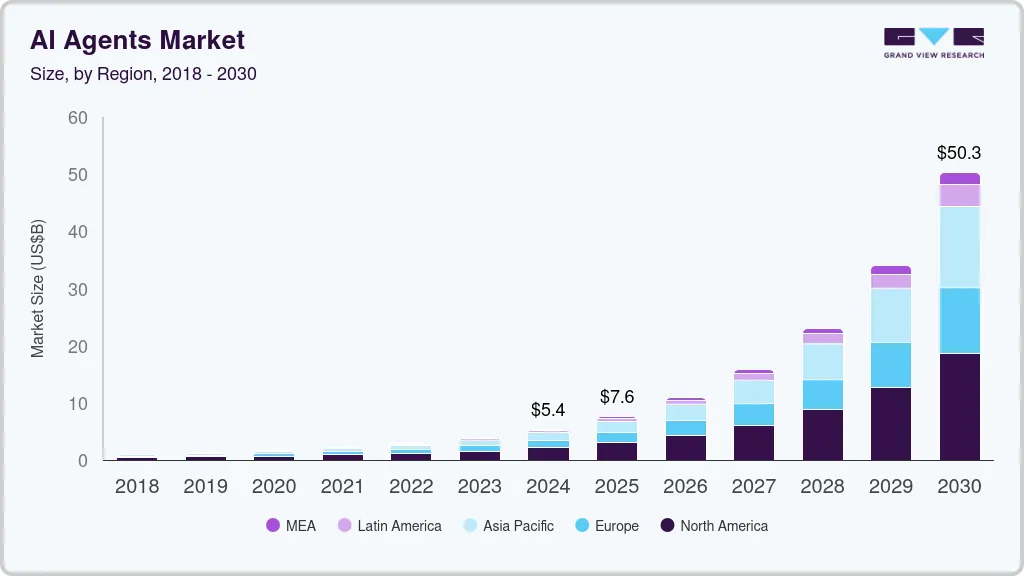
The global AI agents market was valued at USD 5.40 billion in 2024 and is projected to reach USD 50.31 billion by 2030, growing at a compound annual growth rate (CAGR) of 45.8% from 2025 to 2030.
Core Features of an AI Agent Marketplace
An AI agent marketplace succeeds or fails based on the robustness of its features. It must serve three key stakeholders simultaneously: end-users who adopt and deploy AI agents, developers who publish and monetize their work, and administrators who govern the marketplace. Each group has distinct needs, and a successful marketplace design addresses them holistically. Below is a breakdown of the core features across these three perspectives.
User Features
- Search & Discovery
The first touchpoint for any user is the ability to find the right agent quickly. An AI agent marketplace must provide a search interface optimized for both keyword queries and contextual needs. For example, a healthcare provider may search for “HIPAA-compliant scheduling agent,” while a logistics manager may browse “last-mile optimization.”
Search should include filters by category, industry, compliance certification, cost model, and popularity. Beyond traditional keyword search, marketplaces can integrate semantic search powered by embeddings, allowing users to describe their problem in natural language and receive agent suggestions. Clear taxonomy and metadata standards are critical here—if agents are poorly tagged, discovery collapses.
- Personalized Recommendations
Discovery does not stop at search. A modern marketplace should function like a recommendation engine, analyzing past usage, industry trends, and peer adoption to suggest relevant agents. Personalized recommendations reduce cognitive load, especially as marketplaces scale to thousands of listings.
For example, a law firm that previously integrated a “contract review agent” may be recommended a complementary “compliance audit agent.” AI-driven recommendation systems also encourage cross-selling and increase overall marketplace engagement.
- Easy Agent Onboarding & Subscription Management
From the user’s standpoint, one of the biggest differentiators is how seamless it is to activate and manage agents. Instead of manual installation or complicated integrations, users should be able to:
- Add an agent to their account with a single click.
- Configure access permissions and data connections through guided onboarding.
- Manage multiple subscriptions in a unified dashboard.
The experience should mirror modern SaaS subscription flows, with clear options to upgrade, downgrade, or cancel. This reduces friction and ensures businesses can experiment with agents without long procurement cycles.
- Secure Payments & Billing
Trust is built through secure, transparent billing. A marketplace must support multiple payment methods (credit cards, digital wallets, enterprise invoicing) and accommodate different pricing models (subscription, pay-per-use, freemium).
Enterprises often require consolidated billing, purchase orders, and integration with expense management systems. For B2C or SMB users, recurring payments with automated invoicing is sufficient. Offering tiered billing cycles (monthly, annual) and usage-based metering also expands flexibility. Security is non-negotiable: compliance with PCI-DSS standards and integration with trusted payment gateways reassures both developers and buyers.
Developer Features
- Agent Publishing Tools
Developers are the supply side of the marketplace. They need intuitive publishing tools to upload, document, and manage their agents. A best-practice publishing workflow includes:
- Upload and configuration: Define agent purpose, capabilities, and input/output parameters.
- Metadata tagging: Industry, use case, compliance level, and technical requirements.
- Demo sandbox: Allow potential buyers to test agents before purchase.
- Documentation hub: Tutorials, API references, and integration guides.
The smoother this process is, the more attractive the marketplace becomes to developers, especially independent creators and startups.
- Pricing Models (Free, Subscription, One-Time License)
Monetization flexibility is central to developer adoption. A robust marketplace enables developers to effectively monetize AI agents by choosing from various pricing options:
- Free agents: Useful for community building and exposure.
- Freemium models: Limited free usage with paid upgrades.
- One-time license fees: Traditional software purchase model.
- Subscriptions: Recurring revenue streams based on usage or tiered access.
- Usage-based pricing: Metered billing tied to API calls or agent activity.
Providing multiple pricing models empowers developers to align monetization with their business strategies and customer segments.
- Analytics & Usage Dashboards
For developers, visibility into performance is as important as monetization. Detailed dashboards should display:
- Number of downloads/subscriptions.
- Active usage metrics (calls per day, retention rates).
- Revenue analytics (by customer segment, region, or tier).
- User feedback and ratings.
Analytics not only help developers refine their offerings but also create a feedback loop for innovation. If a compliance agent sees high adoption in finance but low usage in healthcare, the developer can pivot accordingly.
- API/SDK Support
Developers often want their agents to integrate with multiple environments. Marketplaces should provide robust APIs and SDKs to:
- Allow developers to embed marketplace features directly into their apps.
- Enable programmatic publishing, updates, and subscription management.
- Support cross-platform deployment (web, mobile, enterprise systems).
For example, an SDK could allow a logistics agent to integrate seamlessly into an ERP system or a WhatsApp chatbot. By offering these tools, marketplaces lower technical barriers and attract a wider developer ecosystem.
Admin Features
- Agent Vetting & Approval
Marketplace administrators act as gatekeepers. To maintain trust, every agent should undergo a vetting process before going live. Vetting includes:
- Security testing (to prevent data leakage or malicious code).
- Compliance validation (e.g., HIPAA for healthcare, GDPR for EU).
- Functionality checks (ensuring advertised features actually work).
This is especially important in industries where agent errors could have serious consequences, such as finance or healthcare. Automated vetting pipelines combined with human review strike the right balance between speed and safety.
- Compliance & Moderation
Compliance is not a one-time task—it requires continuous moderation. Admins must enforce content and usage policies, ensuring agents do not violate laws, misuse data, or propagate bias. Features such as:
- Real-time monitoring of agent activity.
- Policy enforcement engines.
- Transparent audit logs.
By building trust in compliance, marketplaces differentiate themselves from generic software stores and attract enterprise buyers who cannot risk regulatory breaches.
- Marketplace Monetization Controls
Admins need flexibility in how the marketplace itself generates revenue. Controls should include:
- Commission settings (percentage on transactions).
- Featured placement and promotion slots.
- Enterprise licensing agreements.
- Tiered revenue-sharing models.
A transparent, configurable system benefits both the operator and developers by clearly defining financial terms.
- Reporting & Analytics
Finally, administrators need platform-wide analytics to guide strategy. Reports should include:
- Top-performing agents by revenue, usage, and ratings.
- Developer activity trends.
- User engagement metrics.
- Financial performance (transaction volumes, revenue distribution).
These insights enable admins to optimize the marketplace, improve curation, and identify gaps in supply or demand. For instance, if data shows strong user demand for logistics agents but limited developer supply, admins can incentivize new contributions in that category.
The core features of an AI agent marketplace are not just checkboxes; they define the ecosystem’s health and growth. Users expect frictionless discovery and secure adoption. Developers demand monetization, visibility, and technical support. Admins require governance, compliance, and financial oversight. A successful marketplace balances these needs through carefully designed workflows and scalable infrastructure.
By investing in these core features from the outset, marketplace builders can ensure not only adoption but also sustained trust and innovation—the two pillars of long-term success in the AI economy.
Business Models & Monetization Strategies
No marketplace can succeed without a sustainable business model. While the technical architecture defines how an AI agent marketplace operates, monetization strategies determine its long-term viability. The challenge is to design revenue streams that attract developers, appeal to enterprises, and align with end-user expectations. Below are the most effective approaches for monetizing an AI agent marketplace, along with practical considerations and ROI examples.
-
Commission-Based Model
The most common approach is the commission model, where the marketplace operator takes a percentage of every transaction between developers and buyers. This model is attractive because it scales directly with usage: as more agents are adopted, revenue grows.
For example, if a marketplace sets a 20% commission rate, a developer selling a compliance agent for $100 per month would earn $80, while the marketplace captures $20. This incentivizes the operator to support developers, improve discovery, and maintain platform quality.
However, commission rates must be balanced. Too high, and developers may avoid the platform; too low, and the marketplace may struggle with sustainability. App stores like Apple and Google typically set commissions at 15–30%. For AI agent marketplaces, a flexible commission range (10–25%) works better, especially in the early stages when attracting developers is critical.
-
Subscription Tiers (B2B vs. B2C)
Another powerful monetization strategy is offering subscription-based AI agents through tiered plans for users. Instead of paying per agent, businesses or individuals can subscribe to different marketplace access levels.
- B2C subscriptions might focus on affordability and convenience, such as $15/month for unlimited access to personal productivity agents (note-taking, scheduling, content generation).
- B2B subscriptions are structured around value-added services, such as $500/month for enterprise bundles that include advanced analytics, compliance-certified agents, and priority support.
The subscription model smooths revenue volatility and creates predictable recurring income. It also allows upselling. For instance, a company might start with a basic subscription for three agents and later upgrade to an enterprise plan with unlimited usage, custom integrations, and governance features.
Marketplaces can also combine subscriptions with usage-based billing. For example, an enterprise pays a base subscription of $1,000/month, plus $0.01 per agent call beyond a certain threshold. This hybrid approach ensures scalability while maintaining a minimum revenue floor.
-
Featured Listings & Promotions
Beyond transactions and subscriptions, marketplaces can monetize visibility. Featured listings, promoted placements, and sponsored categories offer developers the chance to increase discoverability.
For example, a new startup launching a healthcare diagnostic agent may pay $1,000 for a one-month featured slot in the “Healthcare” category, ensuring visibility to hospitals browsing the platform. Similarly, marketplaces can offer sponsored search results or recommendation boosts, similar to advertising models used by Amazon and app stores.
This strategy benefits all stakeholders. Developers gain exposure in a crowded marketplace, while operators generate incremental revenue without impacting user experience. The key is balance: promotions should enhance discovery without overwhelming users with ads. Transparency in labeling “featured” vs. organic results is essential for maintaining trust.
-
Enterprise Licensing Deals
While individual transactions drive volume, enterprise licensing delivers scale. In this model, enterprises pay the marketplace operator directly for bulk access to multiple agents, often with custom terms around compliance, security, and SLAs.
Consider a logistics enterprise with 10,000 employees across regions. Rather than individually subscribing to a routing agent, the enterprise negotiates a licensing deal with the marketplace, paying a flat annual fee of, say, $250,000. This grants organization-wide access, simplifies procurement, and provides predictable revenue for the marketplace.
Enterprise licensing is particularly attractive in regulated industries such as healthcare, finance, and government, where bulk adoption is common and compliance is critical. Marketplaces can also offer white-label solutions, allowing enterprises to brand the marketplace internally while leveraging its ecosystem.
-
Revenue Projections & ROI Examples
To understand the financial potential, consider a hypothetical marketplace operating in year two of its launch:
- Developer base: 1,000 active agents listed.
- User base: 20,000 active monthly users (mix of individuals and businesses).
- Commission revenue: If average transaction value is $50/month per agent, with 5,000 active subscriptions, gross volume = $250,000/month. At a 20% commission, the marketplace earns $50,000/month ($600,000/year).
- Subscription revenue: Suppose 2,000 users subscribe to a $20/month consumer plan = $40,000/month. Additionally, 200 businesses subscribe to a $500/month enterprise tier = $100,000/month. Combined, subscriptions yield $140,000/month ($1.68M/year).
- Featured listings & promotions: 50 developers pay $500/month for promotions, generating $25,000/month ($300,000/year).
- Enterprise licensing deals: 10 large enterprises commit to $200,000/year contracts, adding $2M/year.
Total annual revenue: approximately $4.58M by year two.
From an ROI perspective, the initial investment in marketplace development (ranging from $500,000 to $2M, depending on scope and infrastructure) could break even within two years if adoption is strong. The scalability of digital marketplaces means that beyond a certain point, incremental users add disproportionately higher margins, since infrastructure costs grow more slowly than revenue.
A successful AI agent marketplace blends multiple monetization streams rather than relying on one. Commission ensures fair revenue sharing, subscriptions deliver predictable cash flow, featured listings provide advertising revenue, and enterprise licensing unlocks large-scale deals. Together, these models create a diversified income portfolio that stabilizes growth and maximizes profitability.
Ultimately, the right monetization strategy depends on positioning. A consumer-focused marketplace may prioritize subscriptions and featured listings, while a B2B or enterprise-oriented platform may lean heavily on licensing and compliance-driven value-adds. By aligning pricing models with user segments, marketplace operators can build not just revenue but also trust, loyalty, and long-term ecosystem health.
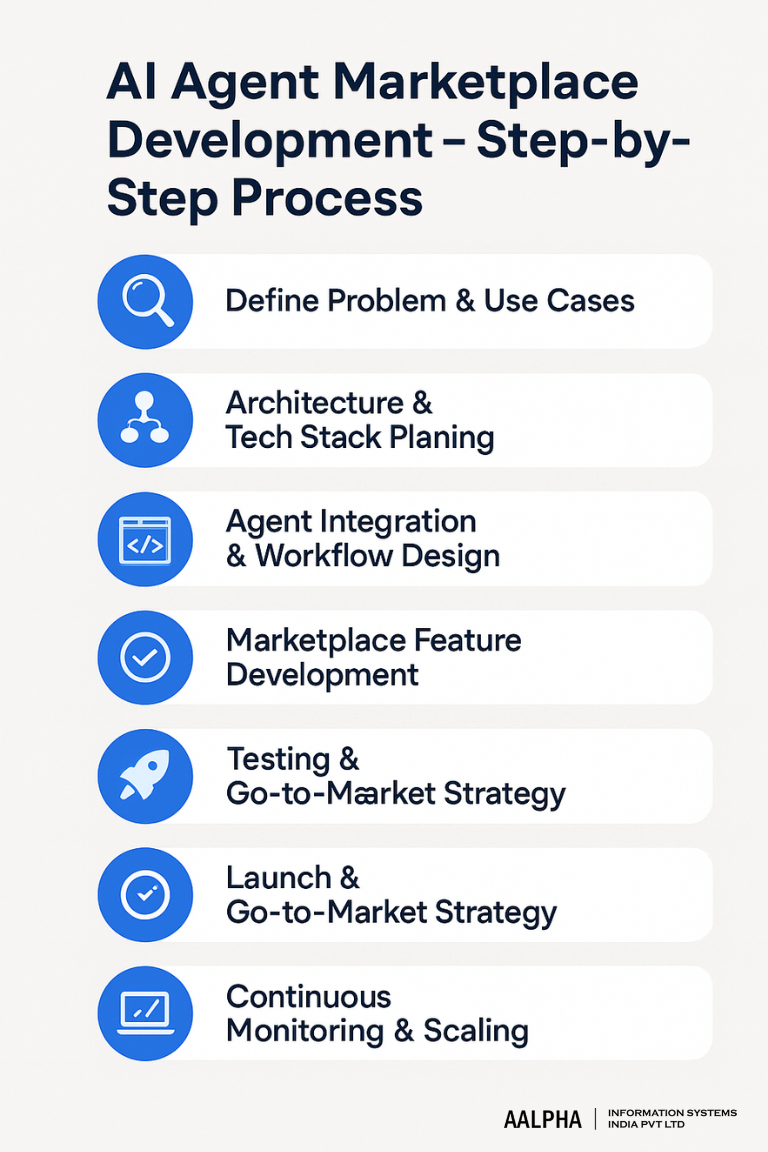
AI Agent Marketplace Development – Step-by-Step Process
Developing an AI agent marketplace is not simply a matter of coding a web platform and opening it to developers. It requires deliberate planning across business strategy, architecture, compliance, and ecosystem building. Below is a seven-step process, with each stage broken down into actionable components that marketplace builders must address to succeed.
Step 1: Define Problem & Use Cases
The first step in building an AI agent marketplace is identifying the problem it aims to solve and the specific use cases it will support. Without clear positioning, marketplaces risk becoming unfocused repositories where value is diluted.
Target Audience
Defining the target audience is crucial. An AI agent marketplace designed for enterprises will look very different from one targeting SMBs or consumers. For example:
- Enterprises: Require governance, compliance certifications, audit trails, and integration with legacy systems. Buyers may be CTOs, CIOs, or procurement teams.
- Clinics and hospitals: Seek HIPAA-compliant agents for patient intake, appointment scheduling, and medical record management. Ease of use and trust are key selling points.
- Law firms: AI agent for law firms can assist with legal research, contract analysis, and compliance tasks. These firms prioritize accuracy, confidentiality, and seamless integration with case management software.
- Startups and small businesses: Look for affordable productivity agents, marketing automation, and customer service chatbots. They prioritize cost-effectiveness and speed of deployment.
By narrowing the audience, the marketplace can tailor its onboarding flows, compliance features, and monetization models to that segment.
Identifying High-Value Agent Categories
Once the target audience is set, the next task is identifying high-value agent categories. Early success depends on curating agents that solve pressing pain points. Examples include:
- Healthcare: Patient intake agents, medication reminders, medical billing assistants.
- Logistics: Route optimization, customs clearance, fleet maintenance prediction.
- Finance: Fraud detection agents, compliance auditors, risk assessment bots.
- E-commerce: Personal shopping assistants, inventory trackers, pricing optimizers.
- Education: AI tutors, assessment graders, curriculum design assistants.
The goal is to identify 10–15 core agent categories where buyer demand is already validated. Instead of trying to launch with thousands of agents, marketplaces should start with depth in high-value niches and expand later.
This step ensures that the marketplace doesn’t fall into the “generic platform trap” but instead offers clear differentiation and strong problem-solution alignment.
Step 2: Architecture & Tech Stack Planning
Once the market direction is clear, the next step is to design the technical foundation. A poorly designed architecture leads to performance issues, security gaps, and scalability bottlenecks.
Backend, Frontend, APIs
The backend should be modular, with microservices handling different marketplace functions: user authentication, agent catalog management, payments, analytics, and compliance. This modularity ensures scalability and easier maintenance.
The frontend must prioritize usability. Clear navigation, intuitive search, and responsive design are non-negotiable. A well-structured UI can differentiate the marketplace, especially for enterprise buyers who expect professional-grade interfaces.
APIs act as the connective tissue. A strong API layer allows developers to publish, update, and integrate agents easily. APIs also enable third-party integrations (CRM, ERP, communication platforms) that increase marketplace stickiness.
Cloud Infrastructure
Modern marketplaces should be cloud-native. Providers like AWS, Azure, or Google Cloud offer elastic compute, managed databases, and deployment pipelines that support growth. Critical considerations include:
- Auto-scaling to handle spikes in traffic.
- CDNs for faster agent access worldwide.
- Serverless functions to support lightweight agent execution.
Selecting the right provider is not just a technical decision—it also affects global compliance, latency, and cost predictability.
Security & Compliance (GDPR, HIPAA)
Compliance must be designed into the architecture from day one. For healthcare use cases, HIPAA compliance is mandatory; for European customers, GDPR regulations require strict data governance. Security best practices include:
- Data encryption (in transit and at rest).
- Multi-factor authentication.
- Role-based access control for enterprises.
- Logging and monitoring for audits.
A marketplace that fails to inspire trust in its compliance posture will struggle to attract serious buyers, no matter how rich the catalog.
Step 3: Agent Integration & Workflow Design
The marketplace is not just a storefront—it must support smooth integration of agents into user workflows.
Standardized Agent Protocols
To prevent fragmentation, agents must adhere to standardized input/output protocols. This ensures that agents from different developers can interoperate. For example, a compliance agent should be able to pass data seamlessly to a reporting agent without requiring manual reformatting.
Standardization also reduces developer overhead, as they don’t need to guess how their agents will fit into workflows. Establishing schema definitions, response formats, and error handling standards is essential.
Sandbox Environments for Testing
A sandbox environment allows buyers to test agents safely before deploying them into production. For example, a logistics company may simulate how a routing agent performs under different conditions before integrating it with its fleet management system.
Sandboxes improve buyer confidence and reduce the risk of failed deployments. They also allow developers to showcase agents in action, which increases adoption.
Multi-Channel Delivery (Web, Mobile, WhatsApp)
Modern users expect agents to work across multiple channels. A marketplace must support cross-platform delivery:
- Web apps for enterprise use.
- Mobile apps for on-the-go productivity.
- Messaging platforms like WhatsApp or Slack for conversational agents.
Multi-channel availability makes agents more versatile and accessible, particularly in regions where mobile-first usage dominates.
Step 4: Marketplace Feature Development
This step focuses on building the core marketplace features that tie everything together.
User Flows
From discovery to subscription, every step must be optimized for minimal friction. Example flows include:
- Browsing → testing in sandbox → subscribing → integrating into workflow.
- Rating and reviewing agents post-usage.
- Managing subscriptions and billing.
Mapping user journeys early ensures developers and designers understand how features fit into the overall experience.
Developer Dashboard
A robust developer dashboard is critical for the supply side. It should allow developers to:
- Publish new agents.
- Monitor downloads, subscriptions, and usage metrics.
- View revenue breakdowns.
- Respond to user feedback.
The dashboard should be self-service oriented, reducing the need for manual admin involvement.
Payment Integration
Payments are at the heart of monetization. The marketplace must support multiple pricing models (subscriptions, usage-based, one-time licenses) and integrate with secure payment gateways. Enterprises may require invoicing and purchase order flows, while smaller users may prefer credit cards or PayPal.
Automated billing, revenue sharing, and payout systems are key to retaining developer trust.
Step 5: Testing & Quality Assurance
Before launch, rigorous testing ensures the platform is stable, scalable, and secure.
Functional Testing
Functional testing validates that all features work as expected: search, onboarding, payment, sandbox, and integration flows. Automated test suites can speed up this process while reducing human error.
Load & Scalability Testing
Marketplaces must handle high concurrency, especially during peak adoption. Load testing simulates thousands of users browsing, subscribing, and testing agents simultaneously. Scalability testing ensures that auto-scaling works as intended and that performance doesn’t degrade under pressure.
Agent Reliability Tests
Agents themselves must also undergo quality assurance. This includes testing for accuracy, uptime, and adherence to declared functionality. An unreliable agent can damage marketplace reputation, so setting quality benchmarks and running regression tests is critical.
Step 6: Launch & Go-to-Market Strategy
A successful launch is more than pushing code live—it’s about building a community of users and developers.
Beta Launch
Start with a private beta, onboarding a small group of developers and early adopters. This allows real-world testing while minimizing risk. Beta feedback helps refine user flows, pricing, and feature priorities.
Early Adopter Recruitment
Target industries with urgent pain points. For example, pitch healthcare scheduling agents to clinics or route optimization agents to logistics firms. Early adopter case studies generate credibility and testimonials.
Incentives such as reduced commission rates or promotional credits can attract developers and users alike.
Marketing & Community Building
The marketplace must invest in brand-building:
- Content marketing (case studies, whitepapers, tutorials).
- Developer evangelism programs.
- Events and hackathons to showcase agents.
- Social proof via partnerships with recognized organizations.
Community is a moat: once developers and users invest in the ecosystem, switching becomes harder.
Step 7: Continuous Monitoring & Scaling
Post-launch, success depends on iteration and scaling.
Usage Analytics
Analytics are the lifeblood of continuous improvement. Tracking adoption rates, agent performance, and customer churn helps prioritize roadmap decisions. For example, if analytics show low retention for finance agents, further investigation may uncover usability issues.
Feedback Loops
Actively soliciting user and developer feedback ensures alignment with market needs. Feedback can be collected via in-app surveys, developer forums, or structured NPS (Net Promoter Score) surveys. Closing the feedback loop builds trust and loyalty.
Adding New Verticals
After initial traction, marketplaces can expand into new categories. For instance, a marketplace that started with healthcare and logistics agents may branch into education or finance. Expansion should be deliberate and data-driven, focusing on verticals with clear adoption signals.
Scaling also involves investing in global infrastructure, localization, and partnerships to capture regional markets.
The seven-step process provides a structured roadmap for marketplace development. From defining use cases to scaling into new verticals, each step addresses critical aspects of technology, compliance, and community building. Skipping or rushing any stage risks undermining trust, which is the cornerstone of adoption in AI marketplaces.
By following this systematic approach, businesses can move beyond experimental AI pilots and deliver a scalable ecosystem where agents thrive, developers profit, and enterprises unlock real value.
Security, Compliance & Governance
Trust is the foundation of any AI agent marketplace. While innovative features and seamless user experiences attract initial adoption, long-term success depends on how well the platform safeguards data, enforces compliance, and governs responsible use. Unlike traditional app stores, AI marketplaces handle sensitive interactions, dynamic decision-making, and often regulated data. This raises the stakes considerably. Below, we break down the four critical pillars of marketplace security and governance.
-
Data Privacy Laws (GDPR, HIPAA, SOC2)
An AI agent marketplace must be designed to comply with international and industry-specific regulations. Failure to do so risks not only reputational damage but also heavy financial penalties.
- GDPR (General Data Protection Regulation): Any marketplace with users in the European Union must implement GDPR-compliant practices. This includes ensuring lawful data collection, offering consent management, enabling data portability, and providing a “right to be forgotten.” For example, if a hospital in Germany subscribes to a scheduling agent, the marketplace must guarantee that patient data processed through the agent is encrypted and deletable upon request.
- HIPAA (Health Insurance Portability and Accountability Act): In the United States, marketplaces that host healthcare-related agents must ensure HIPAA compliance. Agents handling patient records must operate within secure, audited environments with safeguards such as role-based access control and data anonymization. HIPAA compliance often becomes a decisive factor in winning or losing healthcare clients.
- SOC 2 Certification: SOC 2 is a voluntary but widely respected standard for cloud service providers. It evaluates how platforms manage security, availability, processing integrity, confidentiality, and privacy. Achieving SOC 2 compliance reassures enterprises that the marketplace follows best practices for data handling and system reliability.
Compliance with these frameworks cannot be treated as a “checkbox exercise.” It must be built into the marketplace’s infrastructure, onboarding flows, and contractual agreements with developers.
-
Ethical Use of AI Agents
Beyond legal compliance lies the question of ethics. AI marketplaces have the power to shape how businesses and individuals adopt intelligent agents. This responsibility demands policies and features that ensure agents are used ethically.
Key considerations include:
- Transparency of purpose: Each agent must clearly disclose what it does, what data it processes, and how its outputs are generated. Hidden functions or vague descriptions erode trust.
- Human oversight: Agents deployed in sensitive areas—such as legal advice or medical triage—should require human confirmation for critical decisions. Marketplaces should mandate such safeguards during the vetting process.
- Fair access: Ethical governance also means preventing exclusion. If pricing models or licensing terms systematically block smaller businesses or under-resourced organizations, the marketplace risks reinforcing inequities rather than democratizing AI access.
By embedding ethical guidelines into the publishing standards, marketplaces not only protect users but also enhance their reputation as trustworthy platforms.
-
Preventing Misuse & Bias
AI agents are powerful but can be misused or perpetuate bias if unchecked. Marketplaces must proactively guard against both.
- Preventing misuse: Without safeguards, malicious actors could repurpose agents for harmful activities. For example, a text-generation agent could be abused to create disinformation campaigns. Marketplaces must implement content moderation systems, abuse detection algorithms, and takedown protocols to stop misuse quickly.
- Addressing bias: AI agents trained on skewed data can produce discriminatory or harmful outputs. A recruitment agent, for instance, could unintentionally favor candidates of a certain demographic if its training data is biased. Marketplaces should require developers to provide model documentation, bias testing results, and explainability features. Admin teams can further conduct independent audits before approving such agents for listing.
The challenge is not only technical but cultural. Marketplaces must foster a developer community that prioritizes fairness, inclusivity, and accountability, rewarding those who meet higher standards.
-
Transparent Audit Trails
Transparency is the final safeguard in building a trustworthy marketplace. Without visibility into what agents are doing, enterprises cannot evaluate risks or defend themselves in the event of disputes.
Audit trails provide a verifiable record of agent activities, including:
- When and where an agent was deployed.
- What data it accessed.
- What decisions or outputs it generated.
- Who authorized and monitored its use.
These logs should be immutable, timestamped, and accessible to authorized stakeholders. Advanced marketplaces may even adopt blockchain-based audit systems to enhance tamper-resistance and verification.
Audit trails serve multiple purposes:
- For users: They provide peace of mind and a mechanism for accountability.
- For developers: They highlight how agents are used, ensuring fair compensation and identifying potential misuse.
- For regulators: They demonstrate that the marketplace maintains compliance and can respond to audits without delay.
By making auditability a core feature, marketplaces position themselves as partners in governance rather than neutral distributors.
Security, compliance, and governance are not afterthoughts—they are the pillars that sustain trust in AI agent marketplaces. Compliance with laws like GDPR and HIPAA ensures legal protection, while ethical guidelines prevent misuse and promote fairness. Proactive bias mitigation and transparent audit trails reassure enterprises that the marketplace is safe for mission-critical adoption.
In a world where AI adoption is accelerating but skepticism about misuse remains high, marketplaces that lead with trust-first design will have a decisive competitive advantage. Ultimately, security and governance are not costs; they are investments in credibility, adoption, and long-term resilience.
Challenges & Risks in AI Agent Marketplace Development
While the promise of AI agent marketplaces is immense, building and sustaining one is far from simple. These platforms must balance the demands of users, developers, enterprises, and regulators while contending with technical, business, and strategic obstacles. Ignoring these challenges can derail even the most well-funded initiative. Below, we examine the most pressing risks across four dimensions: technical, business, regulatory, and competitive.
-
Technical Challenges: Scalability, Latency, and Interoperability
AI agent marketplaces must deliver high availability and low latency, especially when agents are integrated into mission-critical workflows. Scalability is the first technical hurdle. As the number of agents and users grows, the platform must handle thousands—or even millions—of concurrent calls to agents without performance degradation. Traditional app stores distribute static applications, but AI marketplaces must manage dynamic, cloud-hosted agents that constantly process and generate data. This places significant demands on compute infrastructure, load balancing, and caching.
Latency is equally critical. A logistics manager using a route optimization agent cannot wait several seconds for results during peak delivery hours. Similarly, a customer service agent embedded into a live chat must respond in near real-time to avoid frustrating end users. Marketplaces must therefore invest in edge computing, optimized inference engines, and regional data centers to keep response times competitive.
Interoperability introduces another layer of complexity. Agents built by different developers must work together seamlessly. Without standardized APIs, schemas, and response formats, multi-agent workflows break down. For example, a healthcare diagnostic agent should be able to pass structured results to a patient scheduling agent without requiring manual reformatting. Achieving this requires strong protocol design, developer guidelines, and possibly even middleware layers that normalize agent outputs. Marketplaces that fail to solve interoperability risk becoming fragmented repositories rather than cohesive ecosystems.
-
Business Challenges: Attracting Both Developers and Users
Every marketplace faces the chicken-and-egg problem: developers will not publish agents without users, and users will not join without a rich catalog of agents. This dynamic makes initial traction extremely difficult.
To attract developers, marketplaces must offer clear monetization opportunities, transparent revenue-sharing, and robust publishing tools. Early incentives, such as reduced commission rates, promotional credits, or guaranteed visibility, can help seed supply. However, sustaining developer interest requires proof of active demand—something only strong user adoption can provide.
On the other side, users need confidence that the marketplace offers high-quality, trustworthy agents. If early adopters encounter unreliable or poorly documented agents, they are unlikely to return. Therefore, curation and quality assurance are as important as growth. One common mistake is chasing rapid expansion at the expense of user trust. A smaller but carefully vetted catalog often builds credibility faster than a large, uncurated one.
The business challenge, then, is balancing supply and demand in a way that grows both sides of the marketplace simultaneously. Partnerships with anchor clients—such as hospitals, logistics firms, or banks—can help establish credibility and stimulate early usage.
-
Regulatory Hurdles
AI marketplaces operate in a heavily scrutinized regulatory environment. Governments worldwide are drafting laws to govern the use of AI, and marketplaces sit at the intersection of these rules. Unlike individual developers, marketplace operators are often held accountable for the agents they distribute.
For example, if a healthcare agent fails to comply with HIPAA in the U.S. or GDPR in the EU, the liability may extend to the marketplace itself. This necessitates stringent vetting processes, ongoing monitoring, and compliance certifications. Regulatory hurdles also vary by geography. A marketplace operating in Europe, the U.S., and Asia must navigate three distinct legal frameworks, often with conflicting requirements.
In addition to data protection laws, marketplaces must consider sector-specific regulations. Finance agents may fall under banking regulations, while educational agents may be subject to child protection laws. These layers of compliance increase operational costs and demand specialized legal expertise. Failure to address them not only risks fines but can also erode enterprise trust.
-
Competition from Big Tech Ecosystems
Perhaps the most formidable risk is competition from established technology giants. Companies like OpenAI, Microsoft, Google, Amazon, and NVIDIA already operate AI catalogs, model hubs, and cloud-native agent services. They have deep resources, brand recognition, and pre-existing enterprise relationships, making it difficult for new entrants to compete directly.
Big tech ecosystems also enjoy integration advantages. For example, Microsoft can embed agents directly into Office 365 or Azure, while AWS can distribute agents through Bedrock. These platforms already have millions of enterprise customers, reducing acquisition friction.
For smaller entrants, differentiation is key. Competing head-to-head on scale is unrealistic. Instead, independent marketplaces can focus on vertical specialization (healthcare, logistics, legal), stronger governance, or developer-friendly monetization policies. Another viable strategy is forming strategic partnerships with industry associations, regional enterprises, or niche developer communities to carve out defensible ground.
The challenges in AI agent marketplace development are significant, spanning technical infrastructure, business dynamics, regulatory compliance, and competitive positioning. Yet these risks are not insurmountable. Each one points to strategic choices: invest in scalable cloud architecture, prioritize curation over quantity, build compliance into the DNA of the platform, and differentiate against tech giants by going deep where they remain broad.
Ultimately, success will belong to marketplaces that navigate these challenges while maintaining user trust and developer engagement. The risks are real, but so is the opportunity: building the trusted infrastructure for the next generation of AI adoption.
Future Trends in AI Agent Marketplaces
The AI agent marketplace landscape is still young, but it is evolving rapidly. What started as simple catalogs of models is moving toward sophisticated ecosystems where agents collaborate, industries demand tailored solutions, and new technologies reshape trust and governance. Understanding the future trajectory of these marketplaces is essential for builders, developers, and enterprises planning their strategies.
-
Rise of Multi-Agent Collaboration
The next generation of marketplaces will not be limited to single-purpose agents sold in isolation. Instead, we will see the rise of multi-agent collaboration, where marketplaces curate teams of interoperable agents that work together to solve complex problems.
For example, in logistics, one agent might analyze shipment data while another optimizes routes, and a third handles customs documentation. Instead of buying these individually, users could subscribe to a workflow package where agents automatically hand tasks off to one another. This shift requires marketplaces to standardize communication protocols, enforce interoperability guidelines, and provide orchestration layers that manage coordination.
From the buyer’s perspective, multi-agent collaboration increases value dramatically. Rather than stitching together individual solutions, enterprises will expect marketplaces to deliver end-to-end process automation out of the box. Marketplaces that succeed here will effectively transform from distribution platforms into operating systems for intelligent workflows.
-
Industry-Specific Marketplaces
While general-purpose platforms will continue to exist, the future will likely see a proliferation of verticalized AI marketplaces. Just as app stores evolved into niche ecosystems for gaming, healthcare, and finance, AI marketplaces will increasingly specialize.
- Healthcare marketplaces will emphasize HIPAA compliance, patient safety, and clinical validation. Hospitals might prefer a dedicated platform where all listed agents meet stringent regulatory and ethical standards.
- Fintech marketplaces will focus on fraud detection, risk management, algorithmic trading assistants, and compliance with financial regulations like Basel III or MiFID II.
- Legal marketplaces will provide vetted contract review, case law research, and compliance agents that integrate with case management systems.
Industry-specific marketplaces offer two key advantages: trust and relevance. Buyers in regulated industries often distrust broad platforms with inconsistent vetting standards. A vertical marketplace that demonstrates deep expertise and domain compliance will gain faster traction. For developers, it also creates clear alignment: they know exactly what kinds of agents to build and what standards to meet.
-
Decentralized AI Marketplaces Using Blockchain
A growing conversation surrounds the concept of decentralized AI marketplaces, where blockchain ensures transparency, provenance, and fair compensation. Unlike centralized marketplaces, which control listings, pricing, and payouts, decentralized platforms use smart contracts to automate these processes.
In this model, developers could publish agents directly onto a blockchain-based marketplace, where users pay via tokens or stablecoins. Smart contracts would guarantee that developers receive their share instantly, without relying on a central operator. Provenance records stored on-chain would also provide immutable proof of agent ownership, updates, and usage history.
Decentralization also promises to reduce vendor lock-in. Enterprises wary of depending on a single marketplace operator might prefer a blockchain-based system where governance is distributed and transparent. While challenges such as scalability, regulatory recognition, and user adoption remain, blockchain introduces a compelling model for trustless agent commerce.
Several startups are already experimenting in this space, positioning themselves as alternatives to big tech–dominated ecosystems. Over time, decentralized marketplaces may coexist with centralized ones, catering to different segments of the market.
-
Role of LLMs in Powering Marketplace Operations
Large Language Models (LLMs) will increasingly shape not just the agents within a marketplace but also the marketplace’s own operations. LLMs can be deployed as meta-agents, managing core marketplace functions such as:
- Intelligent search and recommendations: Rather than simple keyword queries, LLM-powered search can interpret user intent, context, and domain-specific terminology to surface the most relevant agents.
- Automated vetting and moderation: LLMs can analyze agent descriptions, documentation, and even test outputs to flag potential risks, bias, or compliance issues before human review.
- Onboarding and support assistants: Marketplaces can deploy LLM-powered concierge agents to guide developers through publishing workflows or assist enterprises with integration questions.
- Workflow orchestration: LLMs can act as controllers that mediate communication between specialized agents, ensuring smooth handoffs in multi-agent systems.
In effect, marketplaces themselves will become agent-driven platforms, using LLMs to optimize their internal governance and user experience. This recursive application of AI—using agents to manage agents—represents a natural evolution toward self-improving ecosystems.
The future of AI agent marketplaces is defined by convergence: agents collaborating rather than acting alone, platforms specializing in industries rather than serving everyone equally, governance shifting toward blockchain-based transparency, and LLMs running behind the scenes to orchestrate everything.
For enterprises, this future means more powerful, reliable, and trustworthy automation ecosystems. For developers, it offers clearer monetization opportunities, whether through vertical specialization or decentralized ownership models. For marketplace operators, it underscores the importance of adaptability and foresight: only those who anticipate these trends and design accordingly will remain competitive as the ecosystem matures.
In short, the marketplaces of tomorrow will not merely distribute agents—they will govern intelligent societies of agents, transforming how organizations consume and trust AI.
Case Studies & Examples
Examining existing platforms provides practical insights into what makes AI agent marketplaces succeed—or struggle. While each marketplace has its own positioning and user base, their stories reveal common patterns about community building, monetization, compliance, and scale. Below, we explore three significant case studies: Hugging Face Hub, OpenAI GPT Store, and niche B2B marketplaces in sectors like healthcare and finance.
-
Hugging Face Hub – Open-Source Driven Success
Hugging Face has become synonymous with the open-source AI movement. The Hugging Face Hub began as a repository for natural language processing models but has since expanded into a comprehensive marketplace for models, datasets, and applications (“Spaces”). As of 2025, the Hub hosts millions of models and contributions from thousands of developers worldwide.
The Hub’s success rests on three pillars:
- Open collaboration: Unlike closed marketplaces, Hugging Face encourages community participation. Developers can upload models freely, share datasets, and even fork existing projects. This accelerates innovation and builds a network effect similar to GitHub in software development.
- Trust through transparency: Every listing includes documentation, version histories, and metrics such as downloads and likes. This transparency reduces buyer uncertainty and allows users to assess reliability before adoption.
- Ecosystem integration: Hugging Face integrates tightly with popular frameworks like PyTorch, TensorFlow, and JAX, making it frictionless for developers to deploy models. Its APIs and Inference Endpoints provide monetization options, balancing open access with commercial needs.
For AI agent marketplaces, Hugging Face demonstrates that community and openness can scale globally. However, it also highlights a trade-off: while open platforms thrive on adoption, they may struggle with monetization consistency unless paired with enterprise-grade offerings.
-
OpenAI GPT Store – Early Traction in Agent Distribution
Launched in early 2024, the OpenAI GPT Store was one of the first mainstream attempts to distribute custom GPT-powered agents at scale. Builders could design specialized GPTs (e.g., a travel planning assistant, a legal research tool) and publish them for discovery. Users accessed these GPTs through ChatGPT, creating a built-in distribution channel with millions of users.
The GPT Store validated demand for agent distribution by achieving rapid adoption within weeks. Its success was driven by:
- Massive user base: Because GPTs were directly integrated into ChatGPT, the store had instant access to millions of active users—a head start few new entrants could replicate.
- Ease of creation: The builder tools required little technical expertise, lowering the barrier to entry for non-developers. This democratized agent creation and expanded supply quickly.
- Revenue-sharing program: OpenAI introduced payouts to builders based on engagement, providing early proof that developers could monetize their creations.
However, the GPT Store also faced challenges. Developers expressed concerns about opaque payout structures and limited customization options. For enterprises, the lack of rigorous compliance features meant adoption was mostly consumer-driven.
For new marketplaces, the GPT Store underscores the importance of distribution channels and builder incentives. At the same time, it shows the limitations of consumer-first marketplaces: without enterprise-grade governance, they may struggle to capture regulated industries.
-
Niche B2B Marketplaces in Healthcare & Finance
Beyond open platforms and consumer-first stores, niche B2B AI marketplaces are quietly gaining traction in regulated industries. These marketplaces cater to specialized needs where compliance, reliability, and domain expertise matter more than scale.
- Healthcare marketplaces: Platforms offering HIPAA-compliant agents for clinical scheduling, patient intake, or medical coding are finding demand among hospitals and clinics. Unlike general marketplaces, these prioritize security certifications, peer-reviewed validation, and integration with electronic health record (EHR) systems. Trust is the differentiator.
- Finance marketplaces: Banks and investment firms increasingly turn to curated marketplaces for fraud detection agents, algorithmic trading assistants, and compliance monitors. These platforms emphasize regulatory alignment with frameworks like MiFID II, KYC/AML standards, and auditability.
The advantage of niche B2B marketplaces is that they solve specific pain points in industries where general-purpose platforms cannot compete. Their smaller size is offset by higher margins, since enterprises are willing to pay premium licensing fees for trustworthy, compliant solutions.
Lessons for New Entrants
Taken together, these case studies highlight critical lessons for anyone building an AI agent marketplace:
- Community drives scale, but trust drives adoption. Hugging Face scaled through open collaboration, while healthcare and finance marketplaces succeed through compliance-first curation. A hybrid approach may be optimal.
- Distribution is a competitive moat. OpenAI’s GPT Store achieved traction because of its integration with ChatGPT. New entrants without such reach must build distribution through partnerships, community engagement, or vertical specialization.
- Monetization models must evolve with the audience. Consumer-focused marketplaces may succeed with ad-driven promotions or engagement payouts, but enterprise marketplaces thrive on licensing, subscriptions, and compliance services.
- Differentiation is survival. Competing head-to-head with big tech is a losing game. Success lies in specialization—whether that means focusing on industries, emphasizing interoperability, or offering transparent revenue-sharing policies that others lack.
Case studies of Hugging Face, OpenAI, and niche B2B marketplaces illustrate the diversity of strategies that can succeed in the AI ecosystem. What unites them is an ability to align incentives between developers and users while building trust through transparency, compliance, or scale. For new entrants, the challenge is not replicating these models but adapting their lessons to unique positioning. In a fast-moving AI economy, the marketplaces that will endure are those that combine community, governance, and industry focus into ecosystems where agents can thrive sustainably.
Conclusion
AI agent marketplaces represent the next major inflection point in digital transformation. Much like app stores redefined mobile software distribution, marketplaces for AI agents will determine how organizations discover, adopt, and scale intelligent automation. What sets them apart is not just the ability to distribute tools, but the potential to orchestrate living ecosystems of agents that adapt, collaborate, and deliver real-time value across industries.
Over the course of this guide, we have explored the market opportunity, the core features, the business models, and a step-by-step framework for development. We have also examined the challenges and future trends shaping the ecosystem. One pattern emerges consistently: success in this space is not about building the biggest catalog but about creating a trusted, compliant, and developer-friendly environment where quality prevails over quantity.
For businesses, the opportunity lies in accessing pre-built, validated AI solutions without committing years of investment into in-house development. For startups, marketplaces lower the barriers to distribution, enabling innovative agents to reach global audiences quickly. And for enterprises, the right marketplace ensures both regulatory confidence and operational scalability.
The timing is crucial. Enterprises are budgeting heavily for AI adoption, regulators are drafting standards that will favor trusted platforms, and users are demanding AI-driven workflows that can deliver measurable results. This convergence makes now the moment to act.
If you are a business leader exploring automation, a developer building specialized agents, or an investor evaluating growth opportunities, the call is clear: AI agent marketplaces are not a future possibility—they are today’s competitive frontier.
At Aalpha Information Systems, we specialize in designing and developing AI-driven platforms, including full-scale AI agent marketplaces tailored to specific industries and business needs. Whether you are planning to launch a vertical marketplace in healthcare, finance, logistics, or education—or build a general-purpose distribution ecosystem—we provide the technical expertise, compliance frameworks, and scalable architectures to bring your vision to life.
Ready to build your own AI agent marketplace? Partner with Aalpha to turn your vision into a secure, scalable platform.
FAQs
What is an AI agent marketplace?
An AI agent marketplace is a platform where developers publish intelligent agents and users can browse, test, and adopt them. These agents perform specialized tasks, from scheduling appointments to optimizing logistics. Unlike traditional app stores, AI marketplaces handle dynamic, adaptive agents that require governance, compliance, and continuous monitoring.
How much does it cost to build one?
Costs depend on scope. A basic marketplace with core features like search, subscriptions, and payments may run $300,000–$500,000. Enterprise-ready platforms with compliance features (HIPAA, GDPR, SOC 2) typically range from $1–2 million. Ongoing costs include cloud hosting, audits, and maintenance—usually 15–25% of the initial build per year.
Can small startups launch AI marketplaces?
Yes, but focus is essential. Startups succeed by:
- Specializing in verticals like healthcare, legal, or education.
- Serving regional markets with local compliance support.
- Offering developer-friendly monetization such as lower commissions or faster payouts.
Instead of competing with giants, small players thrive in niche or underserved segments.
How do marketplaces differ from custom AI platforms?
Custom AI platforms are built for one organization’s needs. They are closed systems with tailored workflows. Marketplaces, by contrast, are multi-tenant ecosystems where many developers publish agents for many users.
- Custom platforms = flexibility and exclusivity.
- Marketplaces = scale, diversity, and faster adoption.
Enterprises often combine both—building custom platforms while sourcing specialized agents from marketplaces.
What industries benefit most from AI marketplaces?
Industries with heavy data, repetitive tasks, and strict compliance see the greatest benefits:
- Healthcare: patient intake, diagnostics, medical coding.
- Logistics: route optimization, customs clearance.
- Finance: fraud detection, compliance monitoring.
- E-commerce: pricing engines, shopping assistants.
- Legal: document review, research assistants.
- Education: tutoring and grading agents.
These sectors value ready-to-use, compliant agents that shorten deployment cycles.
How to ensure compliance & trust?
Trust is the differentiator. Marketplaces must:
- Follow regulations like GDPR, HIPAA, SOC 2.
- Vet agents for accuracy, security, and bias.
- Provide audit trails so enterprises can track agent decisions.
- Enforce ethical publishing rules, requiring transparency from developers.
Trust isn’t a one-time feature—it’s a continuous governance process.
What are examples of successful implementations?
- Hugging Face Hub: open-source success with millions of models and community-driven growth.
- OpenAI GPT Store: proved consumer demand by embedding agents directly into ChatGPT.
- Niche B2B marketplaces: healthcare and finance platforms offering HIPAA- or compliance-certified agents with high enterprise adoption.
These examples show that different models can succeed—some focus on scale, others on compliance or specialization.
AI agent marketplaces are rapidly becoming the infrastructure of intelligent automation. Costs vary, but opportunities exist for both startups and enterprises. By ensuring compliance, building trust, and focusing on industry needs, marketplaces can become the backbone of AI adoption across sectors.
If you are ready to explore building your own AI agent marketplace, get in touch with Aalpha today. Together, we can turn innovative ideas into intelligent ecosystems that empower businesses, developers, and users worldwide.